

Commentary From Brainerd: Solving Issues as Neighbors
Brainerd is a town of nearly 14,500 people. Most work within 20 minutes of where they live, and where they live is a short distance from the Mississippi River as well as hundreds of lakes. The downtown area includes a food co-op, numerous restaurants, and shops ranging from homemade chocolates to musical instruments.
It is a community that came together in grief this past summer after two middle-school students — 11-year-old Ava and 13-year-old Lexi — committed suicide three weeks apart, both having been impacted by bullying. Some community members are now gathering in discussion groups about why mental health resiliency among youth has dropped, and what can be done about it. I had an extensive conversation with the young leader of a youth community center in town.
Brainerd also includes a domestic violence shelter and child visitation safe space — the only ones in the region. The child visitation space was named after Alex and Brandon, two local brothers under the age of six who were killed by their father in 1996 during an unsupervised visit. The community spent four years raising funds to build the center. The ongoing work of education to address domestic violence continues: While I was in Brainerd last week, I listened in as domestic violence advocates from Relationship Safety Alliance talked with nursing students about warning signs of abuse and how to handle it.

Two advocates from Relationship Safety Alliance (and Minnesota Women’s Press publisher Mikki Morrissette) after a conversation advocates had with nursing students
The area also includes the Crow Wing County jail, where I talked in 2024 to several law enforcement officers and social workers who recognized that the definition of public safety needed to be expanded to include more funding for social services rather than simply incarceration. Most of the people in the jail, they told me, have mental health and chemical dependency issues. Drug treatment programs are available but limited in scope — one told a staff member at the jail, “They’re going to teach me how to identify my triggers and some coping skills, but the reasons I’m using are not being addressed.”
One social worker said, “Every winter a guy would call to say he was about to burglarize a place. We’d bring him in. He said it was better than being homeless in the winter. It didn’t matter to him how many charges were piling up. [Eventually,] he ended up going to prison, instead of our jail. But the crime truly was related to being homeless.”
At the time, I was traveling around the city with then-U.S. House candidate Jen Schultz — who was unsuccessful that year in her bid to replace Pete Stauber as the local representative. She taught economics at the University of Minnesota–Duluth. Required reading for her students include Matthew Desmond’s book Poverty, by America, which noted that poverty is the problem behind many public safety issues, and could be fixed more cheaply than dealing with crime. As Schultz said, in comparison, “addressing poverty doesn’t cost very much.”
Lately, Indivisible Brainerd area residents have been gathering to bring attention to the decision of the Crow Wing County sheriff to sign a 287(g) agreement that deputizes local sheriffs to carry out tasks on behalf of ICE agents — essentially, jailing immigrants. Said Hallie Pond at a rural women event I attended over the summer in Aitkin County, “It’s harmful work. It breaks the precious trust in the fabric of our communities that we rely on to survive and to keep each other safe. These intergovernmental support agreements turn our local jails into deportation pipelines.”
Pond also noted that more than 1,000 people were on the streets together in 2025 to protest White House actions. “We believe in courage, we believe in truth, we believe in love and compassion — and policy decisions and elected officials who are going to uphold those tenets in the systems that govern our communities.”
The differences in how people define and approach public safety are one of the polarizing issues in the country: Who is considered “illegal” and why? Who gets overlooked as perpetrators of fraud and corruption, and why? What are the long-term solutions to homelessness and chemical dependency?
During my return visit to Brainerd last week, I talked to several people engaged in addressing community issues — which I find are similar whether people are living in a town of 14,000 or larger urban cities: domestic violence, mental health, bullying. Those conversations, including with a local woman who ran for county commissioner this fall, will be published here soon.



How Are We Good Neighbors?

lobby area of Central Lakes College in Brainerd
I listened in as Brainerd residents gathered at Central Lakes College for a Land of Neighbors (LON) gathering. Gatherings are being held around the state to collect notes from small group discussions about how we successfully connect in our neighborhoods, sometimes despite differences of viewpoints. The goal is to co-create statewide solutions to bridge communities.
Several LON attendees — about 30 community members — indicate they tend to be in bubbles with people who have shared values. Others indicate they have learned how to not talk about certain topics, especially with family members during holiday gatherings. Others noted that sometimes more open and honest discussions are required, likely with a mediator, so that multiple solutions can be considered before making decisions about how to address a problem — rather than letting it get worse.
Minnesotans pride themselves on being self-sufficient and also have the capacity to help neighbors. One participant said in best-case scenarios, neighbors identify an issue and figure out how to step in: a struggling single mom gets childcare support, a fallen tree gets cleared by a local group, snow is shoveled at the homes of elders. In bygone days, before all-wheel drive became more common in Minnesota, people regularly helped push stuck cars out of the snow, which provided a shared experience of neighborliness.
Some ingredients about ways to make connections:
- Share potluck or other meals together
- Text chains with neighborhood groups to raise concerns
- Humor to diffuse passive-aggressive exchanges
- Community-minded projects to bring people together

Brainerd area community members gathered to talk and write on reflections related to how we are good neighbors locally, regionally, statewide.
What Gets in the Way?
Another said she doesn’t know her neighbors; isolation can be a factor no matter if you are rural or urban, requiring intentional efforts to create gatherings.
A prevailing concern expressed is how to diffuse issues when people are afraid of those who might appear to be different from them. Several people indicated that “Minnesota Nice” can be selective and asked, “what, really, does Minnesota Nice mean?” The not-so-nice label is a mindset by some that certain people “don’t belong.”
One man pointed out that there tends to be a tribal instinct in many — divided by township, sports team, faith traditions. When he led a local club, he didn’t allow joking that put down “others” — even Vikings versus Packers fans — because it can quickly go too far.
A summary of what I heard:
- Civility and respect can sometimes be a lost art. It is okay to be angry, but we need to relearn how to be civil about it. The rise of social media trolls undermines the practice of being community-minded.
- Can we learn how to mingle with greater diversity and speak up in an effective way when we see or hear unacceptable behavior or when we disagree with someone’s solution or viewpoint?
- How can we learn to lean in with curiosity instead of defensiveness? Can we sit in tension while we practice conversation?
- How many people have a voice in decisions that affect their lives? When finding common ground, is there an underlying assumption that it means “white-folk common ground?”
Specific Suggestions for Bridging
In the wider community, as the conversation went deeper, people raised questions about how detached policing might have become — even in a smallish town like Brainerd. For example, accusing youth of being up to trouble simply being in a park together is more easily diffused if an officer knows the kids and can lightly indicate it is curfew time. In other cases, a parent can too easily be accused of neglect, for example, if their child is allowed to navigate independently. [Jonathan Haidt’s book The Anxious Generation, which many Brainerd community members are discussing, calls for a return to fewer expectations that parents “helicopter” their children. More on that book to come.]
One woman said it was her dream that people would have more opportunities to come together without a specific cause — removing the tendency to be “for” or “against” something. What might it look like if we had more gatherings designed to simply “be” together?
Since Brainerd has many summer tourists, it might be useful to have more frequent gatherings of locals and visitors engaged in conversation. Other suggestions included:
- food potlucks
- regular fix-it clinics
- environmental cleanups
- nature walks
- swap meets for clothing, food, and services
One joked that we need more ice cream trucks.
One sentiment that especially resonated with me: Can we have enlightened conversations and story sharing that acknowledge there ARE differences among people and remind us that is okay? “No two people are alike, and that is a good thing” could become a more common refrain, as we work to resolve affordability and collective health and public safety issues that impact all of us.
As I was reminded in Brainerd, the social issues impacting our communities do not have to be bookended by political identities. When something needs to be addressed, the labels do not matter as much as the conversation about what we see that needs change, and what creative and tested solutions might help to get there. Improving mental health and reducing chemical dependency, addressing domestic violence, improving access to healthcare, and affordability factors do not need to be considered political issues — they are common community needs.
Politics has given us some easy tribal labels that can get in the way of authentic community actions — and become a media narrative that points out what separates us rather than what can bring us together. To be sure, there are differences in how we address social needs, but I wonder how much of that can be somewhat defused when we aren’t centering a tribe we affiliate with?

Coffeehouse conversations included talking about racial bullying, workplace sabotage, and why a local woman decided to run for county commissioner
Concluding Thoughts
The day after returning from Brainerd, I visited Temple Israel with a Neighboring Faiths class of middle school students; I am currently introducing students at my First Unitarian Society of Minneapolis congregation to concepts of Judaism.
The service we attended — the night before Halloween and a few days before the final election day — included a talk by Rabbi Marcia Zimmerman that tied both events together. She pointed out that when strangers come to our door on Halloween, we don’t ask them what they believe; we share gifts openly. Even in ancient teachings, she continued, we learn about the values of not bringing assumptions, or self-righteousness, into encounters with strangers — but to work toward the goal of making connections.
In the coming weeks, I will be unveiling plans to connect with people statewide over ideas, histories, data, and solutions about Future Forward systems changes in Collective Health, The Eco, and Violence Prevention. As a pioneering consumer-directed media co-op, MN Press Changemakers Alliance will explore what we can learn and do together.
To be part of upcoming discussions:

Related Stories
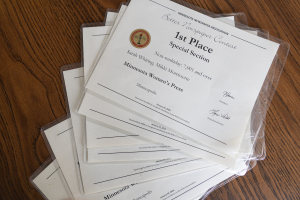 For 2025 coverage, Minnesota Women’s Press earned a community leadership award, three photography awards, and four editorial awards, including for coverage of social issues and for our Spring 2025 “Know Your Rights” special section supported by Unidos MN. Our publisher was named Journalist of the Year by Violence Free Minnesota for gender-based violence coverage.

