


Bridging the Political Divides: Rural Women Running
We do not yet have an underwriter for Politics & Policy coverage this year; please contact ads@womenspress.com to offer support
Bridging at Palisade (photo by Mikki Morrissette)
At a large gathering of rural voices in June — a potluck party along the river in Palisade, a Minnesota town of less than 200 people — women shared their perspectives about culture, politics, and the nature of mutual aid in all communities.
Shanai Matteson, who co-created the event, said she was inspired because she started to hear in many spaces the story that women cannot win, women cannot be leaders, “no one will accept us as leaders, especially in [rural small] towns like this. That just doesn’t resonate with my experience, because I grew up here and I was raised by strong women, and I know many of you were, too. Whether you live in little towns like Palisade or on the reservations in this region, or you live in some of the big little towns, you know that women are already leading us. It’s women who are the caregivers, who are the strategists. We’re don’t just clean up messes —although we do clean up a lot of messes. We are imaginative and creative, and we have vision for what will make our community stronger.”
She invited people in the audience to come up and share what kind of support they are looking for, which included organizers concerned about mining and data centers. “We all need help. We are not rich here — we’re not going to be able to make the changes that we need by raising a bunch of money. We need to get back to the basics of taking care of each other.”
Matteson acknowledged the people raising kids and grandkids, doing day jobs, and “solving the problems that we all face in our families and communities, gathering their neighbors to talk about things that are important to us, helping each other out. That is the kind of leadership that will help us move into a better future.”
Whether it is arts and culture groups expressing themselves, or door-knockers for candidates, she added, she sees that a majority of those organizers are women.
Here are comments from some of the women Matteson helped to gather in a small town by the Mississippi River.



Gaylene Spolarich, Palisade mayor and Ojibwe grandmother

Gaylene Spolarich (photo by Johnny Barber)
“We’re concerned about things that need to change. Am I right?”
In Palisade, she said, visitors might think her little town is idyllic, yet like every community it needs mutual support to work well. “It’s a little city with big city problems. We’ve got infrastructure problems. We’ve got ordinance problems. But the beauty is that I have a council that is very strong, that is as vested as I am. We’ve lived here forever and we care, so our job is to build this little city back into a little metropolis that we can keep coming back to — a bench on the Mississippi.”
She also talked about her full-time job working for the Minnesota Department of Children, Youth, and Families. “What I’ve watched happen the last year and a half has been heartbreaking. The trauma to children and families in this country has been devastating. I do site visits with communities of color, and they have so many stories to tell. The children and families in this country are suffering because of what we have in our [federal] administration. So, I’m glad that you’re here. I hope that we all get out and vote.”
Spolarich shared the story of visiting members of a long-time Hmong community in Saint Paul that has in the last year been teaching each other about advocacy and getting out the vote. Before that work started, she said, many in that Hmong community “didn’t realize that their vote was important.” It’s important to educate about the value of elections, she said.
Nevada Littlewolf, Women Winning director

Nevada Littlewolf (photo by Johnny Barber)
With mentors like Winona LaDuke, former Vice Presidential candidate, and former Minnesota U.S. Senator Paul Wellstone, Littlewolf said she was encouraged early in her life to be part of the political sphere. As a young artist and community organizer in Virginia, Minnesota, she said, it was “not necessarily a space that I wanted to be in or thought of myself as being in.”
But with that encouragement, at age 31, she ran for city council — where she served for ten years. “I had never seen a native woman serving in local office.” Littlewolf had seen women leading in every tribal council in Minnesota, but not much beyond that community. Now she leads Women Winning, a statewide organization that works to recruit, support, train, endorse, and elect pro-choice women at all levels of office — particularly at local levels. “Much of the work I’ve done has been in rural communities with rural women. I get excited about seeing gatherings like this — particularly the idea that we can learn from our tribal communities and tribal women. There are a lot of gifts and knowledge there.”
Trina Swanson, candidate

Trina Swanson (photo by Johnny Barber)
“At this point last year, I was working for U.S. Citizenship and Immigration Services. I had been a public servant for almost 25 years. At that point, I had dedicated my entire adult life to giving back to this country and doing things that I thought were valuable for America. Then Trump 2.0 came in.”
Swanson said she was asked, in her capacity as director of international operations, to fast-track a visa for the nanny of someone newly working at the White House. She saw the double standard that “immigration is okay when it’s for them, but not okay when it’s for everyone else.”
As someone who traveled the world talking to refugees, “I would interview people that had experienced the worst persecution you could imagine a human doing to another human. People had sat in camps for years, for decades. They had raised families in camps while they were waiting for the opportunity to come to the United States and start a new life. Yet they had to wait in line — and this administration wanted me to let a few people cut in front. So I made the decision to leave, which was the toughest decision I had ever made. I started my own immigration law firm, to fight back against what’s happening.”
Swanson said she knows ways that government is not working for its people and told herself: “I can run against this man, we can get him out of office, and we can have a representative that actually shows up in our communities.”
She said it is not easy to get money, even from your own party. “It’s all about money. We all know we need to take money out of politics.” She pointed out that candidates like her opponent, Pete Stauber, recently brought in $700,000 from corporate money. “He’s going to have unlimited MAGA money because he’s a rubber stamp.”
Her candidacy won’t win by how much money is raised, she said, but “because of events like this. Because we have hundreds and hundreds of volunteers that are signed up for my campaign to help.” She visited all 21 counties in her district in April alone. “We are joining arms with great state candidates, door knocking together, dropping literature for each other. This is a grassroots effort for all of these campaigns. Please join us. It’s going to take every one of us to get out into the communities to share our stories, to spread the message, to help people know that there is hope, and that we can have a Congress and a state government that represents the people and what we need, and not just the 1% of corporate profit.”
Hallie Pond, Brainerd Lakes Area Indivisible

Hallie Pond (photo by Johnny Barber)
Prior to the current White House Administration, the largest rally in Brainerd had included about 300 people. At the Hand’s Off rally in April 2025, more than 1,000 people were on the streets together. “I believe in a future free of organized violence and systemic oppression, and I think you all do too. We’ve begun organizing in Brainerd and throughout Congressional District 8 because we stand in alignment for that shared vision. We believe in courage, we believe in truth, we believe in love and compassion — and policy decisions and elected officials who are going to uphold those tenets in the systems that govern our communities.”
She said community members have been coming together in solidarity, largely to respond against the Crow Wing County sheriff’s decision to sign a 287(g) agreement that “basically deputizes local sheriffs to carry out tasks on behalf of ICE in our communities. It’s harmful work. It breaks the precious trust in the fabric of our communities that we rely on to survive and to keep each other safe. These intergovernmental support agreements turn our local jails into deportation pipelines.”
Pond is supporting candidates who are working toward overturning harmful decisions. “We know that we are the change we want to see.”
Dawn Espe, candidate

Dawn Espe (photo by Johnny Barber)
As someone who has worked 20 years in community development — as founder of The Sowing Room and former Region Five Development Commissioner — Espe is running for District 4 county commissioner in Crow Wing. She had been thinking of running for several terms to help address county issues — because part of her work long has been “about listening to the people that actually live and work in our places versus the higher ups making all of our decisions. My walk through life has taken me in more directions than I ever thought possible. I have always come back to rural because this is where I belong.”
Since the commissioner is a nonpartisan role, Espe says, “it’s not Democrat or Republican. You’re simply serving the people. Right now, I feel like a lot of folks in our commissioner roles are just doing what they’ve always done and not really getting back out there listening to the people. I want to be those boots on the ground.”
Kim McLaughlin, candidate

Kim Kotonias McLaughlin (photo by Johnny Barber)
“Public education is near and dear to my heart. Across Minnesota, across the Northland, we need to do something different. I am in my tenth year on the Hibbing School Board. I have worked in public higher education for almost 30 years, first as an internal auditor and now as a business manager. So, I have a probably a different perspective than many of the people in the state senate. I am a CPA, and I’m a fraud auditor. Although I am one voice, it’s really driving me kind of nuts when I hear people throwing around the word fraud. I’ve worked in that arena in various capacities. I’ve dug into information. I’ve done reports. I’ve taught people policy. My opponent keeps pointing fingers, and I hope to go to Saint Paul and be somebody that can offer alternative solutions.
“Education and accessible health care in rural Minnesota is so important. We need to make sure we have a pathway for health care providers to want to be in our communities. We also need to trust in government. So that’s why I’m running.”
Tara Killen, candidate

Tara Killen (photo by Johnny Barber)
As a candidate for Senate District 10, her area covers parts of Aitkin, Benton, Crow Wing, Isanti, Kanabec, Mille Lacs, and Morrison counties. “I’m keeping this really brief. I want to hear from you. I want to hear what matters to you. If you can find it in your hearts to door knock, I swear they won’t hurt you. I just go to a neighborhood and start walking, because the deal is when I’m elected in the Senate, I’m not just representing you, it’s everybody. So, it’s my job to listen to everybody. My slogan is TK for a New Day, because we have lived the same goddamn day for way too long.”
Mary Carlson, candidate

Mary Carlson (photo by Johnny Barber)
As a candidate for Minnesota Senate in District 11 — which represents Carlton and Pine Counties, and some of St. Louis, Kanabec, and Chisago Counties — she has a lot of energy to cover big territory. She is a mother, restoring a 100-year-old farm, has launched two successful businesses, and serves on the local school board. She has dealt with sometimes unintentional sexism toward women in leadership. Some party leaders might not think she can win against a male incumbent, “but they’ve never met me.”
“We’re going to get this done, but I need your help, and so does every other female candidate that has taken the chance. Let me tell you, in this day and age, it’s scary. You have to decide if you’re going to put your address out there publicly or not. We need you to start door knocking with us. We’ve got lit packets that you can drop. You can make buttons. There is a position for every single person in this space, and all of your neighbors on this campaign trail.
“It is going to be fast, and it is going to be hard, but we can get this done. I am done hearing that women cannot win, because look at us here.”
Compiled by Shanai Matteson
- Trina Swanson for U.S. House — Congressional District 8 *
-
Denise Slipy — MN Senate District 6
-
Kim ‘Kotonias’ McLaughlin — MN Senate District 7
-
Tara Killon — MN Senate 10
-
Mary Carlson — MN Senate 11
-
Erin McCabe Ningen — MN House Senate 7A
-
Melissa Maertens — MN House 10A
-
Dawn Espe — Crow Wing County Commissioner 4
- Women Winning
- Brainerd Lakes Area Indivisible
- Good Trouble Club Aitkin County
- Fire in the Village
- Rise & Repair
- Women’s March
- Northern Civil Defense Network
- Tamarack Water Alliance
- Stop the Hermantown Data Center
- MN Voice GOTV efforts
- Northern Neighbors
See also
We need your support so we can continue to do our unique community-based coverage:


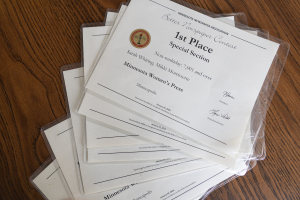 For 2025 coverage, Minnesota Women’s Press earned a community leadership award, three photography awards, and four editorial awards, including for coverage of social issues and for our Spring 2025 “Know Your Rights” special section supported by Unidos MN. Our publisher was named Journalist of the Year by Violence Free Minnesota for gender-based violence coverage.

