

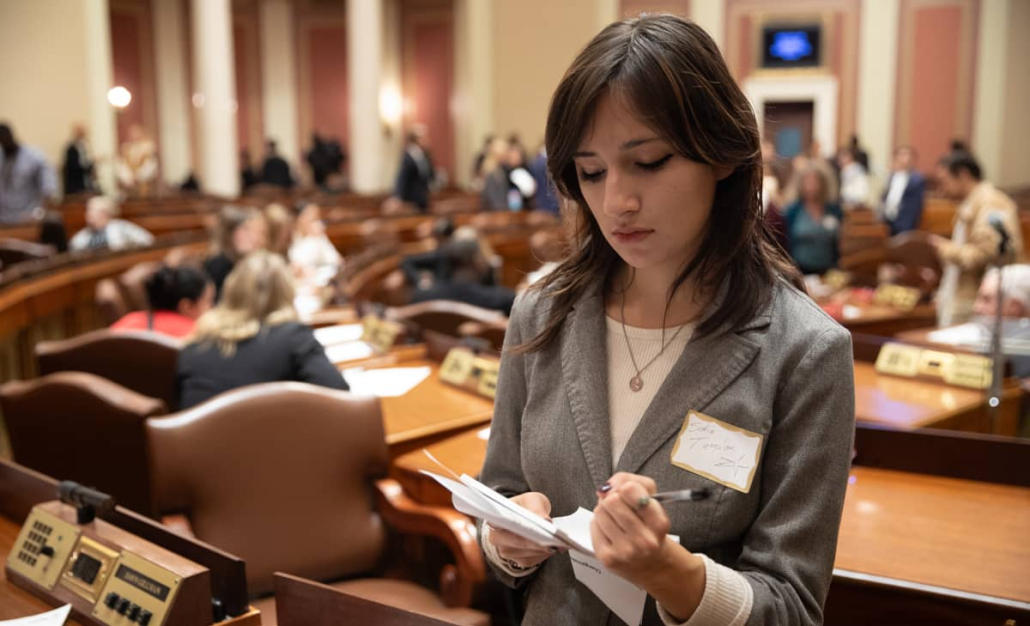
Commentary: Listening to Minnesota Students Discuss 2026 Legislative Priorities

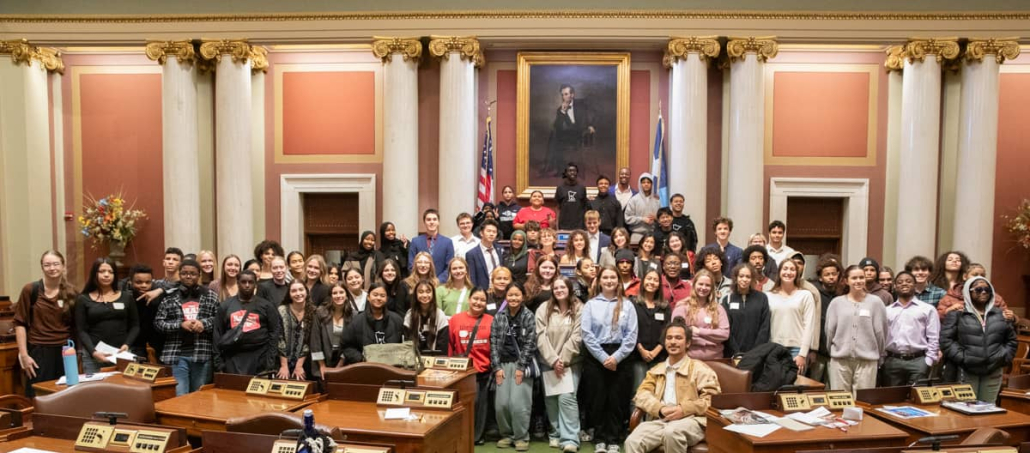
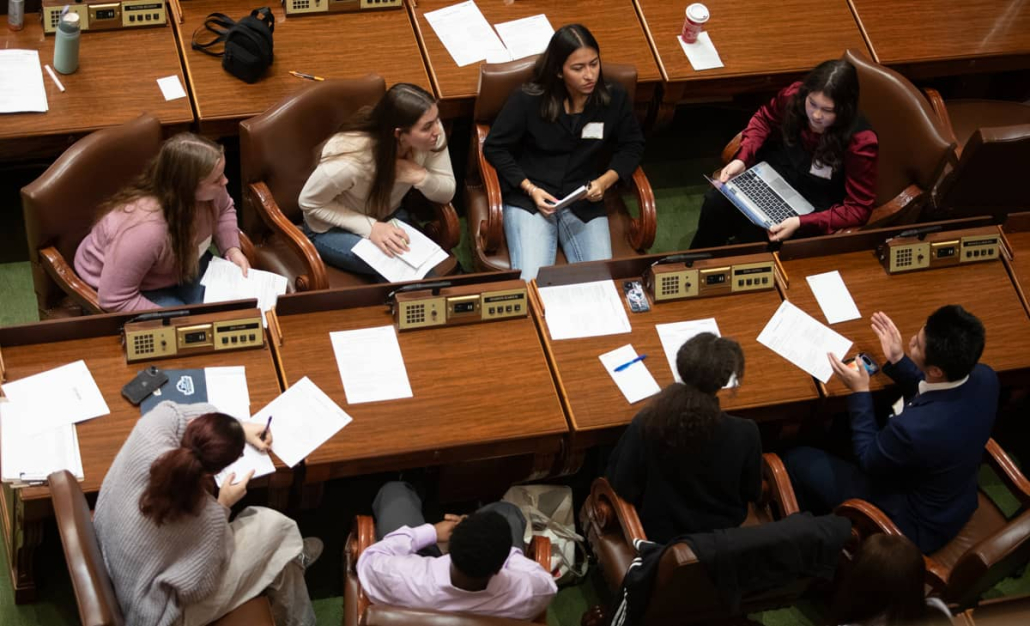
The full group of students and some mentors at the Youth Summit in November 2025, who met in the House chambers at the Minnesota State Capitol (photo by Sarah Whiting)
I read a recent Columbia Journalism Review story about the fact that the progressively political Teen Vogue is one of the latest print publications to close. The quote that got my attention enough to read the story was that Condé Nast, the parent company, had “dealt a blow to the larger ecosystem of feminist media.” However, what stood out for me as I read the story was this quote, from the magazine’s former political director Allegra Kirkland:
“Kids are being fatally shot in schools, our government is making teenagers give birth to kids they don’t want and aren’t prepared to have, teens write to us about being displaced because of climate disasters like the LA wildfires,” she said, “and we’re treating them like they’re not old enough to engage in politics.”
Kirkland said she was worried about the loss of a fact-checked publication addressing teens’ issues in this age of book bans, university censorship, and unverified health advice on TikTok.
Small group discussions by youth were held in House chambers, where an image of Rep. Melissa Hortman honors her memory
In a related vein, this is why Minnesota Women’s Press is developing a series in 2026 called “Future Forward,” focused especially on the insights and voices of young people who are, frankly, walking into a country currently laden with weakened economics, low employment and housing options, and highly divisive politics. This new series will connect with young systems changers who will inherit a broken world and re-mold it.
To find some of these voices, I spent a recent Saturday in the House chambers at the Minnesota Capitol with 87 mostly high school students from around the state. They assembled for the third annual Youth Summit — a caucus that had youth leading each other in small group discussions about education, gun violence, housing, and mental health.
Each group proposed a piece of legislation they would like to see enacted in 2026 and voted from House desks ‘yea’ or ‘nay’ on priorities. This was the start of a six-month process that many of them will engage with for the coming legislative session.
Two young women from last year’s summit wrote Minnesota Women’s Press with stories about their work during the passage of two bills, on opioid education and menstrual equity.
The Summit is organized by Catalyst for Systems Change, which empowers youth, families, and historically marginalized communities to lead systemic change “by transforming their lived experiences into actionable solutions with measurable impact.” Read about the origins of this organization, and its founding pair, here.



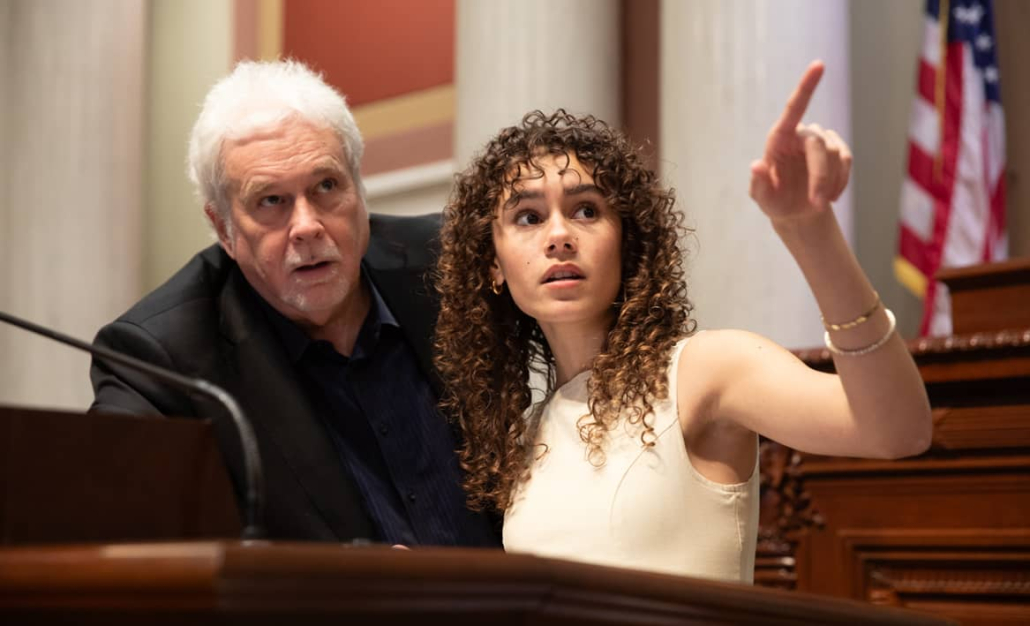
House clerk Pat Murphy examines the voting tally with student leader Maitreya Reeder, who wrote a story for us in July about her role in 2025 legislation (photo by Sarah Whiting)
Opening Insights From Adults
One of the adults who made the Summit possible in the House chambers is Pat Murphy, the House clerk (coincidentally on the cover of our current magazine issue laughing with Kaoly Her and Melissa Hortman). He told the Saturday morning youth gathered: “Your voice is your power. If you don’t use it, someone else will. Don’t let them.”
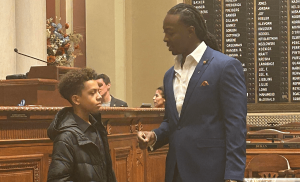
Khalique Rogers talking with one of the younger visitors to the Youth Summit
Khalique Rogers, who co-developed the program as part of the Catalyst for Social Change, told the young people they were living a dream he had but did not see a path to when he was homeless in Chicago. He wanted to make a difference after moving to Minnesota and finding similar problems here. Rather than complain, Rogers said, he needed to activate, because “dreams matter” but “dreams don’t work until you do.”
The diverse youth assembled include those from The Man Up Club in Minneapolis, Open World Learning in Saint Paul, and students from a wide range of statewide cities, such as Hinckley-Finlayson, Caledonia, and Willmar. One large contingent from Worthington left their homes at 6am for the trip.
Rep. Matt Norris, of Blaine, shared that at the age of 16 he served on a Brooklyn Park commission that was trying to figure out why youth crime was such a big issue. When he got the courage, he recalled, he pointed out that there is nothing for youth to do. Eventually, more youth activities and jobs were created. In five years, violent crime went down 40 percent. [See related issues from North Minneapolis and Saint Paul.]
Sen. Bobby Joe Champion, of North Minneapolis, encouraged them to think about what they want to see done differently, and that these decisions are made by “those who show up.” He said many people can complain about what is wrong, and that it is innovators and investors who make things happen. “We are judged by what we build, not what we destroy.”
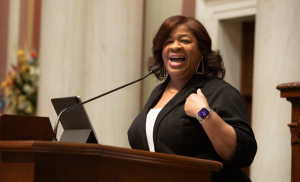
Dr. Macarre Traynham (photo by Sarah Whiting)
Dr. Macarre Traynham, assistant commissioner in the Minnesota Department of Education, indicated that her role in equity is about helping people with limited supports get what they need “as the foundation to a stronger and brighter future for everyone.”
Student leaders Maitreya Reeder and Sofia Templos launched the day of discussions. They outlined how they were part of the 2025 work researching and writing a policy brief about opioid addiction rates, meeting and testifying with legislators, and ultimately seeing their bill pass.
The largest group gathered around the topic of mental health. However, as I listened in on conversations, I heard mental health raised in the groups focused on housing and gun violence as well. Some of the comments I heard in the small group discussions:
- Mental Health: For people aged 10 to 34, suicide is the second leading cause of death; there should be free resources for all students from kindergarten to 12th grade to access counseling. Classmates and teachers should be made aware of warning signs for depression and suicidal ideation. One student co-leading the group discussion asked participants to each share why the topic was important to them: “Mental health affects the entire lifestyle,” “No one wants friends struggling to get actual help,” “We can all benefit from learning coping skills.”
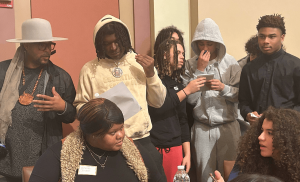
A large group of young men and women discussed solutions to gun violence
- Gun violence: With the proliferation of guns, they are being used as a default reaction to arguments. Background checks and a registry should be mandatory for gun ownership, including a mental health assessment and required renewals, just as we do with driver’s licenses. Safety training should start by the 5th grade, as DARE programs do about drug use.
- Housing: Anyone living without a secure home should have free on-site access to mental health and family support resources. Sexual exploitation is common among the housing insecure, and we need more safe spaces with advocates, lawyers, and translators.
- Education: Rep. Connie Levi is one of the legislators 40 years ago who made possible the development of post-secondary educational opportunities (PSEO) so that students still in high school could get a start on credit. Youth Summit developers Rogers and Joe Nathan met when Khalique was a PSEO student 14 years ago. Students at the Summit discussed possible improvements that could be made especially for those in rural areas.
- Open-ended: This group talked about offering more community gathering spaces and extracurricular activities designed to support low-income students.
Choosing Solutions and Priorities
Sofia Templos takes notes from the large group of students engaged in the gun violence discussion (photo by Sarah Whiting)
Gun Violence Prevention group: “Gun violence continues to pose a serious threat to the safety and well-being of our youth. This issue matters deeply to us, because young people are disproportionately affected, and the long-term impact of families and communities is significant. Addressing the problem is essential to creating a safer, healthier environment. Our vision is for Minnesota to experience a meaningful reduction in gun violence, both accidental and intentional. Our first objective is to strengthen gun carry policies to advocate for the enforcement of more effective policies regarding to the carrying and handling of firearms within the state. Objective two is to expand early gun safety education — to introduce and support gun safety education programs for children, grades five to 12, providing age appropriate guidance ranging from basic safety to more detailed information as children grow. This will help ensure they are informed, responsible, and aware of the dangers associated with firearms.”
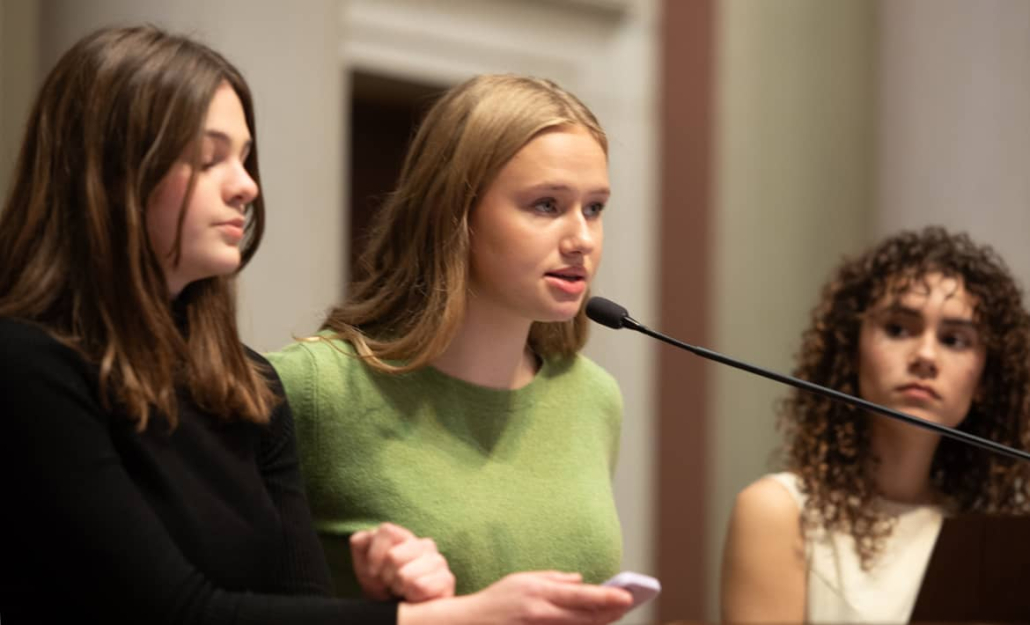
photo by Sarah Whiting
Housing Solution: “We’re from the affordable housing group. Youth are struggling with the issue of homelessness in the Twin Cities in Greater Minnesota. Teens that experience domestic violence or insecurities in their home life are forced into situations where they are unhoused. We propose that the state of Minnesota begin remodeling and rebuilding abandoned buildings throughout the state and transform them into safe shelters for young people experiencing domestic violence at home. These shelters will provide mental health and rehab resources, translators, and immigration lawyers for those who are unable to secure housing due to undocumentation.”
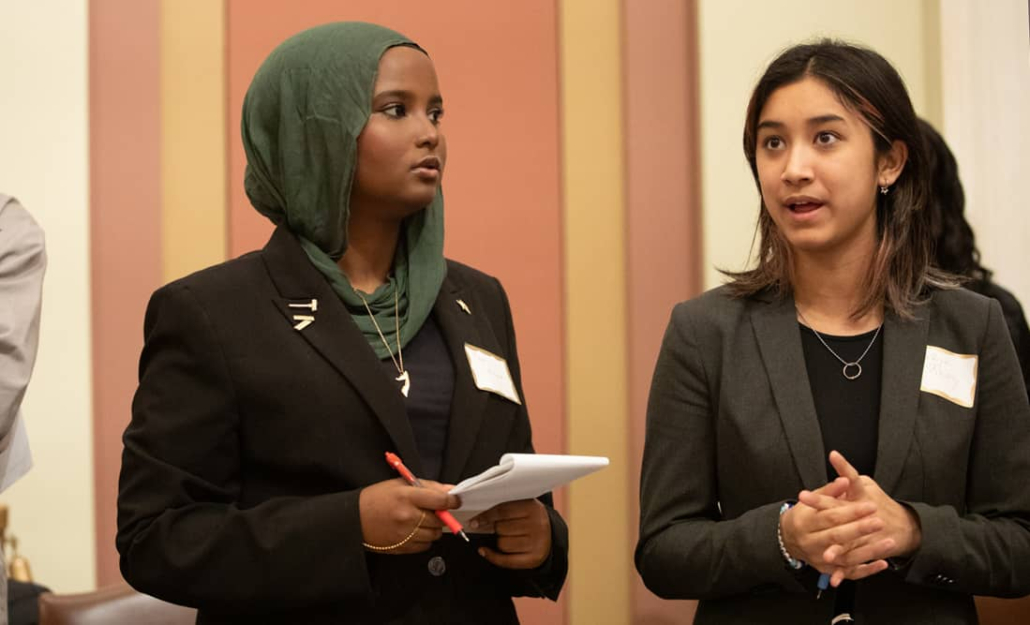
Samia Mohamud (left) and Safiya Khimji (photo by Sarah Whiting)
Mental Health Resolution: “I want everybody in this room to think about somebody they may have lost or somebody they know who struggles with mental health. Suicide rates among minors in the U.S. has increased significantly. It is the second leading cause of death from the ages of 10 to 34. This is an issue we cannot ignore. Our mission is to create an environment where students can go to the adults in their life and tell them, ‘I’m not okay, and I need help.’ As a group, we came up with two objectives. 1) Add recognizing signs of negative mental health to teachers in professional trainings, and 2) Implement after-school support groups in all schools where students can meet together in a comfortable, safe setting.”
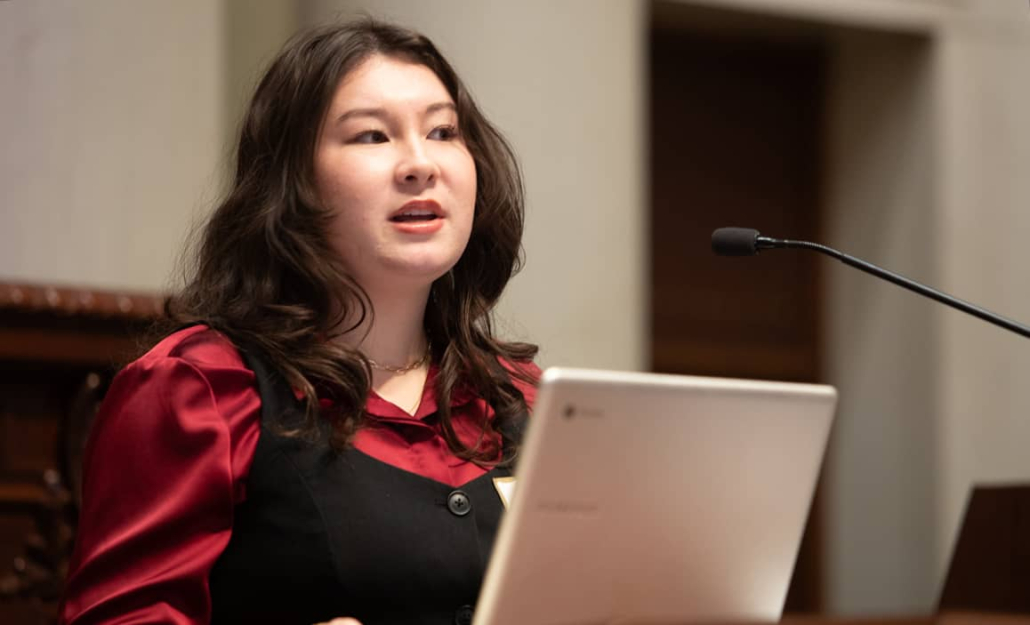
photo by Sarah Whiting
General Issue Spokesperson: “A main problem highlighted was how communities have a substantial and long-lasting impact on the lives of young people. Whether it be an amazing coach or a horrible teacher, it has affected us all in some way. Marginalized, low-income communities are disproportionately affected. The lack of community for students affects performances in the classroom and beyond. Firstly, we are incentivizing extracurriculars through a scholarship program available for low-income students and for underperforming schools. This increases participation, gives students a community to trust through sports teams, ensembles and the like, allowing us to create spaces for communities. Secondly, people in the community are allowed to petition to create community gathering spaces meant to for service and employment for youth.
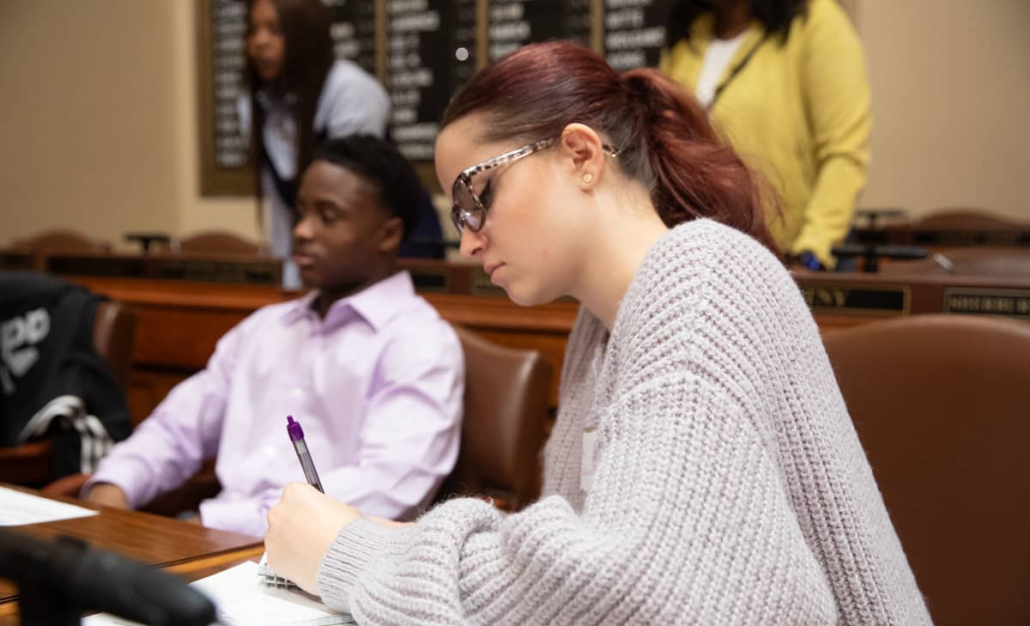
photo by Sarah Whiting
From the Education subcommittee: “One of the similarities we found is that we all take post-secondary enrollment classes, but we come from different districts with different sizes and different resources. We found disparities between rural districts and others districts to have transportation to post-secondary enrollment options. Our solution is that the state will provide transportation funding to individual school districts to pay for reimbursement for students to have equal opportunity in post secondary enrollment options.”
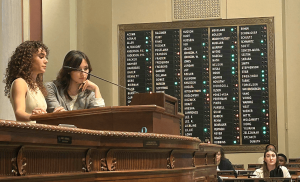
Students used the desk “yea” options to vote for each proposed solution
Reeder, Templos, and Rogers indicated that committees will develop from the participants in the coming weeks and months to create a viable plan for each solution alongside legislators. All participating students were paid $50 for being consultants — “being paid for what is in your mind,” Rogers said, adding that “collective action gets things done.”
Funding support for the Summit came from John and Denise Graves Foundation, Morning Foundation, Elmer Andersen Foundation, and individual donors.
To support coverage of stories like this (which doesn’t happen without funding):




 For 2025 coverage, Minnesota Women’s Press earned a community leadership award, three photography awards, and four editorial awards, including for coverage of social issues and for our Spring 2025 “Know Your Rights” special section supported by Unidos MN. Our publisher was named Journalist of the Year by Violence Free Minnesota for gender-based violence coverage.
