


zAmya Theater Tackles Public Housing With Humor and Heart

Tech rehearsal image for “The Waiting List is Full” (photo by Haadiya Numani)
For more than two decades, zAmya Theater Project has used performance art to illuminate housing injustice and inspire action for housing justice, all while centering the voices of folks with lived expertise. zAmya’s newest project is “Living in America: The Waiting List is Full,” a one-act play packed with nuanced insights and no small amount of humor.
“The Waiting List is Full” will be performed at a variety of locations across the Twin Cities for Hunger & Homelessness Awareness Week (November 16 – 22). It premiered to an energetic crowd at a theater space in downtown Minneapolis’ Central Library, where it had been originally developed via a long-running zAmya residency program. The Creative Expressions Sessions offers collaborative and joyful creative expression, especially welcoming folks who have experienced housing instability.
“The Waiting List is Full” is a tapestry of first-person storytelling, musical interludes, and comic skits stuffed with impressive amounts of easily-digestible policy analysis. The structure does lead to mood shifts between different portions of the play. Yet cohesion came from the production’s consistent focus on the whos, whats, hows, and whys of public housing. The play’s flexible approach also helped the short (just over an hour) production cover a lot of ground. Some of the highlights follow.



An Eye-Opening History Lesson
One of the play’s simplest but most effective skits walked the audience through nearly a century of public housing history: the redlining of the 1940s, the Fair Housing Act and white flight of the 1960s, the shift in government public housing funding from permanent housing to emergency shelters in the 1970s, the birth of critical but polarizing innovations like tiny homes and widespread encampments in the 1990s. The skit provided a brilliant snapshot of the teeter-totter of public housing trends. One step forward, two steps back, through the “wave of the 21st century, where we have been treading water.”
The production brings this history lesson to life using basic but eye-catching props; for instance, cardboard cars are whisked across the stage by performers as freeways cut through communities of color, like Rondo in the 1950s). There is dark humor as well as creative, resourceful staging and laughter that bring stories to life.

Promotional image for “The Waiting List is Full” (photo by Bruce Silcox)
Why Not the U.S.?
Another memorable section highlighted countries that have approached public housing in very different — and more successful — ways than the United States.

Promotional image for “The Waiting List is Full” (photo by Bruce Silcox)
Some intriguing examples included Malta’s diverse array of public housing types; these offer dignity and independence, unlike many American public housing arrangements depicted in the play. Chile’s government-subsidized new builds incorporate prospective owners’ design inputs. Singapore’s government manages a massive public land trust.
From within the winding, strangling housing system in the U.S., it can be hard to see a way out. or what any potential large-scale solutions could look like. While much of “The Waiting List is Full” focused on illuminating American struggles, a critical endeavor, it was equally important that the play offered tangible, intriguing visions of alternate paths.
Palpable Comraderie
Personal storytelling is at the heart of “The Waiting List is Full,” allowing the production to avoid generalizations and instead highlight nuanced examples of the impacts of housing injustice.
Three performers shared personal experiences of how racism intersects with housing inequity, from segregated and under-resourced public housing in Georgia and Indiana, to the alienation experienced by residents of the Wind River Reservation in Wyoming. Each story confronts head-on the deep issues built (literally) into these childhood homes, but also expresses pride, resiliency, and determination to fight for something better for local communities.
A memorable narration came from Renita Parkhurst, who shared how landlord negligence resulted in her getting lead poisoning as a young child in Minneapolis.
Even as “The Waiting List is Full” bounced between different moods, and performers visibly tired during the performance, the comraderie among the zAmya troupe was palpable. The deep sincerity, conviction, and insight brought by each person is a reminder of the power of handing the mic to those most affected by housing injustice.
In an informal post-performance chat, a cast member noted that zAmya is thinking about a part two for “The Waiting List is Full.” If a second act contains as many sharp observations, humor, and heart as the first, it would be memorable. There are certainly more housing stories to tell, more housing questions to ask and answer, and a long way to go until we create public housing worthy of the name in the United States.
Tech rehearsal image by Haadiya Numani
To support coverage that you don’t see elsewhere:
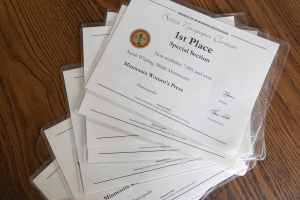 For 2025 coverage, Minnesota Women’s Press earned a community leadership award, three photography awards, and four editorial awards, including for coverage of social issues and for our Spring 2025 “Know Your Rights” special section supported by Unidos MN. Our publisher was named Journalist of the Year by Violence Free Minnesota for gender-based violence coverage.
