


Why We Are Suing
Kathryn Hoffman, CEO, Minnesota Center for Environmental Advocacy. Photo by Sarah Whiting
Data center story development is made possible by the financial support of CURE: harnessing the power of people who care. Ecosystem reporting support from the Minnesota Center for Environmental Advocacy.
For an audio version of this story:
Running a nonprofit law firm, I get a lot of phone calls from coworkers, the press, or other leaders in the environmental field. It’s not every day I get a call from a whistleblower at a state agency. But in 2024, that’s what happened. This person wanted to talk about an issue most Minnesotans are now aware of: data centers.
I did, of course, have data centers on my radar by that time. Leading the Minnesota Center for Environmental Advocacy (MCEA), which has served as the state’s environmental watchdog for over 50 years, means I’m always tracking emerging environmental threats. At the time this call came in, the facilities were mostly being built in Virginia and Texas. In fact, there were perhaps two or three proposals for hyperscale data centers in Minnesota.
At least, that’s what we thought.
In fact, there were at least 10 large-scale proposals across our state — but they were being kept out of public view. To date, we are now tracking at least 17 potential data center proposals.
That phone call changed the direction of our work and the trajectory of these proposals in Minnesota.



My team began investigating. What we discovered was troubling. Across multiple communities, nondisclosure agreements (NDAs) were being used to keep proposals hidden from residents. City officials were signing NDAs with developers, then declining to inform the public about the specific nature of projects being considered in their neighborhoods.
Minnesota’s environmental review law was established in 1973. The principle is straightforward: Minnesotans have a right to know what’s proposed in their community and a right to participate in decisions about it.
Yet across multiple communities, nondisclosure agreements were being used to keep proposals hidden from residents. When elected officials, whose responsibility is to serve their constituents — not corporations — sign these NDAs, at best it undermines their accountability to constituents, and at worst it enables secret lobbying.
We’re also facing a common industry playbook: trying to force states into a “race to the bottom” on regulations, sowing fear that if standards are enforced the community will lose financial investment.
It is hard to reconcile company statements that they want to come to Minnesota because of clean energy standards consistent with their sustainability goals. Yet on the other hand, these sustainability goals are also condemned as getting in the way of good business, and many ask for exceptions.
Many states are wrestling with this issue right now. Minnesota can be a model of not racing to put profits above people’s long-standing needs for water and affordable energy.
MCEA has filed five lawsuits so far challenging inadequate environmental review in Hermantown, Pine Island, Lakeville, North Mankato, and Faribault. These legal actions are designed to make sure communities and decision-makers have access to the information they need to make informed choices.

Understanding the Scale
One thing we hear from proponents of these proposals is that data centers have been in operation in Minnesota since their advent. That is true, but these centers in operation are minuscule compared to hyperscale proposals. The basement of General Mills, for example, might contain its own localized cloud computing space. On the other hand, proposals like the one in North Mankato, as one example, can cover four million square feet. That is more than twice the size of the Minnesota Vikings stadium.
Whether you’re talking about size, water, or energy consumption, the numbers are significant. If all the data centers currently proposed in Minnesota were built, they would consume as much electricity as every home in the state combined.
Where will that energy come from? Will it drive up our electricity bills? Will it slow down the transition to clean energy, even as we know that addressing the climate crisis needs swift and large-scale action?
Many cities with proposals we are tracking are already in stressed aquifers. Overtaxing our groundwater supplies is not a theoretical issue. White Bear Lake, for example, has been depleted by high-capacity pumping and has lost five feet of water quantity since 2003. Many of the water appropriations for data centers are being authorized as amendments to city permits, which means requests for huge amounts of additional water resources aren’t receiving the scrutiny they deserve.
Environmental implications extend beyond resource consumption. A Cornell study found that training a large A.I. model produces air pollutants equivalent to more than 10,000 round trips by car between Los Angeles and New York City. The research estimates public health costs could reach $20 billion by 2028. [Find a similar report summarized in New Scientist.]
At MCEA, our work protects clean water, energy, clean air, community impacts, and mining. Data centers intersect with all of these issues.
The Hermantown Case
When people understand what’s being proposed and can provide input, it leads to better outcomes like improved project design, greater community acceptance, and early identification of potential problems while solutions are still possible. This process has been effective for over 50 years.
When it comes to many recent data center proposals, however, we’ve observed a departure from this transparency.
Consider Hermantown. In November, MCEA filed a lawsuit with the citizen group Stop the Hermantown Data Center, challenging the environmental study for “Project Loon,” as it was cryptically named in documents — a 1.8 million-square-foot hyperscale data center. The city and other government entities had information about this proposal for over a year before the public found out about it.
Did residents finally learn about the proposal because the city came forward with the information? No. It took an information request from one of our staff attorneys, and many additional follow-ups, before we were given access to these public documents.
Even though emails show the proposal was known to be for a data center, the environmental study conducted by Hermantown instead identifies it as a “light industrial” development. Minnesota law requires environmental studies to include “clear, complete, and detailed” descriptions of projects under review. You can’t meaningfully analyze environmental impacts when you won’t name what you’re studying.
The study estimated water and electricity use based on assumptions about general “light industrial” development rather than the specific demands of a large data center. It projected 50,000 gallons of daily water use, substantially below what comparable data centers typically require. Electricity estimates were also much lower than we would expect. Where did they get their estimates, and how accurate are they?
Additionally, there were no binding commitments to reduce impacts related to water use, power consumption, or air, light, and noise pollution. This is a pattern we have seen in other Minnesota cities as well.
What You Can Do
The lack of adequate information has led hundreds of residents in communities across the state to spend considerable time advocating for basic transparency. At one community meeting, our attorney observed residents with bookmarked and annotated copies of environmental reviews — not the level of attention most people are expected to give to municipal planning documents. A good environmental review process makes protections easier for residents, not harder.
We hope our lawsuits will take some of the burden off residents, but in the end it is Minnesota residents who can take back their power. How to take steps:
- Call MCEA. We can talk you through how to make a document request from your city. It is your right to know what’s happening in your community. We can also help figure out what stage in the process your city is in, if there are descriptions in the proposal that flag it as a potential data center, and how to connect with people in other communities who are doing this work. Many of these decisions are made by city councils, who are not used to hundreds of people showing up to their meetings. They don’t want that backlash. You have more power than you think.
- Follow the 2026 legislative session. Litigation was not the first step for MCEA. We initially lobbied for state laws that would mandate certain requirements for data centers. We’re not done fighting for unified permitting and environmental protection at the state level. Keep an eye out for bills related to data centers. There will be bills about what we want to see as established policy, as well as bills that place development goals over people. MCEA is a resource to track these. Sign up for our emails, or bookmark the bill tracker on our website (mncenter.org). Call your legislators and sign on to our actions so they know constituents care about this issue.
- Do your own research and show up. We’ve heard developers say residents don’t understand the proposals and aren’t informed. We know that’s not true. People are showing up fully informed of state laws, environmental review, and where current proposals miss the mark.
Don’t let developers say people don’t know what’s best for their communities. Attend local meetings and make sure your voice is heard.
In short, environmental review isn’t about preventing development. It’s about informed decision-making, giving communities a meaningful voice, and holding powerful interests accountable to the people who will otherwise experience long-term consequences from their developments.
MCEA is committed to our role as a watchdog and defender of Minnesota’s environmental laws. We hope the courts will provide the clarity that legislative action has not yet delivered. But the responsibility and the power to demand transparency do not rest solely with attorneys. They belong to every Minnesotan who cares about the future of their community.
To enable us to follow this issue through the 2026 legislative session:




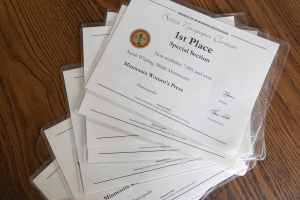 For 2025 coverage, Minnesota Women’s Press earned a community leadership award, three photography awards, and four editorial awards, including for coverage of social issues and for our Spring 2025 “Know Your Rights” special section supported by Unidos MN. Our publisher was named Journalist of the Year by Violence Free Minnesota for gender-based violence coverage.
