


Transforming Our Reliance on Limited Fossil Fuels


Photo Sarah Whiting
Like many children in the U.S, I grew up swimming in energy, unaware that this made me a privileged minority. When I learned about the challenges created by this consumption, my views were turned upside down.
Energy consumption has tended to come from food and biomass. The industrial revolution brought technological leaps and overflowing fossil fuels. The availability of these dense fuels increased over the following centuries, creating an economy dependent on growth.
But these ancient fossil fuels are finite, and once gone, they will never be available again. Even more pressing in the near term will be the loss of economically viable reserves. As extraction becomes more remote, complex, and expensive, rising costs will reduce accessibility for the average person.
Renewables and nuclear power can help, but they won’t be able to overcome the fundamental reality of living on a finite planet among endless pressures to consume. In short, we will need to cope with declining energy availability as a culture. We will all be better off if we reduce the energy we use.



There Are Good Options
I was able to make sweeping changes in my life. I localized my diet, learned how to bike around my city, and reduced consumption across the board.
Of course, access to a car and fresh food is a privilege. It is those of us with choices who have the biggest footprint.
My biggest changes go beyond individual actions. One of the most insidious negative consequences of fossil fuels has been the erosion of social ties and reciprocity. Because we have such abundant energy, we’ve lost our sense of reliance on neighbors — retreating into short-term comforts and isolating conveniences at the cost of resilient support systems.
Growing deep roots has become my guiding principle. I’ve engaged with my city by learning about local policies, especially for transportation and housing. I live in Minneapolis, which has been building bike infrastructure, quickly becoming the best city in the country for cyclists. This might sound like a small impact, but biking is deeply connected to equity in housing, health, and finances.
There are so many groups working toward better futures. Local agriculture is particularly special, such as Community Supported Agriculture, farmers markets, and teaching youth agricultural techniques to build a connection with the land. But this is only the beginning of what’s possible.
One article that has been stuck in my brain talks about community canneries in the early 20th century. There was a time when canning was a necessity for eating locally year-round in the midwest. Doing this individually was an enormous task. Community canneries shared this labor and provided education to women.
Community canning centers were dissolved during the mid-20th century as industrial, processed canned goods became available in stores — typically produced under dubious working conditions. I wonder what areas designated as food deserts — often impacting low-income communities — might look like if community-based canning centers were still commonplace to help preserve locally grown fresh produce.
A lower energy future will look different in Minnesota than in other places around the world, and unrecognizable from how we live today. These transformations are most critical at the local level, as we fight for policies that serve people and the earth, even while our national politics are veering toward the opposite.
For me, the most important way to build community is also the most fun. Finding my people, sharing the joys of life, and creating deep connections has grounded me.
Navigating complex relationships can be uncomfortable. But humanity has only ever truly thrived within community — and it is the only way we’ll have a shot at vibrant, flourishing futures.
Lizzy Sirianni (she/her) is a senior producer and researcher for the Institute for the Study of Energy and Our Future.
To support our unique story sharing:

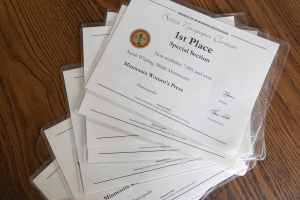 For 2025 coverage, Minnesota Women’s Press earned a community leadership award, three photography awards, and four editorial awards, including for coverage of social issues and for our Spring 2025 “Know Your Rights” special section supported by Unidos MN. Our publisher was named Journalist of the Year by Violence Free Minnesota for gender-based violence coverage.
