


Karin Wille: My Roots in Feminism


Wille’s Great-Grandfather James, Grandma Pearl, and Great-Grandmother Louisa Phare
I grew up on a three-generation dairy farm in southern Minnesota and graduated from law school in 1974, when very few lawyers were women or people of color. As our country approaches its 250th birthday, I find myself thinking more about the history of women’s rights in this country, and its impact on my female ancestors as well as myself.
The laws in the United States were initially based on English common law. Under an English common law doctrine called coverture, a woman’s separate legal identity was absorbed into her husband’s upon marriage. William Blackstone described it bluntly in his Commentaries on the Laws of England: By marriage, husband and wife became one person in law, and that person was the husband.
That doctrine sounds archaic now, but it was not ancient history when my great-grandma Louisa married in 1868. It was the legal world she entered as a wife and mother. She bore child after child, buried several of them, and lived within a legal and cultural order that assumed a married woman’s identity was subordinate to her husband’s.



My grandma Pearl, born in 1890, was unable to vote in federal or state elections until she was thirty, when the 19th Amendment to the United States Constitution passed. Prior to that time, women in Minnesota could only vote on matters relating to family or education, such as school and library boards.
When my mom became pregnant in 1948, her choices were narrow. Reliable contraception was difficult to obtain, and abortion was illegal except in the most limited circumstances. The federal Comstock Act of 1873 defined anything used to prevent conception as obscene, thereby prohibiting its mailing across state lines. State laws, including Minnesota’s, restricted access as well.
After my older sister was born, Mom asked the only doctor in town, who happened to be Catholic, to fit her for a diaphragm. He refused. His religious beliefs mattered more to him than her physical or emotional welfare, her exhaustion, or her ability to decide when to have another child. Five months after giving birth, she was pregnant again — with me.

Wille (r) with her late mother Virginia Leigh Wille
Second-Wave Feminism
I was 13 in 1963 when the second wave of feminism began. Although I couldn’t have spelled the word “feminism” in a spelling bee, I found my early feminism in the Leslie Gore song that came out the same year, “You Don’t Own Me.” I especially loved the lines about “just let me be myself … to say and do whatever I please.”
In the larger world, 1963 was christened the beginning of second-wave feminism due to the publication of Betty Friedan’s The Feminine Mystique. Friedan drew on the ideas of French writer Simone de Beauvoir, who determined, in her book The Second Sex, that male-centered ideology was being accepted as the norm. Friedan’s book was published the same year that President Kennedy’s Presidential Commission on the Status of Women, chaired by Eleanor Roosevelt, released its report.
The 1963 report recommended addressing gender inequality by providing paid maternity leave, greater access to education, and help with childcare.
The first legal victory of second-wave feminism also occurred in 1963, when the Equal Pay Act was passed by Congress. The law required that men and women be paid the same for jobs requiring “equal skill, effort and responsibility” and performed under similar working conditions.
In 1964 Congress enacted the Civil Rights Act, which prohibited discrimination based on race, religion, or national origin in public accommodations and employment. In an effort to kill the bill, an amendment was offered adding sex to the categories of prohibited employment discrimination. Likely surprising to the bill’s author, both the amendment and the bill passed.
In 1965, when I was 15, a decision of the U.S. Supreme Court finally gave married women like my mom the legal right to use contraceptives without interference by the government.
When I got married in 1972, I kept my own name. It seemed simple enough to me, but when I tried to register to vote in my first election, I was told I couldn’t unless I used my husband’s name.
A year later, the Supreme Court gave women the right to an abortion without significant restrictions in the first and second trimesters of pregnancy. In 1974, shortly after I graduated from law school, Congress passed the Equal Credit Act, which made discrimination in credit decisions due to sex or marital status illegal. No longer could the bank send us credit cards only in my husband’s name.
Equality was far from the norm, however. Women made 59 cents for every dollar earned by men. The Equal Rights Amendment, passed by Congress nearly 50 years after it was introduced, was still unratified by the requisite number of states in 1979. There were no women in the U.S. Senate and only 19 women in the House of Representatives (17 percent), despite women being more than 50 percent of the population. There were no women on the Minnesota or the U.S. Supreme Courts.
In the 1980s, the shortcomings and tensions of second-wave feminism continued to plague its forward momentum, including the frustration of Black and Indigenous women and other women of color who felt their experiences were ignored and dismissed by the primarily white leaders of the movement. After significant legislative and court victories, the movement essentially came to a close in the mid-1980s.
Third-Wave Feminism
In 1991, Anita Hill — a Black female attorney — testified against a Black male Supreme Court nominee because of sexual harassment she experienced while working for him at the Department of Education and, of all places, the Equal Employment Opportunity Commission. Rebecca Walker, the daughter of Black second-wave feminist Alice Walker, wrote “Becoming the Third Wave” in Ms. magazine:
Let Thomas’ confirmation serve to remind you, as it did me, that the fight is far from over. Let this dismissal of a woman’s experience move you to anger. Turn that outrage into political power. Do not vote for them unless they work for us. Do not have sex with them, do not break bread with them, do not nurture them if they don’t prioritize our freedom to control our bodies and our lives. I am not a post-feminism feminist. I am the Third Wave.
Many women, me included, shared Ms. Walker’s anger about how Hill was treated not only by Thomas — including his characterization of the proceedings as a “high-tech lynching” — but also by the 14 members of the Senate Judiciary Committee, all of whom were white males. In many parts of the country women took out their anger at the ballot box, increasing the number of female senators from two to six, including the first Black female senator. The number of female representatives increased from 30 to 47. By 2007, that number had increased to 88.
In 2016, Hillary Clinton became the first female presidential candidate of a major political party. The November election put 65,844,610 cracks in the glass ceiling, as Clinton received nearly 2.9 million more votes than Donald Trump.
However, because of the arcane and outdated electoral college method of electing presidents, Clinton lost the presidency.

(l–r) Mike Casserly (late husband), Kate Hansen (granddaughter), and Karin Leigh Wille (author)
When the Needle Moves Backward
In the summer of 2018, President Trump nominated a federal Court of Appeals judge, Brett Kavanaugh, to the U.S. Supreme Court. Early in the process, Dr. Christine Blasey Ford, a professor and graduate of Stanford Medical School, accused Kavanaugh of sexually assaulting her when they were high school students in 1982. Although two other women made similar allegations, the Senate Judiciary Committee forwarded Kavanaugh’s nomination to the full Senate on a straight party vote of 11 Republicans to 10 Democrats.
Despite the passage of more than 30 years since Anita Hill made her accusations of sexual harassment against Clarence Thomas, despite the third wave of feminism and the “Me Too” movement, despite the presence of four Democrat women on the Senate Judiciary Committee, it felt like nothing had changed since 1991.
In 2022, the United States Supreme Court, in a six-to-three decision, overruled the nearly 50-year precedent established by the Court in 1973 that gave women the constitutional right to an abortion in the first and second trimesters of pregnancy. The three dissenting justices were all women. Justice Amy Coney Barrett, a Trump nominee and the fourth woman on the court, voted with the majority.
My 24-year-old granddaughter Kate was furious about the decision. Unfortunately, I had little comfort to give. She had grown up assuming her right to an abortion would not be taken away. All I could say to her is that the fight is never over, that we would have to organize and lobby and vote again, and again, and again.
There are many, including me, who would argue that in 2026 we are in danger of losing the gains of the second wave of feminism and that, as our nation turns 250 years old, genuine equality is even farther out of our reach. We have gone from women represented in increasing numbers in politics and business to high-ranking government officials being fired because they are women or people of color. After nearly 50 years of the federally protected right to abortion, the Supreme Court took away that right, returning the issue of abortion to the untrammeled discretion of 50 states.
Those of us who helped in some small way to secure the rights of the second wave of feminism, and who benefitted by them, are old enough now that some of these changes will have a minimal impact on us personally. It is for our children and our children’s children, for those times we may never see, that we need to be reminded of our history and to keep working toward full equality for all.
Minnesota Women’s Press uniquely centers marginalized voices — but we need your support to keep doing so. As you might have heard, media outlets like Lavender (newly closed) and Star Tribune (dramatic personnel cuts) are curtailed. So are we. But we are committed to freelance story development with whatever funds we have as we move toward a consumer-owned media co-op model by years-end.

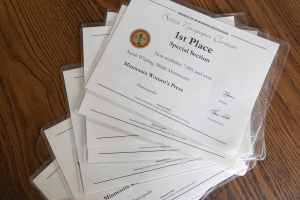 For 2025 coverage, Minnesota Women’s Press earned a community leadership award, three photography awards, and four editorial awards, including for coverage of social issues and for our Spring 2025 “Know Your Rights” special section supported by Unidos MN. Our publisher was named Journalist of the Year by Violence Free Minnesota for gender-based violence coverage.
