


Planting Seeds in Times of Darkness

Winona LaDuke sorting beans and corn with farm team volunteers at the Akiing Farm. Photo Sarah Whiting
“When enough seeds are awake, freed from fear and other negative aspects of the third- and fourth-level consciousness, the fifth-level seeds will be able to sprout within humanity and form a Whole.”
— Qeros Prophecies from the Andes
I was recently asked to be on a panel about “Planting Seeds in the Times of Darkness.” Andrea Ixchiu, a Mayan Timekeeper, reminded us that seeds are planted in darkness into the earth. “The energy of the seed … teaches something that maybe we have forgotten — that every life starts in darkness. The seed that falls on the land doesn’t see the sun immediately. She doesn’t know what it’s going to be. She has to trust — in the moist humidity, silence, in the long work under the soil — to what she’s going to become. Before blossoming, she dies. Before feeding, she gives herself to the soil.”
So, too, our wombs are dark, and from that hallowed space is where babies are born. What this teaches us: In these times of darkness, plant seeds. Seeds are life, promise, and commitment. Consider my squash seeds. One squash can have more than 800 seeds in it. That’s abundance!
In these times, I think about the seeds that we plant. I go to my gardens, which will feed our family and our community. That is a hope, and an intergenerational responsibility.
In the Anishinaabe language, Anokogijikan — the word for great-grandparents — is the same as the word for great-grandchildren. Our language connects us to the past and the future. That’s perspective. That’s why a long-term perspective helps us transform.
We make something beautiful with our hands, hearts, and prayers. First we protect that which is life: water, land, and biodiversity.
Northern Minnesota is a place where the wild things are, with some of the most biodiverse areas — on the White Earth Reservation, the Smoky Hills, and the Upper Shell River Basin.
This is where I live — which is why I was arrested here, protecting the Shell River from the Line 3 pipeline destruction. This is the place of mussels that clean the water. This is a place of life. Our community is the restored place of the lake sturgeon and trumpeter swans. These beings have returned, along with a buffalo herd growing on the White Earth reservation in the upper reaches of the Buffalo River. We bring back the good life of our ancestors, and we wish to keep our promise to them all, to protect them and nourish life. These are places of life.
Northern Minnesota is also home to the Boundary Waters, where you can still drink the water from a lake. In a world where water is no longer available to billions of people, let us protect the water. Let us remain Water Protectors, recalling the generations past and the generations to come. Those are Indigenous teachings of intergenerational responsibility and wealth.
On a worldwide scale, Indigenous people represent about 5 percent of the world’s population but steward 75 percent of the world’s biodiversity. We are successful in protecting these lands because we are committed to the land, to life, and to moderating our own behavior so that life can continue. That’s how we can hang out in an ecosystem for a thousand years and it’s still healthy. Indigenous knowledge and values help preserve life.
Our prophecies as Anishinaabeg speak of this time as that of the Seventh and Eighth Fire. We are told that we will have a choice between a scorched path and a green path. We must take the green path if we are to survive and to light the Eighth Fire of peace. Those teachings have implications for all of us. Here are a few of those teachings.

An underground greenhouse in process, by Anishinaabe Agriculture Institute. Photo Sarah Whiting
1) Seeds Are Life
Seeds are our future, yet, in the world of globalized agriculture, things are not looking good. One out of four farmers this year will not be buying fertilizer, and more farms will go under. That’s a price of war. This will be a challenge for food that most of us will eat, and this is also a moment to grow, without the chemicals of war and conflict.
This is the time to nourish and replenish soil, not scorch it with additives that end in -cide, the word of death: pesticide, fungicide, homicide, genocide. Believe in life.
Our awareness of this crisis is opportunity. It enables us to reaffirm relationship with soils through organic and local agriculture and rethink how we treat “dirt.”
In our community, we are growing corn varieties that put nitrogen into the soil and adding organic fertilizer and cover crops to rebuild soils. We farm with horses and ancestral seeds. Our work is pre- and post-petroleum.
We also grow hemp because it is the answer to many of the crazy choices of fossil fuels. We call it the New Green Revolution. Hemp can sequester carbon at the highest rate of any field crop. It represents a carbohydrate economy, not a hydrocarbon economy. That is key.
Hemp can build houses. Hempcrete construction requires approximately three acres per house. That house can be grown and built in the same year. The hempcrete is fire-retardant and mold-resistant, as well as energy efficient.
We grow hemp because Minnesota once had 11 hemp mills. The word “canvas” comes from cannabis. Can you imagine if we replaced the plastic tarps used for boats and wrapping bales with hemp? That would be healing.
Fast fashion — petroleum-based clothing — is choking our ecosystems, and has quickly become a major environmental problem. France is banning fast fashion from their runways. Hemp and linen — two once locally grown materials — “wear in” instead of “wearing out,” and provide elegant alternatives for even the most discerning clothes collector.
Consider also hemp paper, which would save our industry in Minnesota, dwindling because of lack of supply. We are shredding remaining forests for toilet paper — which is silly, since hemp is a good option. One acre of hemp produces four times as much paper as an acre of trees and can be grown in a year, not 20. It can be recycled twice as many times as paper from trees. That’s a solution to many problems of our material society.

Waabizii One is a 500-kilowatt solar project serving Pine Point Village. Photo Sarah Whiting
2) Local Energy Is More Efficient
Enbridge, the pipeline company, is the largest energy consumer and mover in the state of Minnesota. When its Line 6B ruptured in Michigan in 2010, more than 843,000 gallons of heavy crude oil leaked into Talmadge Creek and the Kalamazoo River. When heavy crude oil mixes with river sediment and water, it forms a heavy, toxic, tar-like sludge that sinks into riverbeds. The U.S. Environmental Protection Agency required years to clean up millions of gallons of contaminated oil-water mixture.
Newly proposed data centers will require significant amounts of energy and water. At some point, we need to think about the term “appropriate technology” — how much do we need?
Lawrence Livermore Labs’ annual energy flow charts indicate that 61 percent of the energy fed to the grid is “waste heat.” It is past time we build something more efficient.
There was a ribbon-cutting in May in the White Earth Nation for a 500-kilowatt solar project with 2.75 megawatts of battery storage. It powers the Pine Point Elementary School in our village, and represents the largest project on the Itasca-Mantrap Cooperative’s grid. Further to the south, the Upper Sioux reservation added a megawatt of power to its grid.
The tribes are being opposed by other rural cooperatives, who have set punitive charges and threatened to shut off power for the tribal communities. However, more projects are coming — because this is the future and tribes are tired of the big bills and the high disconnect fees. Poor rural consumers deserve local power.
War makes fossil fuels increasingly expensive. The system doesn’t provide security for communities. War destabilizes — it does not build.
Local energy combined with efficiency is an answer; 8th Fire Solar builds solar thermal panels to reduce heat bills by up to 30 percent for residential and commercial customers. That’s more power to the people. It’s also an opportunity to not waste energy and use our friend the sun to heat our homes. Minnesota is cold but sunny most of the winter.
Another example of smarter energy available today is the electric car. Despite Trump’s hopes to destroy the market, the opposite is occurring. It is getting less expensive to drive an electric vehicle. People want more and better, without mining for minerals. Alternative energy sources will continue to benefit from smarter investors and choices — like examining how we move things, where we move to, and why.
It turns out that the answer is apparent, and underused. Trains are the most energy-efficient method of moving people and freight on land. There are big corridors in Minnesota — such as to Duluth and toward Fargo — that would benefit from a real train system. It is simple physics. Metal on metal is better than rubber on the road; it is 30 percent more efficient, even more so when we move from diesel to electric trains.
Many models of electric trains convert more than 90 percent of their energy into motion; diesel trains convert only about 30 percent. A national effort called Solutionary Rail promotes an electric train system, modeled partly on what they do in Europe. The Galloping Goose train system used to be available in the north; people would take a train to their lake cabins, get picked up, and then canoe in peaceful bliss. I think that’s a good plan to reconsider.
Frankly, most of the world has better trains than the U.S. The Dutch train system works almost entirely on wind energy. Trains there move 600,000 commuters; one turbine can power a train for 120 miles.

Hours-old foal Azhigan (Socks) nuzzles up to his mother Aameshii. Photo Sarah Whiting
3) Reduce Garbage
We make way too much unnecessary garbage. Bayern Brewing in Missoula, Montana, has a bottle-washing station. It takes in bottles from breweries who have the sense to standardize bottle sizes. Inspired by German breweries — which reuse bottles up to 30 times — Bayern invested $250,000 in a bottle-washing machine that can clean and sterilize 8,000 bottles per hour. They reuse each bottle again and again. That’s efficiency.
Thinking about how much energy we use simply crushing glass gives me a headache. We can all reduce our levels of consumption. We need to relocalize, get smarter about efficiency, to create that healthy path.

Native youth planting a field of fiber hemp with a team of Haflingers. Photo Sarah Whiting
4) Mutual Aid Is the Future
This past winter in Minnesota taught us what we are made of: mutual aid. We are a place where people can solve problems as we create a better future.
We’re a state with a history of social justice movements: the MacDonald Sisters, Marv Davidoff, Women against Military Madness, and the beauty of neighbors showing up for each other.
We can follow the instructions of our ancestors and guiding forces like Sitting Bull, who told us that if we put our minds together, we can make a good future for our children.
That’s this time. In this darkness, it is a time of seeds to be planted for the years to come. I am often reminded of the Zapatista saying:
“They buried us. They forgot that we were seeds.”
We are the seeds. Let us plant and care for them so the new world can be born. If you are quiet, you can hear her breathing. I look forward to her beauty.

Photo Sarah Whiting

Photo Sarah Whiting

Photo Sarah Whiting

Photo Sarah Whiting

Photo Sarah Whiting

Photo Sarah Whiting
Minnesota Women’s Press uniquely centers marginalized voices — but we need your support to keep doing so. As you might have heard, media outlets like Lavender (newly closed) and Star Tribune (dramatic personnel cuts) are curtailed. So are we. But we are committed to freelance story development with whatever funds we have as we move toward a consumer-owned media co-op model by years-end.


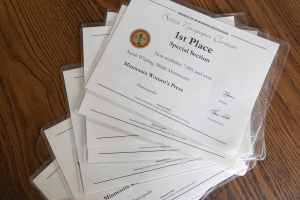 For 2025 coverage, Minnesota Women’s Press earned a community leadership award, three photography awards, and four editorial awards, including for coverage of social issues and for our Spring 2025 “Know Your Rights” special section supported by Unidos MN. Our publisher was named Journalist of the Year by Violence Free Minnesota for gender-based violence coverage.
