


Future Forward: How My Advocacy Work Began at Age 13

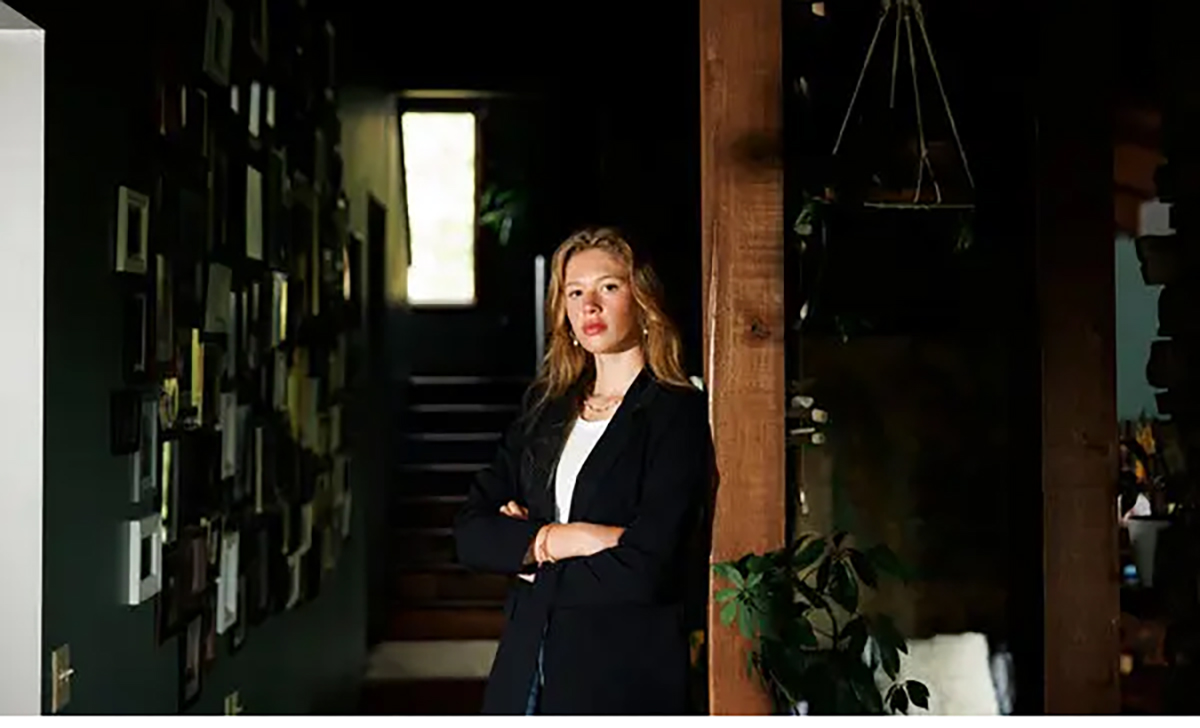
Maarit Mattson (photo by Jenn Ackerman)
The spring of my eighth grade year, Roe v. Wade was overturned. Up to that point, I had not been involved in advocacy work nor had I paid close attention to politics.
It was May, the weather had finally begun to warm up, and I was excited for the end of the school year. I was sitting in bed when I saw a news alert on my phone. It was the leaked decision in Dobbs v. Jackson, the case that overturned Roe v. Wade. I am not sure what caught my attention in that headline. I did not yet know what Roe v. Wade was, or what it did, but I stayed up into the middle of the night reading the Supreme Court’s 90-page leaked decision. I have the notes I took while reading saved in my phone.
Before it was overturned, Roe v. Wade had provided constitutional protections for abortion access in the United States up to the point of viability — about 20 weeks of gestation — across the United States. It had been in place since 1973, almost 50 years at the time the Dobbs decision was leaked. While Roe v. Wade protected abortion access until the point of viability, states were free to make their own regulations after that point, as long as there were exceptions that allowed intervention to protect the mother’s life.
Overturning Roe v. Wade removed those protections — meaning states were able to independently set any and all regulations they wished on abortion access. While some states decided to protect the right to abortion, many have moved to ban the procedure, sometimes even without exceptions to save the mother’s life.



The leaked decision to overturn Roe v. Wade did not immediately allow abortion to be banned, but it was clear that bans would be coming. As soon as the official decision was announced, old pre-Roe state laws that limited or banned abortion access would go into effect, some dating back to the 1800s.
After I read the decision, I decided to organize a walkout at my school. As I listened to the radio news about the decision in my mom’s car on the way to school the next morning, I told her that I wanted to do something. We spent the next afternoon in an office supply store where I printed hundreds of flyers for a walkout.
Many of my peers, not surprisingly, had no idea what the decision meant or why it was important to me. I spent the next week handing out flyers to students and explaining as much as I could about the issue. I let them ask questions and I let them debate the issue with me. I believe that is what drew many kids into participating.
I learned it is important to make sure the people you are trying to organize understand what the issue is, and have an opportunity to ask questions and develop their own stance on it. The opportunity to develop their own opinions, and hear that their thoughts matter, is how young people become invested in the cause and become advocates.
I was never somebody who was confident speaking in front of people, and had always been shy when it came to speaking to people I did not know. Organizing the walkout forced me to step out of my comfort zone. It was difficult for me to do this, but it helped me get over my fear and build public speaking skills that have helped in both advocacy work and my education.
The Pivotal Day
When the day of the walkout came, I walked to the front doors through a massive crowd of students. Many kids had made signs during free periods in the art room. Others had painted green handprints down their arms and legs — the color used to symbolize the fight for bodily autonomy and legal abortion access.
There was such an energy in the air as we walked outside. Kids were empowered. Like me, they were realizing they had a voice and could use it to stand up for the things they believed in.
I led the group down to the fence line on our school property, which bordered a busy highway. We spent the afternoon holding signs up to cars that honked back at us. Students gave speeches. In our small Minnesota community (about an hour south of the Twin Cities), 500 students left class to protest the overturning of Roe v. Wade. It was incredibly inspiring that so many young students stood up for individual rights they believed in.
That pivotal experience in 2022 inspired me to pursue a law degree. I continue to find ways to encourage students to be involved in politics and speaking their minds. I am a junior in college — I am doing the post-secondary enrollment option (PSEO), so I graduate from high school this year and from Gustavus Adolphus next year.
My Next Steps
While in high school, I organized another walkout with other students. I am now in my fourth year working with the Planned Parenthood Action Fund. I run a student club that helps students access resources for advocacy projects to confront other issues in our communities. I worked in 2025 on the Minnesota Menstrual Equity Bill, which requires that free menstrual products be provided to students in Minnesota schools, for grades 4 to 12, to combat the issue of period poverty. One in three students in the U.S. are unable to afford menstrual hygiene products.
After the bill was signed into law by Governor Walz, I oversaw the rollout of next steps in my home school district.
I also have worked on panels for the 2024 and 2025 United Nations Women and Children’s Rights Reports, and have run voter registration programs to get more Minnesota students involved in politics.
Where We Are on Reproductive Rights Today
Seven months after Roe v. Wade was overturned, Minnesota adopted the Protect Reproductive Options Act, which created constitutional protections for abortion access within the state. Minnesota is a sanctuary state for abortion access in the Midwest; Iowa, Wisconsin, North Dakota, and South Dakota adopted strict abortion bans after Roe was overturned. People from across the Midwest now travel to Minnesota to access safe reproductive healthcare.
The Center for Reproductive Rights has kept updated on news about how people are being impacted by laws about an individual’s right to choose what is right for her family. For example:
- ICE activity near clinics in Minnesota in early 2026 led to an eight percent increase in no-show appointments for contraception, abortion, sexually transmitted infection testing, and cancer screenings, according to Planned Parenthood.
- Texas Attorney General Ken Paxton filed a lawsuit accusing midwife Maria Rojas of violating the state’s abortion ban, and a court shut down the three clinics where she worked. She was the first Texan to be charged with violating the state’s abortion ban. Paxton also filed a lawsuit against a California doctor for allegedly providing abortion pills to Texans.
- FDA regulations have allowed the use of telehealth for prescribing and mailing abortion pills. Louisiana is asking a federal court to block this regulation and prevent patients from getting abortion pills via telehealth. Currently, 1 in 4 abortions in the U.S. are provided via telehealth.
- In Missouri — where voters passed an abortion rights amendment in 2024 — state officials are trying to reverse this decision by voters with a confusing ballot measure in November.
- Some lawmakers are attempting to charge people with murder for getting an abortion. Recently, a Tennessee House subcommittee killed a bill (HB 570) that would have allowed women who obtained abortions to be charged with homicide, potentially facing the death penalty or life in prison. The bill was sponsored by Rep. Jody Barrett and Sen. Mark Pody, but failed to gain enough support to advance. Other state lawmakers have proposed similar measures in Oklahoma, South Carolina, Texas, Kentucky, Georgia, Arkansas, and Alabama.
- Tennessee lawmakers also voted down legislation that would have clarified that doctors can provide abortion care in cases of rape, incest, and serious medical emergencies.
- Find an updated Guttmacher map about state-by-state laws here.
In Minnesota
Although Minnesota has protected reproductive rights, there continue to be opponents working to restrict.
- Rep. Natalie Zeleznikar (R-Fredenberg Township), for example, authored HF25, aiming to fund crisis pregnancy centers and restrict abortion access.
- Groups like Minnesota Citizens Concerned for Life and associated lawmakers are campaigning against the proposed Equal Rights Amendment, arguing it would permanently enshrine unlimited, unregulated abortion into the state constitution.
- It takes 68 votes to pass a legislative bill in Minnesota. In the current 2026 legislative session, the DFL holds a narrow 34-33 majority in the Senate and an evenly split (67-67) House. Bills are not able to advance out of committee or off the House floor without bipartisan support. All 201 legislative seats are on the ballot in the fall 2026 election.


 For 2025 coverage, Minnesota Women’s Press earned a community leadership award, three photography awards, and four editorial awards, including for coverage of social issues and for our Spring 2025 “Know Your Rights” special section supported by Unidos MN. Our publisher was named Journalist of the Year by Violence Free Minnesota for gender-based violence coverage.