


Flashback: Media attention to women’s sports
As we watch the equal split between men’s and women’s sports at the Olympics for the first time — we are now up from 2 percent women athletes at the first modern games in 1900 — we take a look back in our Legacy series at a story from February 1997, “Women’s sports coverage: Still a poor reception?”
When Randy Shaver makes decisions about what fills his daily sports hole, it’s not exactly science.
“There are really no hard and fast rules,” said Shaver, who heads the sports department at KARE-TV. “Each day is different, and you just have to sit down and decide what you perceive as more important, decide what to get on first and go from there.”
Ask other local sports editors in the mainstream media, and they say about the same thing. And whether that exact mix includes coverage of women’s and girls’ sports depends on the day and on what the sports editors perceive as the interest.
“The way we measure ‘interest’ is attendance,” said Tim Wheatley, sports section coordinator at the Star Tribune. Added Dick Pufall, acting sports editor at the St. Paul Pioneer Press, “If there’s 50,000 people at one game, and 400 people at another game, it’s not hard to see which sport attracts more interest.”
Thus, the Timberwolves, Vikings, Twins and even U of M football continue to dominate the sports pages, no matter how wretched their win-loss records.



So, is the bottom line that unless women’s events attract big crowds, they’re not likely to attract banner headlines? “With women’s sports in particular, we have increased our coverage,” Wheatley said. “The unfortunate thing this year is that the [University of Minnesota] women’s basketball team is not having a great year, so attendance and interest is down.”
But using the Gopher women as the example of how stories get coverage makes it sound like, in general, the coverage is fair and equitable. Advocates for women’s athletics say that’s not the case.
“They have this mantra, ‘It’s because of reader interest,’ as if they have no role in creating reader interest,” said Mary Jo Kane, director of the Center for Research on Girls and Women in Sport at the U of M. “Certainly, Minnesota is better than the national average, but it is still not equal.”
“When they say, ‘No one’s interested,’ what they’re frequently really saying is, ‘We’re not interested,” Kane said. “I would suggest that the interest now in women’s athletics, which is greater than ever, has been because of a grass-roots movement of people who have have absolutely insisted that we pay attention to women’s sports and go to women’s sports even though there is a virtual media blackout.”
Indeed, the 1996 Minnesota Women’s Press newspaper survey found that women made up an average of only 10 percent of names found on the front pages of sports sections in the Star Tribune (11 percent) and the Pioneer Press (9 percent).
The Women’s Press began its survey of the two dailies in 1988, when women made up only 4 percent of mentions in sports pages. Mention of women is moving slowly—inching up only 6 percentage points in eight years.
Nationally, coverage of women’s sports is even more meager.
Kane uses the example of the U.S. women’s soccer and softball teams playing before sellout crowds at the Olympics last summer, in spite of very little national exposure.
Others say women have become accustomed to feeling the sports page isn’t for them. Judy Mahle Lutter, president of Melpomene Insistute for Women’s Health Research, wrote a column on women’s sports and recreation in the Pioneer Press sports pages for almost three years. Her column has since moved to the Metro section. She suspects it didn’t receive a wide readership in Sports because she heard from female readers that “the sports page just isn’t a place I ever go.”
Increasingly, however, younger female athletes are seeing themselves reflected on the sports pages and in TV reports. KARE-TV, for example, has honored a boy and girl high school athlete of the week for the past 14 years. A glance at high school roundups in the daily papers also shows a more equitable distribution of space.
A study on hockey coverage by the Melpomene Institute conducted in 1994 and 1995 found that, as the number of girls’ hockey teams increased, so did the relative gender balance of the newspaper coverage.
But when the girls graduate to higher levels of competition, the media spotlight doesn’t necessarily follow them. “With high school sports, we know all the people that we’re covering live in our area,” said Wheatley. “The interest level is obvious.”
Although the Star Tribune has increased regular coverage of NCAA women’s basketball results to include the top 25-ranked teams (compared to virtually nothing just two years ago), Wheatley still contends the local demand for coverage of women’s collegiate games just isn’t as strong as that for men’s games. Last spring, the paper sent three reporters to the Men’s Final Four, and none to the Women’s Final Four.
“It may be changing, but there’s a pretty big difference in interest between the men’s tournament and the women’s tournament,” Wheatley said. “Whether we send a reporter, or we run a 20-inch story from someone else, I don’t think that matters to the reader. Certainly, if we had a bigger travel budget, I could see sending someone.”
Sports editors say they must weigh practical considerations in addition to interest making their daily decisions about what to cover. Resources, and space, are limited. And the number and variety of sporting events from which to choose can be daunting. Said Wheatley, “We realize that not all readers are the same. Some are interested in pro sports, some are interested in college, some are interested in women’s sports, some are interested in auto racing, golf, tennis, bowling, you name it.”
Pufall added that audiences for teams that aren’t the Twins, Vikings or Timberwolves can fluctuate radically from year to year. “Parents of a kid in cross country want us to cover cross country,” he said. “In a couple of years, they might not have any interest anymore.”

“The paper isn’t trying to eliminate women,” Melpomene’s Lutter said. “It’s just that the other stuff is just so much easier to write on a tight deadline. [Reporters] are used to just pulling stuff off the AP, or they’ve got resources who they call and quote regularly.”
This leads Lutter to encourage readers interested in women’s sports to become more savvy about pitching stories to the men and the women holding down the sports desk. “We need to have information ready, we have to be willing to be interviewed, and when something is covered, we need to write or call and say ‘thanks’ for it, because otherwise they don’t know we’re reading it.”
There’s no question that coverage of women’s and girl’s sports has improved over the past several years. “I hope people are noticing,” Wheatley said. He said the Star Tribune is much more careful about designating “men’s college basketball” instead of just “college basketball,” and that the paper shies away from using photos of women falling around on the floor for a loose ball, making it look like they’re are out of control. “I know what the buttons are,” he said.
The coverage is likely to change in other ways. With the addition of women’s hockey at the University of Minnesota next season, the Star Tribune will probably assign a reporter to a women’s athletics beat. And Pufall has proposed that the Pioneer Press devote a whole page to women’s sports, along with its coverage elsewhere in the sports section.
That’s an idea to which Mary Jo Kane would subscribe, as long as the paper gave it some time to catch on. “Remember that the interest in men’s athletics has built up over decades. I think there would be a tremendous response if the media hyped women’s athletics half as much as they’ve hyped the men.”
Related Stories
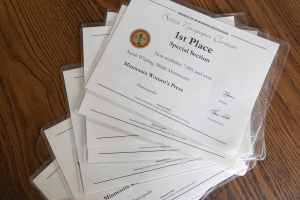 For 2025 coverage, Minnesota Women’s Press earned a community leadership award, three photography awards, and four editorial awards, including for coverage of social issues and for our Spring 2025 “Know Your Rights” special section supported by Unidos MN. Our publisher was named Journalist of the Year by Violence Free Minnesota for gender-based violence coverage.
