


Exploring Sex and Aging
Minnesota Women’s Press hosted panel discussions about “Sex, Menopause, and Aging Bodies” in April, moderated by the magazine’s sexuality writer Gaea Dill-D’Ascoli and outreach director Crystal Brown.
Q: As our bodies change, it can impact our sexual relationships. How do we talk about that and get away from feeling like there is a goal to reach, or dismay that we aren’t feeling the same physically?
Lindsey Hoskins, health education, Family Tree Clinic: Good sex is about being good at communication. It’s not about how big anything is or where you put it. I love this recipe from sex educator Reid Mihalko for having a difficult conversation:
1) I’ve got something I want to talk to you about. 2) I’m nervous to talk to you about it because … 3) What I hope happens is … 4) Then you say what you need to say.
I also highly recommend pelvic floor physical therapy. The muscles in the pelvic area are small, so even a little exercise is a lot. Orgasm feelings are dependent on the strength of those muscles sometimes. The beefier those muscles are, the stronger and easier it is to experience orgasm. Toning those muscles can make a huge difference.
And orgasm doesn’t have to be a goal. Learning to enjoy pleasures large and small, and without a goal, leads to greater satisfaction.
If you’ve got aches and pains in your body — your hips hurt or you can’t lie on your back anymore — talk to a good pelvic floor physical therapist. There’s a lot of referred pain in the pelvis; something hurts over here, but the cause is there.
AJ, psychotherapist, Rainbow Health:
Open up space to talk about sex that isn’t just in the bedroom. Have regular relationship check-ins, when you can talk about a variety of issues. The acronym I suggest is RADAR: Review the amount of time of since your last check in, Agree on the agenda of what you want to talk about, Discuss, name Action steps, and Reconnect after a hard conversation.
Remember that sex is about exploring each other’s bodies and your own body. Maybe there’s room for parallel masturbation or different forms of touch. Sex is expansive, and it can look different ways as we age.
Q: A reader asked how she and partner, now overweight, can adjust the way they have a sexual relationship.
Hoskins: If you can get hips elevated on a pillow, which helps your belly float up a bit so you have easier access to genitals, that’s handy. Don’t be shy about picking up your belly and moving it, as part of your body — it doesn’t move itself. The vagina gets longer when your legs are straight, shorter when your legs are bent. So, if you have more fat padding on your body, sometimes add a little length by extending where your legs are bent.
Often we want to get off of our wrists and elbows. One position is having one partner on the edge of the couch or bed and the other partner standing with easy access. It doesn’t have to be about holding plank position. Laying down sideways also can take pressure off. Surround yourself with pillows. They make pillows for sex that are made of firm foam that are waterproof and washable.
Q: What can you share about how our bellies and digestion change in mid-life?
Carolyn Torkelson, retired women’s health specialist at the University of Minnesota, author of “Beyond Menopause.”
Nutrition and digestion is central to our health concerns. There is a reason that our gut or digestive system is called the second brain. It needs to be nourished with good foods. The gut is not just for elimination. It is part of a system that goes from your mouth to your exit. It has a lymphatic system that fights infections. It has a nervous system that talks to our brain and sends neurotransmitters, like serotonin, that needs to be produced in the gut. It has a gut lining that protects us from toxins passing into the bloodstream. It is a microbiome of trillions of bacteria and viruses that need to be balanced. What we eat is very important.
We know we are supposed to eat locally grown, whole foods, plant-based foods, fibers, probiotics, prebiotics, and avoid lots of sugars and carbs. Where you eat is also important. Our culture has created eating as a multitask. We eat in the car, walking, in front of the refrigerator, while on our phone. We need to stop and enjoy our food, make our food, smell our food. Mindful eating really helps your digestive system.
Kimberlee Reece, licensed acupuncturist and Chinese medicine practitioner, NE Wellness
In American culture, we think that healthy food is a salad and a smoothie. In Chinese medicine, we’re trying to incorporate warm foods and cold foods — yin and yang — along with the five flavors [sweet, bitter, sour, spicy and salty] to our diet based on health needs. If your gut is not working properly, your brain is not going to work properly. We try to make sure it is balanced.
As estrogen declines, the stress hormone cortisol increases, and we sometimes get a little of that belly. I don’t think we should try to go to the gym and exercise it away. [It is important to incorporate] gentle movements, accept our bodies, realize it’s ‘okay to be me.’ Aging is not something to fight off. I think it’s a time of coming into our power.
Q: How can we get to know our bodies better?
Torkelson: One of the biggest reasons I wrote my book is that I felt that there was a big gap between conventional medicine and other integrative care for women. I have heard amazing stories from women about how integrative care helped change their lives. The second part of the book is about different health conditions, such as sexual health, anxiety, fatigue, weight changes, brain health, anxiety, bone health. These are things that often get forgotten in that clinical visit, yet they need to be addressed because they’re often central to how we feel.
Reece: I think that every decade women experience normal hormonal changes. Rest is huge. I think that’s the best medicine. You have to address the adrenals when you’re dealing with anxiety. Something simple that I love for adrenal health is licorice tea and tincture. I love motherwort, which helps with anxiety and insomnia, especially if you are [experiencing palpitations from weeding out caffeine]. Chasteberry is a wonderful herb for balancing both estrogen and progesterone for menstruating women, though it can be a stimulant for some people. Tulsi tea is wonderful for fatigue. Limiting sugar as much as possible — it’s such a big factor with hot flashes, anxiety, irritability, insomnia.
Zayneb Evren, founder, Evran Chiropractic
I track symptoms. I have had most of my life heavy periods and painful cramps to the point where I stayed home. I never discussed it because I thought everyone must experience it. If we gaslight ourselves long enough, that becomes our baseline. Then we start dealing with chronic pain, chronic adrenal fatigue — but that’s our normal, so we don’t see anything wrong with it. Having a good team of providers is to let you know you don’t have to be experiencing that. Another tool that has worked well for my patients is meditation, which can look different for everybody. It doesn’t have to be sitting quietly on a mat and doing nothing. It might be walking, doing yoga, having a mindful meal. My aunt likes to do yoga nidra [a rejuvenating ‘sleep’ that relaxes the mind and bodily senses]. Apps can guide you through a body scan. Spending time in nature. Society profits off us finding things wrong with ourselves, right? — having to shift our bodies to fit some standard or narrative. It is an act of resistance to advocate for yourself, and listen to yourself, and find someone to talk to who can offer support.
Increased cortisol levels over prolonged periods of time affect our immune system function. So, we’re more likely to get sick when we’re stressed. Stress management is huge. Think of three things that help you to reduce your stress. For some people, it’s movement, or reading. Take at least five minutes before you go to bed to do those things that help reduce your stress. Our bellies house our organs. When you breathe with your diaphragm — which none of us ever do because we’re all stressed all the time — you are pressing down on your organs. Let your belly hang heavy. Breathe more fully.
People over the age of 55 have the fastest- growing rate of sexually transmitted illness (STI) in the U.S. The younger age groups are more likely to have an STI, but the older generations are more likely to contract one due to decline in practicing safe sex.
The Centers for Disease Control and Prevention reported in 2019 that the number of cases in the previous five years among Americans aged 55 and older rose 164 percent for gonorrhea, 120 percent for syphilis, and 86 percent for chlamydia.
Recommended Resources
- Comstock Films offers sex documentaries with real couples, comstockfilms.com
- Joan Price, ageless sexuality educator, joanprice.com
- Guide and podcast, blackgirlsguidetosurvivingmenopause.com
- Beyond Menopause: New Pathways to Holistic Health, by Carolyn Torkelson
- Safe sex toys not made with harmful chemicals, smittenkittenonline.com


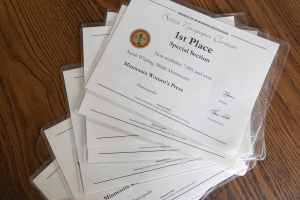 For 2025 coverage, Minnesota Women’s Press earned a community leadership award, three photography awards, and four editorial awards, including for coverage of social issues and for our Spring 2025 “Know Your Rights” special section supported by Unidos MN. Our publisher was named Journalist of the Year by Violence Free Minnesota for gender-based violence coverage.
