

FUTURE FORWARD: A Solution to Youth Homelessness
We currently have no underwriters to support housing coverage (contact us to change that); this story was produced thanks to a grant for student reporters by Advancing Democracy.
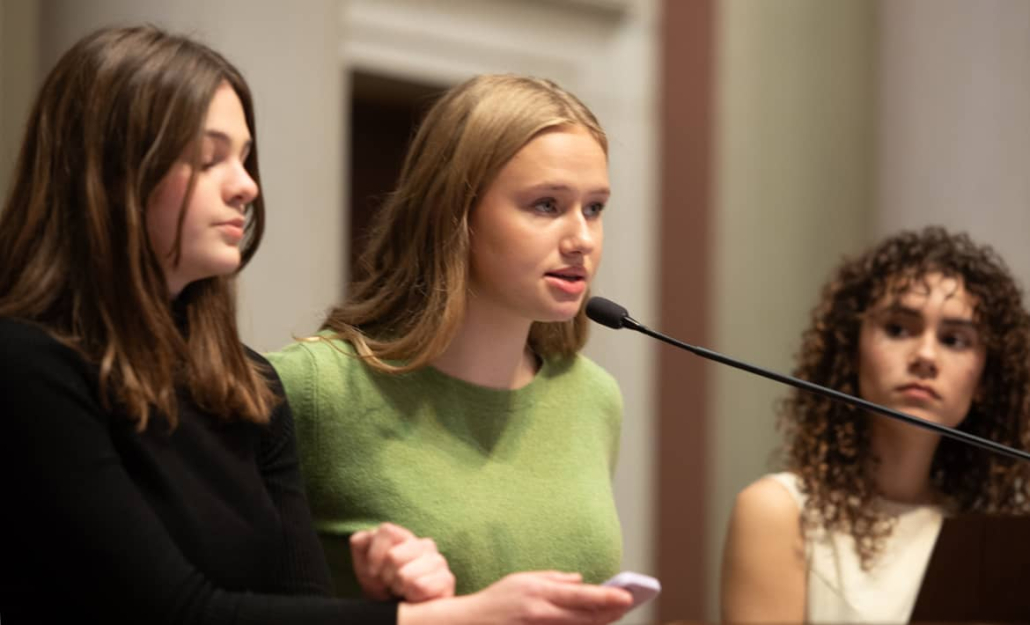
Charley Cheatham (middle) reports at the Youth Summit about a proposed bill to suggest to legislators about housing. Photo by Sarah Whiting.
Teen homelessness in Minnesota has become more prevalent over the past decade. From 2018 to 2025, an estimated 13,300 youth experienced unaccompanied homelessness during the year, based on a Wilder Statewide Homeless Study. In 2025, 46 percent of the homeless population in Minnesota were youth, according to The Bridge for Youth; 5,800 were under the age of 17.
Many of these youth have left abusive or neglectful homes. Some have been rejected because of gender identity or sexuality.
As a member of the youth delegation connecting with legislators this year, we are recommending:
- Development of a pilot program to identify, renovate, and repurpose vacant buildings into affordable housing for youth, with dedicated funding allocated in the next state budget cycle.
- Use of Minnesota bonding bills to create more deeply affordable housing options for all.
- Reduce bureaucratic paperwork that makes the construction of homes more expensive and time-consuming.



The Scope of the Issue
According to The Bridge for Youth, an emergency homeless shelter for youth in Minneapolis, 61 percent of homeless youth have lived with a person struggling with substance abuse, 59 percent have lived with an adult with mental illness, 48 percent have experienced physical violence or abuse, and 31 percent were sexually mistreated or abused.
The Bridge’s report, “Youth Homelessness in Minnesota,” indicates that this trauma often leads to serious mental health consequences. For the population it has served, 85 percent are survivors of domestic violence, 50 percent report their mental health as poor or fair, 23 percent had self-injured, and 17 percent had attempted suicide.
Children who grow up in families with housing insecurity have greater physical, educational, and developmental issues. Unaccompanied homeless youth are vulnerable to sex traffickers and substance abuse.
Shelters are important to homeless teens, providing food, clothing, and other basic support. In Hennepin County, where there are an estimated 425 young people under the age of 25 homeless on any given night, there are — as of March 2026 — 20 host homes, 85 emergency shelter beds, 200 transitional housing beds, and 181 time-limited permanent supportive housing units specifically for youth.
However, many youth report feeling unsafe in some of these spaces. Others find it difficult to feel secure and to continue education while in a temporary space.
Solution Proposed by Students
In November 2025, high school students around Minnesota met to discuss solutions to these issues, and agreed to seek the creation of permanent housing options, especially for teens who are leaving abusive environments. One idea is to transform the state’s many currently unoccupied buildings into housing units. Youth have been engaged this year in talking to Minnesota legislators about supporting this solution.
There are currently about 350 vacant buildings in Minneapolis alone, according to the city’s public dashboard of vacant and condemned properties. Vacant buildings in a community contribute to neighborhood decline and require cities to spend public funds to maintain public safety.
A 2023 report in The Journal of the American Planning Association found that communities with even a basic touch-up of vacated properties, including trash cleanup and window repair, led to measurable reduces in criminal activity, including gun violence.
Minnesota Housing Partnership has suggested including funds for permanent housing — not simply shelters and transitional spaces — in the 2026 Bonding Bill. They also are asking for increased flexibility to give emerging developers easier access to funds and properties to develop attainable homes.
By creating safe houses for teens experiencing homelessness — especially those escaping abusive homes — we will build a stronger future in Minnesota. Youth who have safe housing can get the education and stability they need. Crime rates will be reduced. And repurposing vacant and abandoned properties will improve public safety and finances.
Some investors are buying up properties for punitive and profit-focused purposes. Minnesota can prioritize transforming spaces into supportive and safe communities. As The Bridges for Youth puts it — based on its work with 50,000 youth over the years — with safe housing comes supportive relationships, educational and economic opportunities, and full participation in community life.
Charley Cheatham is a high school student at Open World Learning Community. She developed this story in tandem with Avery Messina of Lakes International Language Academy.
Setting the Groundwork
MPR story about vacant buildings policy change in Minneapolis
- Chicago, Illinois: The “Reclaiming Chicago” initiative, led by United Power for Action and Justice, aims to build over 2,000 homes in vacant, overlooked areas.
- Milwaukee, Wisconsin: Nonprofits like Acts Housing assist families in purchasing and rehabbing distressed, city-owned homes.
- Baltimore, Maryland: The Baltimore Vacants Reinvestment Initiative pairs city, nonprofit, and private partners to rehab derelict homes.
- New Castle County, Delaware: The “Vacant Spaces to Livable Places” (VSLP) initiative has converted over 700 vacant properties into occupied, affordable homes.
Related Resources
“Youth Hold the Truth,” a video produced by High School for Recording Arts students in Saint Paul
Minnesota Housing Partnership “2026 State Legislative Agenda”
Khalique Rogers, et al. “It’s Important to Hear and Learn from Youth Experiencing Homelessness in the Twin Cities,” MinnPost, July 19, 2021
Robbie Sequeira, “Homeless youth say they need more from schools, social services,” twincities.com
Cari Spencer, “Time Is Up for Minneapolis Buildings Left Hazardous and Vacant for Years,” MPR News, July 22, 2024


 For 2025 coverage, Minnesota Women’s Press earned a community leadership award, three photography awards, and four editorial awards, including for coverage of social issues and for our Spring 2025 “Know Your Rights” special section supported by Unidos MN. Our publisher was named Journalist of the Year by Violence Free Minnesota for gender-based violence coverage.
