

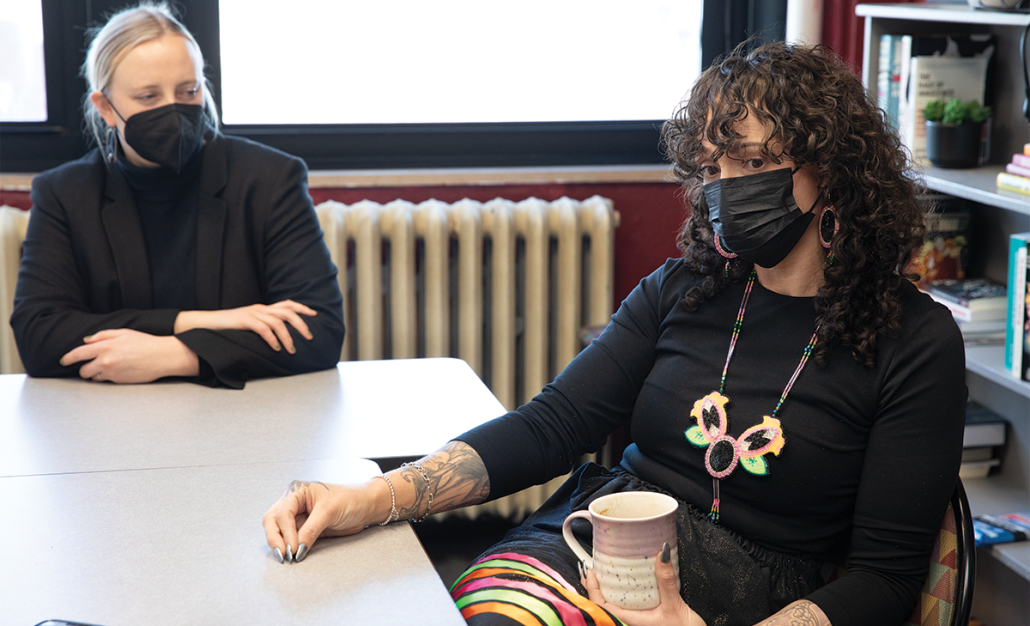
A Conversation About Transforming the State’s Justice System (Part 1)
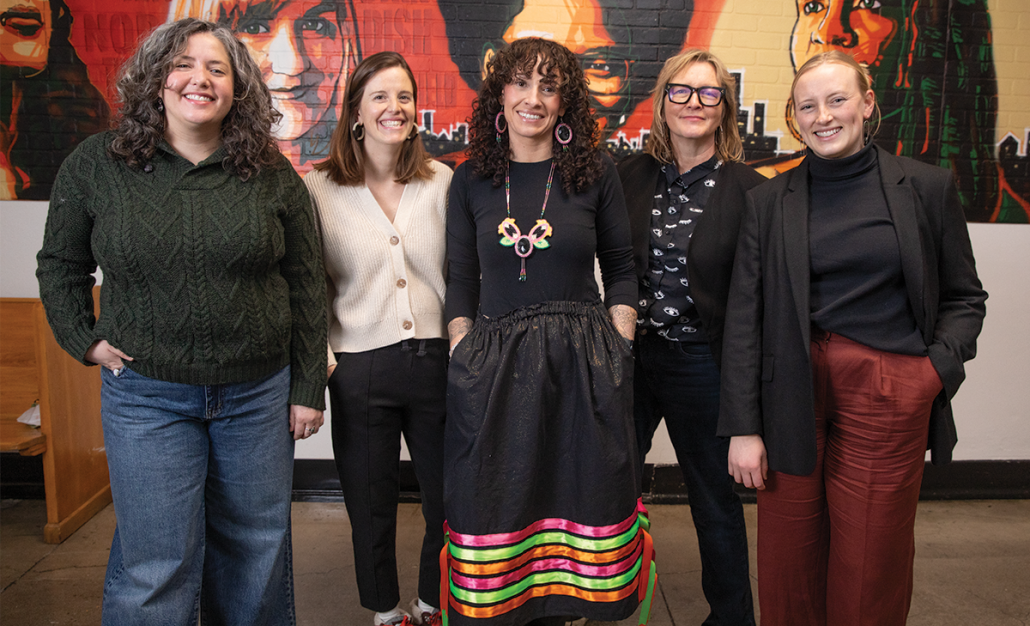
A few members of the Minnesota Justice Research Center team: (l-r) Anna Hall, Katie Remington Cunningham, Kayla Richards, Jenny DeBower, and Mackenzie Farrington. Photo Sarah Whiting
The Minnesota Justice Research Center (MNJRC) is a nonprofit organization that focuses on how to create a stronger and more impactful criminal legal system in Minnesota, based on community-centered listening sessions, research, data analysis, education, and policy development. Its emphasis is on helping policy makers, legal system players, and community members identify how to improve public safety in restorative, fair-minded, and accountable ways. The team is made up of people with experience ranging from scholars and legal practitioners to students, survivors, and formerly incarcerated individuals.
In this story, we talk with some members of MNJRC about its work exploring the pre-trial bail system and evaluating a gun violence intervention program in Saint Paul.



Pre-Trial Bail System
Says Katie Remington Cunningham, MNJRC research director: “Generally speaking, everything that we do is in response to something — a conversation with the community. The conversations we like to have at the beginning are with community members, people directly impacted by the issues that we are tackling.”
After protests erupted in the wake of George Floyd’s murder by a police officer, the Minnesota Freedom Fund paid bail for many protestors to get out of jail. Cash bail became a hot-button issue. Why do people who have easier access to funds generally get out of jail, while those who do not remain? Is that a fair system — punishment based on how much money you have?
“People were talking about it,” Cunningham says. “But what was missing was a deep understanding of the people who are actually paying bail.”
The general perspectives were limited to either:
1) abolish cash bail because it is an unfair money-based system, or
2) oppose a change, because without bail, dangerous people walk free and may not show up for court. The latter viewpoint is held by many despite research showing this is not true.
The reality, Cunningham says, is that the pre-trial system affects more people than simply the person who is jailed. “The people who are paying bail are often women kinfolk of people who are charged with a crime — people who are still presumed innocent,” she says.
“We heard from mothers, girlfriends, and grandmothers who were putting up their houses, putting up their cars, to pay bail for their loved ones. Those were voices that were not being heard.”
MNJRC started to investigate the pre-trial system with a grant from the Minneapolis Foundation. After interviewing 58 people, they wrote a report about the wide-reaching consequences of pre-trial bail. A legislator approached MNJRC, saying, “We know it’s a problem. What should we do? How do we redesign our pre-trial system? How do we make it better?”
Cunningham says, “We put together this amazing team to answer those questions. The legislature gave us a grant to really dig in and figure out the core issues and best practices.”
MNJRC is currently working on the project, which is solutions oriented, in contrast to many research projects that are about identifying the problem.
Anna Hall leads the MNJRC Pre-trial Best Practices team, and also works as a criminal defense attorney at the Legal Rights Center. The team has done 14 community engagement sessions around the state — including the Twin Cities, Bemidji, Rochester, Duluth, Saint Cloud — and is learning about best practice shifts that have already happened around the country. Rural communities experience cash bail, pre-trial detention, and the lack of resources very differently than the metro community, she says.
The team interviewed judges, prosecutors, defense attorneys, and people involved in pre-trial services from every judicial district in the state about what is working and what is not. They made site visits to Illinois, Indiana, New Jersey, and New York to observe pre-trial detention hearings and learn about their revised systems.
In February, the team submitted to the legislature a report of recommendations for an overhaul of Minnesota’s pre-trial system. “Everything that the research says is best practice is what the community has already said they need.”
The Pre-trial Best Practices project is unique among MNJRC projects, Hall adds, because it is proposing policy or programs, rather than evaluating them, as many other projects do. “We did look at what the system currently does, but we looked more at what it could do.”
Saint Paul Project PEACE
Mackenzie Farrington is the MNJRC project manager of the Saint Paul Project PEACE evaluation, which started when relationships with the violence prevention team for the city of Saint Paul — particularly the Office of Neighborhood Safety — reached out last year. They wanted to understand more about what violence prevention might look and feel like, the resources required, and the right questions to be asking. The city also wanted MNJRC to decide how the program should be evaluated, as it was being built and used.
Rather than evaluating with a simplistic approach — does it work or not work? is it good or bad? — the team was brought on board from the start to, essentially, watch it operate in real time and determine what the key pieces of assessing and shifting might be.
Kayla Richards, MNJRC director of community impact, asks the probing questions of clients:
- What is it that you really care about at the end of the day?
- How will you know that you’ve done your job?
- What will be different or better?
Reducing gun violence was an important goal in the community. A factor that often gets left out in conversations about violence, says Richards, is: How are violence prevention efforts tending to the need for communities to have spaces that feel safe and welcoming?
MNJRC was hearing about the need to feel safe in community spaces — such as getting on a bus or playing basketball in the neighborhood.
The Saint Paul team is still hiring people and building a database to track clients. So the current work of MNJRC is about helping the team understand the key pieces to consider when building an initiative like this.
As the team digs further and Project PEACE’s approach changes, research questions have evolved over the span of its first five months. “Mackenzie’s team has worked hard to figure out who the community voices are — the folks connected to and affected by the violence prevention work,” says Cunningham.
Another essential ingredient to doing effective work, she adds: “Kayla and I have learned over the course of the last few years that, before you sign contracts and connect with partners, we’re really clear about the end goal.
“If it’s evaluative, if there are things that we uncover, are they ready to hear that and share it with the people who need to know it the most? We don’t partner with folks who aren’t willing to sign on to that agreement.
“The folks at the city of Saint Paul have been committed to doing good work. If we find they are doing anything wrong, they want to know, and they want others to know and learn from their process.”
For Project PEACE, Farrington explains, the city team wants not simply an effective program but an approach to gun violence intervention and prevention that includes wraparound support to the people most involved with gun-related incidents. “Partnerships are really important to them — with the schools, mental health services, local organizations, families, and community. As we’re doing our evaluation, we’re trying to figure out who those partners are and how to help them build stronger partnerships, especially with the community-based organizations.”
The project team will connect more in the future with youth, young adults, and their families. “The key to our evaluation will be understanding how the participants and their families are experiencing the program. We have a strong relationship with the city of Saint Paul and the life coaches who are case managers,” says Farrington. “They want us to be able to connect with their program participants. It’s just a matter of when and how.”
Cunningham recounts the words of Sandra Richardson, an ally of the MNJRC team: “We are trying to move at the speed of trust. Trust is variable. As Mackenzie said, if we’re connecting with participants, we are patient and persistent, but we are not simply going in and saying, ‘we’d like to interview you.’ We want to make sure trust has developed, which takes time and effort and relationships.”
Resources: mnjrc.org/pretrial-best-practices
Read the final report about pre-trial recommendations to the legislature, delivered in February 2025.
People held pretrial constitute more than 56% of the state’s jail population.
 For 2025 coverage, Minnesota Women’s Press earned a community leadership award, three photography awards, and four editorial awards, including for coverage of social issues and for our Spring 2025 “Know Your Rights” special section supported by Unidos MN. Our publisher was named Journalist of the Year by Violence Free Minnesota for gender-based violence coverage.
