


Weaving Together an Art Practice

photo Sarah Whiting
I started knitting at age 8 — I’m 12 now — because I inherited my great-grandma’s knitting needles and a skein of rainbow yarn. She never used them, but I sure wanted to, because I wanted to make cute stuffed animals. I quickly learned knitting is not the easiest, especially since I was teaching myself. I came across YouTube videos where people were crocheting stuffed animals. Since I found knitting in a circle impossible at my skill level, and the videos I found online were not very instructive, I thought crocheting might be easier. That’s when I started doing amigurumi-style crochet projects.
I still have some of my early projects. They aren’t good, but I love them. I used the same stitch for all of them. At first I made tons of tiny snakes because it was easy to practice. Eventually I learned how to make headbands and scrunchies and stuffed leggy frogs.
Fiber arts are kind of like math; once you learn a skill, it doesn’t go away, just like addition or subtraction. You keep building on that skill to make other things. And that’s what I like about it. I can expand what I can make as I learn.
Last summer, I went to a Pride-focused fiber arts camp at the Textile Center. We spent a week making all kinds of fiber art projects. When I learned how to make stuffed animals, I also learned how to embroider a little and sew a little, because you need to do that to make cute faces and to finish off the projects. They aren’t my best skills, but some kids in the camp were great at that and not as comfortable with crocheting or knitting. So we spoke a common language, in a way, and could learn from each other and our instructors.
Fiber arts people are my people. And so are LGBTQ+ people. So the camp was really my people. Even though our backgrounds and skills are different, our brains are similar. We all understood each other.
Art is personal. I do a lot of my artwork alone. It’s also about identity; we did a lot of identity-based projects together, like making our own version of Nick Cave’s Soundsuits. We made dolls that were a representation of our identity. We also dyed fabrics and embroidered them with symbols to express our identity.
At school, we have art class. I like it, but we’re there to learn a skill together. We only do that skill with a prescribed color palette, or we don’t have access to as many materials, so we achieve similar results. At the camp, we were encouraged to do what made sense to us individually, based on our skills. We could dive deep because we had the luxury of time to spend on it. We had creative freedom in an environment where it was safe and encouraged.
The guideline was: Make this project, but make it different, make it you, make it your own.

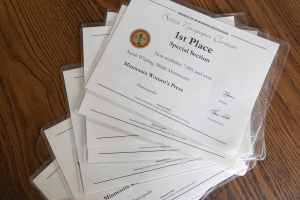 For 2025 coverage, Minnesota Women’s Press earned a community leadership award, three photography awards, and four editorial awards, including for coverage of social issues and for our Spring 2025 “Know Your Rights” special section supported by Unidos MN. Our publisher was named Journalist of the Year by Violence Free Minnesota for gender-based violence coverage.
