

Tag Archive for: health disparities
 https://www.womenspress.com/wp-content/uploads/2021/12/pie-charts.jpg
729
1200
admin
https://www.womenspress.com/wp-content/uploads/2025/09/reverse-300pxwide-1.png
admin2021-12-28 01:15:002023-03-20 18:59:42Survey Results: What Do You Fear?
https://www.womenspress.com/wp-content/uploads/2021/12/pie-charts.jpg
729
1200
admin
https://www.womenspress.com/wp-content/uploads/2025/09/reverse-300pxwide-1.png
admin2021-12-28 01:15:002023-03-20 18:59:42Survey Results: What Do You Fear? https://www.womenspress.com/wp-content/uploads/2021/11/Black-Nurses-Rock-1886.jpg
800
1200
admin
https://www.womenspress.com/wp-content/uploads/2025/09/reverse-300pxwide-1.png
admin2021-11-30 05:03:002023-03-20 18:59:44Bringing Vaccines to Reluctant Communities
https://www.womenspress.com/wp-content/uploads/2021/11/Black-Nurses-Rock-1886.jpg
800
1200
admin
https://www.womenspress.com/wp-content/uploads/2025/09/reverse-300pxwide-1.png
admin2021-11-30 05:03:002023-03-20 18:59:44Bringing Vaccines to Reluctant Communities https://www.womenspress.com/wp-content/uploads/2021/05/Hardeman-Pic-3.jpg
800
1200
Mikki Morrissette
https://www.womenspress.com/wp-content/uploads/2025/09/reverse-300pxwide-1.png
Mikki Morrissette2021-05-25 01:42:002023-03-20 19:00:42Measuring Racism
https://www.womenspress.com/wp-content/uploads/2021/05/Hardeman-Pic-3.jpg
800
1200
Mikki Morrissette
https://www.womenspress.com/wp-content/uploads/2025/09/reverse-300pxwide-1.png
Mikki Morrissette2021-05-25 01:42:002023-03-20 19:00:42Measuring Racism https://www.womenspress.com/wp-content/uploads/2021/01/Catherine-Squires.png
630
704
Mikki Morrissette
https://www.womenspress.com/wp-content/uploads/2025/09/reverse-300pxwide-1.png
Mikki Morrissette2021-04-24 12:27:362023-03-20 19:00:44VIEW: Prioritizing Black Mothers
https://www.womenspress.com/wp-content/uploads/2021/01/Catherine-Squires.png
630
704
Mikki Morrissette
https://www.womenspress.com/wp-content/uploads/2025/09/reverse-300pxwide-1.png
Mikki Morrissette2021-04-24 12:27:362023-03-20 19:00:44VIEW: Prioritizing Black Mothers https://www.womenspress.com/wp-content/uploads/2020/12/Sunflowers_44662222.jpg
340
512
Mikki Morrissette
https://www.womenspress.com/wp-content/uploads/2025/09/reverse-300pxwide-1.png
Mikki Morrissette2021-02-24 17:35:322023-03-20 19:01:46Antiracism and Health Equity Funding
https://www.womenspress.com/wp-content/uploads/2020/12/Sunflowers_44662222.jpg
340
512
Mikki Morrissette
https://www.womenspress.com/wp-content/uploads/2025/09/reverse-300pxwide-1.png
Mikki Morrissette2021-02-24 17:35:322023-03-20 19:01:46Antiracism and Health Equity Funding https://www.womenspress.com/wp-content/uploads/2021/01/Alexis-Yeboah-1-e1613791618743.jpeg
979
1195
Mikki Morrissette
https://www.womenspress.com/wp-content/uploads/2025/09/reverse-300pxwide-1.png
Mikki Morrissette2021-02-16 11:34:482023-03-20 19:01:47VIEW: Why We Need Public Health Education
https://www.womenspress.com/wp-content/uploads/2021/01/Alexis-Yeboah-1-e1613791618743.jpeg
979
1195
Mikki Morrissette
https://www.womenspress.com/wp-content/uploads/2025/09/reverse-300pxwide-1.png
Mikki Morrissette2021-02-16 11:34:482023-03-20 19:01:47VIEW: Why We Need Public Health Education https://www.womenspress.com/wp-content/uploads/2020/08/Leondra.jpeg
744
1098
Mikki Morrissette
https://www.womenspress.com/wp-content/uploads/2025/09/reverse-300pxwide-1.png
Mikki Morrissette2021-01-27 11:41:582023-03-20 19:01:48Legislative Priorities from WoMN Act
https://www.womenspress.com/wp-content/uploads/2021/01/Alexis-Yeboah-1-e1613791618743.jpeg
979
1195
Mikki Morrissette
https://www.womenspress.com/wp-content/uploads/2025/09/reverse-300pxwide-1.png
Mikki Morrissette2021-01-18 19:09:002023-03-20 19:01:50VIEW: Why Public Health and Why Now
https://www.womenspress.com/wp-content/uploads/2020/08/Leondra.jpeg
744
1098
Mikki Morrissette
https://www.womenspress.com/wp-content/uploads/2025/09/reverse-300pxwide-1.png
Mikki Morrissette2021-01-27 11:41:582023-03-20 19:01:48Legislative Priorities from WoMN Act
https://www.womenspress.com/wp-content/uploads/2021/01/Alexis-Yeboah-1-e1613791618743.jpeg
979
1195
Mikki Morrissette
https://www.womenspress.com/wp-content/uploads/2025/09/reverse-300pxwide-1.png
Mikki Morrissette2021-01-18 19:09:002023-03-20 19:01:50VIEW: Why Public Health and Why Now https://www.womenspress.com/wp-content/uploads/2021/01/DSC_7501ab2.jpg
667
1000
Mikki Morrissette
https://www.womenspress.com/wp-content/uploads/2025/09/reverse-300pxwide-1.png
Mikki Morrissette2021-01-12 12:33:232023-03-20 19:01:50Themes for 2021 Minnesota Legislature
https://www.womenspress.com/wp-content/uploads/2021/01/DSC_7501ab2.jpg
667
1000
Mikki Morrissette
https://www.womenspress.com/wp-content/uploads/2025/09/reverse-300pxwide-1.png
Mikki Morrissette2021-01-12 12:33:232023-03-20 19:01:50Themes for 2021 Minnesota Legislature https://www.womenspress.com/wp-content/uploads/2020/09/Graphic-for-rural-healthcare.jpg
365
629
Mikki Morrissette
https://www.womenspress.com/wp-content/uploads/2025/09/reverse-300pxwide-1.png
Mikki Morrissette2020-09-22 10:32:002023-03-20 19:02:48Reimagining Rural Healthcare
https://www.womenspress.com/wp-content/uploads/2020/09/Graphic-for-rural-healthcare.jpg
365
629
Mikki Morrissette
https://www.womenspress.com/wp-content/uploads/2025/09/reverse-300pxwide-1.png
Mikki Morrissette2020-09-22 10:32:002023-03-20 19:02:48Reimagining Rural Healthcare https://www.womenspress.com/wp-content/uploads/2020/07/Nafeesa1.png
747
1450
Mikki Morrissette
https://www.womenspress.com/wp-content/uploads/2025/09/reverse-300pxwide-1.png
Mikki Morrissette2020-07-06 13:21:262023-03-20 19:02:51‘Patient No More’ Addresses LGBTQ+ Health Care Disparities
https://www.womenspress.com/wp-content/uploads/2020/07/Nafeesa1.png
747
1450
Mikki Morrissette
https://www.womenspress.com/wp-content/uploads/2025/09/reverse-300pxwide-1.png
Mikki Morrissette2020-07-06 13:21:262023-03-20 19:02:51‘Patient No More’ Addresses LGBTQ+ Health Care Disparities https://www.womenspress.com/wp-content/uploads/2020/04/specializations-copy.jpg
835
1200
Mikki Morrissette
https://www.womenspress.com/wp-content/uploads/2025/09/reverse-300pxwide-1.png
Mikki Morrissette2020-03-10 11:23:132023-03-20 19:03:27A Rural County’s Response
https://www.womenspress.com/wp-content/uploads/2020/04/specializations-copy.jpg
835
1200
Mikki Morrissette
https://www.womenspress.com/wp-content/uploads/2025/09/reverse-300pxwide-1.png
Mikki Morrissette2020-03-10 11:23:132023-03-20 19:03:27A Rural County’s Response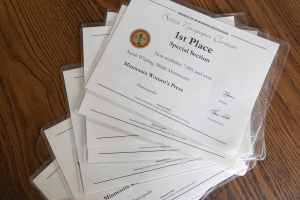 For 2025 coverage, Minnesota Women’s Press earned a community leadership award, three photography awards, and four editorial awards, including for coverage of social issues and for our Spring 2025 “Know Your Rights” special section supported by Unidos MN. Our publisher was named Journalist of the Year by Violence Free Minnesota for gender-based violence coverage.