
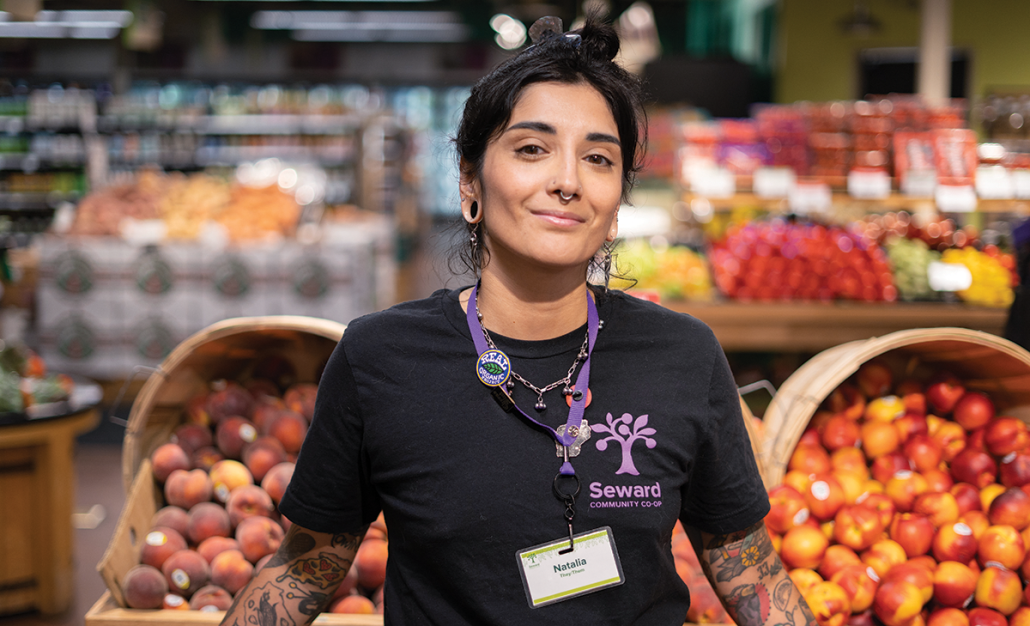
Why I Have Built My Life Around Co-op Culture
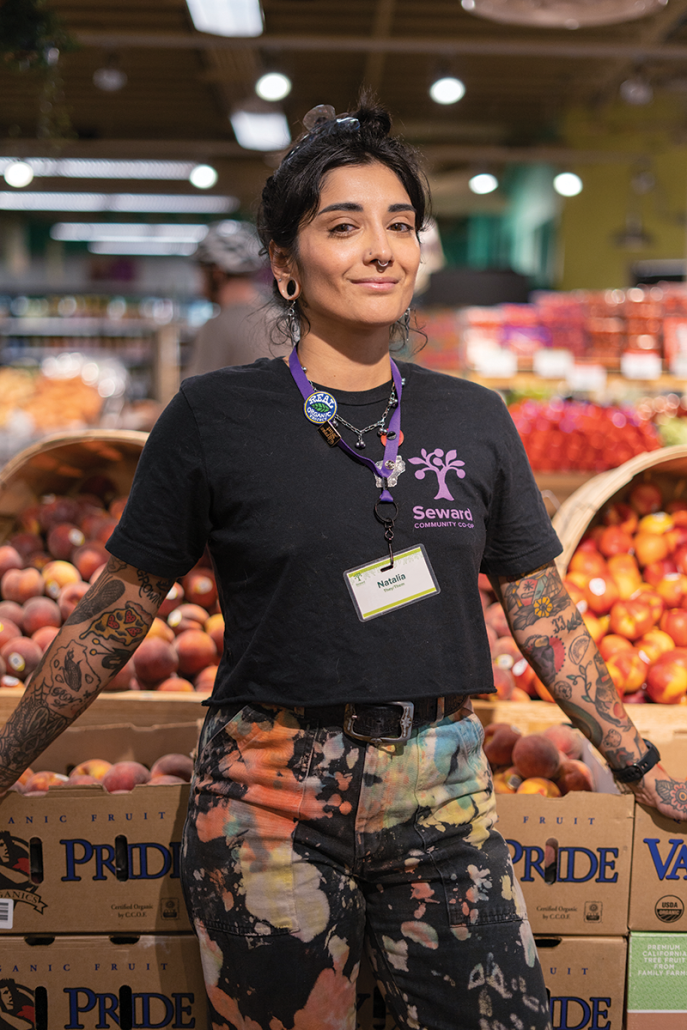
Photo Skye Rygh
I am the director of marketing at Seward Co-op, which is a full-service grocery store, deli, and community space that was created in 1972 and now serves over 25,000 households in South Minneapolis. The co-op model is a business structure rooted in seven principles:
- Ownership is voluntary and open, meaning that anyone can be an owner.
- Ownership control is democratic; everyone has one share, one vote for who serves on the board. There are no shareholders who have a larger say in how things are run or who receive a higher percentage of money out of co-op profits because they own more shares.
- Owners have the autonomous and independent choice to shop and work here.
- Education is a strong value, so we offer classes about local food systems and sustainability. We also work to educate those in community about the ins and outs of the economics of cooperation, whether that’s by uplifting local vendors, sharing information from other local businesses and organizations that align with our values, or trying to break down complex topics so more people can understand the importance of cooperation and its role in our future.
- We manifest cooperation among cooperatives — we work in conjunction with other co-ops.
- Concern for community is central. We prioritize working with small-scale local businesses that have sustainable and environmentally friendly practices as sources for the products we stock on our shelves.
- Financial accessibility is also one of our values, so for those that qualify, we offer needs-based memberships that allow folks to pay for ownership incrementally. Currently, a single Class A stock is $75. We also have an option that provides a 10 percent discount on shopping trips for a year, which can be renewed annually.



Other business structures are often owned and governed by shareholders. The profits of those businesses go to the investors. In a co-op, however, people purchase the stock in exchange for ownership and the profit belongs to those owners.
Owners can run for a seat on the board of directors, and owners each have one vote to elect those directors as well as for one vote on any special bylaws. This year, we are asking for votes on whether to raise the price of lifetime ownership — since it has been the same since the 1980s.
At this time, with businesses rolling back their diversity, equity, and inclusion programs, we’re seeing people wanting to vote with their dollars. Many are turning to — or back to — us for that.
Overall, our goal is to create a cooperative economy, which means that the people who own and democratically control each business are also the consumers of the goods and services they provide. It’s a very “for us by us” system. Although we currently exist within a capitalist system, cooperatives aim to serve as an antidote to it and strive to make decisions that will be beneficial to the community in the long run.
Every business has a different statement that motivates their decision-making, and for us that is our Ends statement: Seward Co-op will sustain a healthy community that has equitable economic relationships, positive environmental impacts, and inclusive, socially responsible practices.
This has been driving our vision of cooperation for over 50 years.
The Benefits and Barriers of Cooperation
The act of cooperation predates capitalism. Communities have always worked together to raise each other’s kids, harvest shared food, and trade. Living in community, sharing resources, and interdependence are traditional values.
The co-op system is especially valuable to people who have been marginalized and/or negatively impacted by oppressive systems of power. This is a movement that is not new. We do it without recognizing it. In the post–Vietnam War era, the Twin Cities was a hot spot for the cooperative movement.
There was controversy. The documentary Co-op Wars captures the sometimes violent struggle between two factions of the food cooperative movement: one that prioritized organic food purity, and the other that prioritized equitable food access.
There are no simple solutions to bridging the gap between the two factions, even today, which is why we offer a mix of organic and conventional products. Additionally, only certain brands and products qualify for assistance programs. In our pursuit of food access, you may sometimes see products on the shelves that are not organic, but do qualify for the guidelines of SNAP and WIC.
Annie Young was an important player in the Twin Cities. She eventually was known for working on the Minneapolis Park and Recreation Board, but prior to that, she started a buying club in Sioux Falls, South Dakota. After moving to the Twin Cities, she worked on a food distribution alliance. Ultimately, she helped build our membership, implemented our numbering system for owners, and helped us increase our price of ownership to ensure financial sustainability.
One of the things I am proud of is we value equity, which means uplifting marginalized people — whether that is their race, ability, sexuality, gender, or presentation. When we noticed that staff at our stores did not adequately reflect the communities we served, we committed to a 10-year plan for increased equity and improvement.
LaDonna Sanders Redmond is on our board of directors. She is a powerhouse in equity work and helped us turn things around. Today, 41 percent of our staff identifies as Black, Indigenous, or people of color. While this is an improvement of inclusion, we continue to look for ways to expand and advance our equity work.
Minnesota Was, Partly, Built on Cooperation
As of October 2024, Minnesota leads the nation in the number of agricultural cooperatives per state. Perhaps that has something to do with the farmers who settled here, operating within an existing cooperative structure. However, it also should be acknowledged that this is a sanitized version of history. It does not include the history of colonization and genocide of still-existing Indigenous nations that led to land grabs of this fertile farmland.
Nonetheless, this is an abundant place for farming, and there is enough for all of us. The cooperative movement economically embodies those values.
While our prices were already not too far off from some of the other big-box brands, even before the tariffs, our prices have always factored in the real cost of food, such as the farmers we work with who pay a higher wage to those harvesting crops. Some produce organic crops that may incur smaller yield and require certifications for their growing practices. We pay the people who work at our stores industry-setting living wages.
Many people already know Minnesota is a great place to live for fresh, local food access and clean water, along with our policies as a trans-refuge state. We’re beginning to see people moving here as a refuge from the effects of the climate crisis. We also have food hubs like The Good Acre, which fulfills orders for purchasers like Seward Co-op.
This is a prime example of how cooperation and interdependence work in action within our local food systems to maintain the natural order of diversity. For local farmers to thrive, there must be a demand for their products. Shopping at Seward Co-op helps sustain local food systems so that they can sustain us long-term.




 For 2025 coverage, Minnesota Women’s Press earned a community leadership award, three photography awards, and four editorial awards, including for coverage of social issues and for our Spring 2025 “Know Your Rights” special section supported by Unidos MN. Our publisher was named Journalist of the Year by Violence Free Minnesota for gender-based violence coverage.
