


What Is Happening to Our Aging Bodies? Stages, symptoms, and solutions to menopause
Women’s bodies have long been misunderstood and mistreated. The field of gynecology has a dark history that involved forced experimentation on enslaved women without anesthesia, an origin story that is rarely spoken about, according to Wendy Kline, author of Exposed: The Hidden History of the Pelvic Exam. In her book, she says, “When there was any acknowledgment at all of the enslaved patients that endured countless painful operations under [James Marion] Sims, it was celebratory [by fellow doctors] rather than critical.”
As we see today, with the rollback of reproductive rights, women’s bodies are still controlled and criminalized. That legacy extends to the stigma women can feel simply acknowledging the transitions they are experiencing in their bodies.
Despite the fact that over two million women reach menopause every year, menopause and its accompanying symptoms are still under-discussed. In a study published by the National Library of Medicine, 82.7 percent of perimenopausal and postmenopausal women surveyed said they felt stigma in regards to their symptoms. An Ipsos marketing research survey queried more than 23,000 people in 33 countries in 2022, and found the U.S. finished 20th in openness about discussing menopause.
Until recently, menopause has not been a primary topic of discussion or education even among the U.S. scientific and medical community. Jill Titze is a nurse practitioner with Herself Health, a local clinic that specializes in health care for women over 65. She recalls that her women’s health classes were primarily focused on ob/gyn “and not much time [was] spent discussing menopause. We had a women’s reproductive care class, but a lot of that curriculum focused on younger patients.”
Titze says training that covered the reproductive to geriatric stages seemed to “breeze over” ages 50 to 70. “I remember learning the various hormone phases, but there was not much time spent on the variety of symptoms or hormone management. [Yet] so much change happens in that time of a woman’s life.”



What happens during menopause?
In a typical menstrual cycle, Titze says, hormones are in a rhythmic balance. “There is a dance with estrogen, progesterone, follicle-stimulating hormone, luteinizing hormone, and others that allows for monthly cycles.”
Perimenopause typically starts about four years before menopause, with the average age being 47. Over four years, hormone shifts cause the ovaries to be less active. As this happens, there are more dramatic menstrual cycle changes or bleeding patterns, and the length of time between menstrual cycles also widens. Over time, less progesterone and decreasing estrogen result in continued ovarian follicle depletion.
“The ovaries aren’t able to mature the follicle and release the egg as the hormones decrease,” Titze says. “As this goes on, women eventually experience a change in the intervals of menstrual patterns along with different hormonal fluctuations, which is referred to as perimenopause.”
Menopause typically begins at age 51, but it can happen to women anytime during their 40s or 50s. Carolyn Torkelson, retired women’s health specialist at the University of Minnesota and author of Beyond Menopause: New Pathways to Holistic Health, says that after 12 months without a period, menopause marks the end of one’s menstrual cycles. The ovaries are not producing the same amount of progesterone, estrogen, and — to a lesser degree — testosterone that the body has been used to for the last 30 to 40 years.
In a 2021 New York Times article, “We Need to Know How Menopause Changes Women’s Brains,” Lisa Mosconi, director of the Women’s Brain Initiative, says that many symptoms of menopause are brain symptoms. Brain fog, night sweats, hot flashes, skin and hair changes, and weight gain are not directly caused by the ovaries, but are an attempt of the body to balance itself after hormonal changes begin.
“It’s really important to recognize that menopause is a natural, biological process,” Torkelson says. “It’s not a disease, but a transition to a new time and a new kind of re-gearing of your body, mind, and spirit. … With the loss of hormones, our body is trying to rebalance.”
Unsatisfactory sleep, high stress, and negative mental health can lead to more lasting issues if not monitored or lessened. Another common concern associated with menopause is weight gain, specifically in the thighs and abdomen as the body shape changes.
Why is depression common?
Titze says, “It is thought that the hormonal changes specific to menopause may also decrease serotonin, which is a chemical involved in regulating mood.”
She also points out that it can be difficult to maintain emotional health during a time that might include caring for aging parents, preparing for retirement, and having children away from home and establishing separate lives. Some women find balance with support from family and friends while managing stressors. Others occasionally feel blue or anxious. Still others, Titze adds, might have persistent chemical imbalances leading to major depression.
Other signs of persistent depression include irritability, loss of interest in regular activities, low energy, sadness, and decreased sex drive. In these cases, antidepressant medications can be helpful.
The controversy around hormone therapy
More than two decades ago, a large-scale study created concern that hormone therapy increases risks of certain cancers and cardiac events. Since women have roughly a 10 percent chance of developing breast cancer during their life, there is concern by some people that hormone therapy could increase that already-high risk.
Torkelson indicates that “research from the Women’s Health Initiative shows that hormone therapy is a safe treatment option, if it’s done at the time of menopausal transition.”
Peter D’Ascoli, former medical director for Planned Parenthood and retired ob/gyn, indicates that the original study was flawed because it gave estrogen to women who had already been through menopause, testing its impact on the cardiac system. Hormone therapy, he suggests, should begin with menopause, not 5 to 10 years later.
D’Ascoli participated with Torkelson and others in a 2023 Minnesota Women’s Press event about sex, aging, and menopause, where he indicated: “My usual take on it is that if someone’s mother has osteoporosis, they should be taking estrogen, because it gives you stronger bones. But if they have a mother who has breast cancer, I think probably not. That’s a simplistic way to look at it.”
Inclusive LGBTQ+ practice
Kate Vaske-Wright, of Family Tree Clinic, acknowledges that “finding inclusive care for folks who identify as LGBTQ+ is very challenging. We also know that not all people who experience menopause identify as female; trying to have their needs met in a medical setting can become a difficult or traumatic experience. Taking a comprehensive sexual history without presuming someone only has a certain type of sexual partner is crucial to creating an inclusive practice. We have to start by honoring the identity of the person to truly provide inclusive and impactful care.”
She notes that gender-affirming hormone therapy shares similarities with menopausal hormone therapy. “There is a lack of research regarding aging and the use of gender-affirming hormone therapy,” Vaske-Wright says. “However, medical professionals can recognize that for patients who identify as transgender or nonbinary and were assigned female at birth, they may have more unique needs as they approach menopause. There is a possibility that these folks may have heightened feelings of gender dysphoria if they begin to experience new menopausal symptoms, and these feelings should not be ignored. Checking in and assessing mental health is key.”
Why does vaginal dryness occur?
Genitourinary syndrome refers to a group of symptoms associated with vaginal dryness. The estrogen deficiency in perimenopause and menopause leads to decreased blood flow, which impacts normal lubrication and sexual function in menopausal women. This also can cause urinary incontinence or painful urination, or recurrent urinary tract infections.
For some women, Titze says, these symptoms can be mild, and for others it can be significant. In the cases of problematic vaginal dryness, low-dose topical estrogen can be effective in managing symptoms.
Why does brain fog occur?
The “Let’s Talk Menopause” website features an interview with Dr. Neill Epperson, a noted researcher focused on brain and reproductive health. She indicates that as neurochemicals shift, it is common for women to feel they’re “not themselves” or that they’re “going crazy.” Strategies or medication can ease this transition, such as cognitive behavioral therapy, taking stimulants, working with a sleep specialist, and hormone therapy.
What can happen to skin and hair?
Dr. Stephanie Faubion is a Mayo clinic doctor and medical director for The North American Menopause Society who is developing deeper clinical research and a database to further understanding of menopausal issues and long-term health care. In a New York Times article titled “How to Recognize and Treat Perimenopause and Menopause Symptoms,” she said that women lose about one-third of the collagen in their skin during menopause. Women can lose hair, grow new facial hair, and have overall dryer skin. Hair loss also can be caused by vitamin deficiencies or thyroid abnormalities. Treatments include taking a daily multivitamin or checking thyroid hormone levels.
How can sleep be impacted?
Titze says up to 40 percent of women in early menopause and 46 percent of women in late transition will experience sleep problems. Some women experience sleep disturbances related to depression and anxiety or hot flashes. Prolonged sleep disturbance further exacerbates depression and can also cause decline in cognition.
Why do hot flashes and night sweats happen?
Titze says, “The hallmark symptom of menopause transition is hot flashes, a vasomotor response to decreasing hormone levels. As estrogen secretion starts to decrease, women can have mild hot flashes. These symptoms can become more common or dramatic during the years of menopause transition, as hormone concentrations continue to decrease.”
She says available research suggests hot flashes occur when decreased estrogen levels cause the body’s thermostat —the hypothalamus — to become more sensitive to slight changes in body temperature. When the hypothalamus thinks a body is too warm, it starts a chain of events to cool down: a hot flash. Night sweats are the equivalent of hot flashes, described on the Let’s Talk Menopause website as the product of constrictions and dilations of blood vessels. Waves of heat around the head, neck, and chest are often accompanied by a racing heart.
For many women, Titze says, these symptoms will diminish and stop within a few years, but some women can experience hot flashes for 20 years after their final menstrual period. Available treatments offer relief, not a cure.
How can women navigate longer postmenopausal life?
Women live longer lives after menopause than they used to. With that comes a longer time without the regulatory function that ovaries play during the reproductive years.
D’Ascoli said at the 2023 event: “Women who have estrogen or are perimenopausal rarely get heart attacks. Men start to have heart attacks around age 50. Women usually start later in the 60s, because that’s when the protection that was there goes away.”
Torkelson encourages women to “do self-care to figure out ways to dampen your stress response, so that every time you have a hot flash, for example, you don’t just flare into this state of fight or flight that triggers your stress and makes everything worse.” She recommends experimenting with meditation, exercise, acupuncture, traditional Chinese medicine, use of herbs, or hormone therapy.
Kimberlee Reece, a licensed acupuncturist and Chinese medicine practitioner at NE Wellness, said at the event, “There are studies that women from Asia experience fewer menopausal symptoms, and they believe it’s due to eating soy from a young age, and dietary and herbal remedies they’ve passed down from generation to generation.”
Reece added that we also need to recognize the value of rest. “I think that so many of us still think we have to go go, do do, produce produce,” she said. “A big part of menopause is working on our tired adrenals. This is really a time to slow down. Treating menopause is not trying to eliminate the symptoms — we’re just trying to smooth them out a little.”
At the same event, Zeynep Tuzcu, founder of Evren Chiropractic, said: “I work with folks who are dealing with persistent headaches, which can come with hormonal changes and drops in estrogen. We see certain areas of the body that carry more tension. Integrative care is about doing a better job of working together with other providers who may not treat the same way, knowing that we all have the same goal of helping the individual become well and that none of our methods of treating are the only way.”
Resources
“Exploring Sex and Aging” article from Minnesota Women’s Press event
“Insights About Menopause and Aging Bodies” from Minnesota Women’s Press event (New York Times)
letstalkmenopause.org @letstalkmenopause
How to Recognize and Treat Perimenopause Symptoms (New York Times)
Why everyone needs to know more about menopause during the pandemic (Washington Post)
We Need to Know How Menopause Changes Women’s Brains (New York Times)
blackgirlsguidetosurvivingmenopause.com
Study of Women’s Health Across the Nation (SWAN)
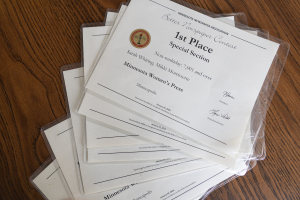 For 2025 coverage, Minnesota Women’s Press earned a community leadership award, three photography awards, and four editorial awards, including for coverage of social issues and for our Spring 2025 “Know Your Rights” special section supported by Unidos MN. Our publisher was named Journalist of the Year by Violence Free Minnesota for gender-based violence coverage.

