

What I Wish Were Different for Survivors Like Me
We are seeking an underwriter to support our Violence Prevention series.
We spoke with a woman in Greater Minnesota who has survived domestic abuse over many years. She wants people to understand why leaving is rarely one clean moment, what makes it difficult for survivors to leave and stay safely gone, where the systems meant to protect families can fail, and what survivors and their children need in order to rebuild and remain free.

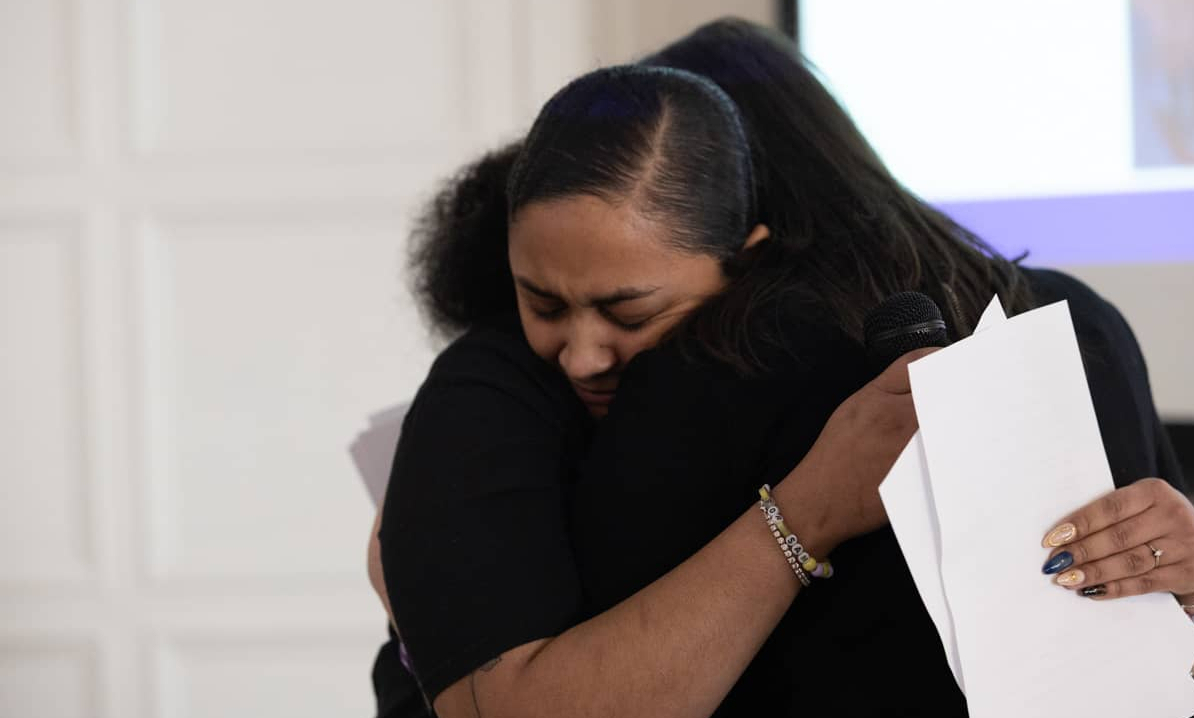
Lucy and family courtesy photo (enhanced image)
For 16 years, I have lived inside the answer to a question survivors hear all the time: “Why didn’t you leave?”
The truth is, I did leave. More than once.
Leaving was never one clean moment where I packed a bag, shut a door, and suddenly became safe. I left and came back. I left again. I stayed with family. I sat in parking lots with children in the car and nowhere stable to go. I tried to work, finish school, raise my children, find housing, survive court, and figure out whether the next decision I made would protect us or make things worse.
The question I wish people would ask is not, “Why did you go back?” It is: “What was missing that would have made it possible for you and your children to stay safely gone?”
That is the part people do not always see. Getting out and staying out are two different things.



When I was younger, I did not have my own vehicle. Transportation was something he controlled. If we argued, he could refuse to take me somewhere, strand me, or make me feel like I had to earn the right to go anywhere.
Later, housing became another form of control. Money became control. The children became pressure. Court became pressure. Even the systems that were supposed to help could become another place where I had to defend myself.
There were times I called for help and still did not feel protected. I watched accountability soften when his family’s connections to law enforcement were involved. I learned early that asking for help could create new consequences after everyone else went home.
Fear is not only fear of being hit. Fear is calculating what happens after the police leave, after the order is filed, after the court hearing ends, after the advocate goes home, and you are still the person who has to live with whatever comes next.
One of the clearest examples of why leaving is not simple happened when I left with my children after I believed he had been drinking and driving with them. I took the car and left because I was afraid for them. He was a cosigner on the vehicle, called police, and reported that I had unlawfully taken it.
I was trying to get my children out of an unsafe situation, and I was the one explaining myself to law enforcement.
That is what coercive control looks like. It is not only what happened behind closed doors. It is the constant knowledge that housing, transportation, money, family relationships, police contact, and court could all be turned into pressure.
I left after assaults. I left after threats. I left after watching my children become afraid of their father. I also went back at times because I did not have a stable place to land.
In 2017, after my father lost his job and that home became unstable for us, I was homeless with four children. I remember crying in a gas-station parking lot with them in the car. Their father offered temporary housing. I knew it was not where I wanted to be. I knew it was not safe. But I was also in family court. I was afraid my homelessness would be used against me. And I had children who needed somewhere to sleep.
From the outside, that decision can be simply summarized as: “She went back.” From inside, I was choosing between unsafe options.
I was not choosing abuse. I was choosing which danger I thought I could survive. That is the difference I want people to understand. A survivor can be ready to leave and still not have the infrastructure to remain gone.
A shelter bed for a few nights is not the same as stable housing. An advocate’s phone number is not the same as having someone beside you when the next motion is filed. Having a job does not mean you can afford a lawyer. Having family does not mean there is room for you and several children. Having a court order does not mean fear dissipates.
By 2023, after years of escalating abuse, the final break came after he held our oldest daughter underwater. I continued living in the house until his arrest, and then the children and I were forced to rebuild again.
Even then, safety did not arrive at once. It took almost a month to get an Order for Protection in place, even with advocacy support. During that same period, I was dealing with a criminal case, family court, housing instability, and trying to keep my children functioning. I lived temporarily with my mother and sister.
Eventually, we found a home of our own. When my children walked in, they kissed the floor and said: “We’re free.” I will never forget that.
Freedom was not dramatic. It was simply having a space that nobody could threaten to take away during an argument. It was knowing where we would sleep that night. It was having an ordinary life — and having an ordinary life felt unbelievable.
But leaving his house for good did not end the control. Some of it moved into the legal system. There were emergency motions asking the court to order us back into his house. There were accusations, subpoenas, records requests, financial disputes, and filings I had to answer while working and parenting.
At one point, I was ordered to pay attorney’s fees while he was not paying child support. A separate conciliation-court claim sought $15,000 from me. My employment, educational, financial, and therapeutic records have been pulled into litigation.
Even after his parental rights were eventually terminated, he and members of his family continued appearing at school activities, concerts, and sporting events involving the children.
In the past year, when I have reached out for help again, I have been repeatedly told that what was happening did not meet the threshold for protection. Other organizations did not have enough funding or resources to help.
More than one person suggested that the safest option might be for me to leave Minnesota. That is one of the hardest truths for me.
After surviving abuse, rebuilding a life, finding housing, building a career, and creating stability for my children, the answer should not be that we have to abandon our community to stay safe.
The system fails survivors when it only recognizes danger at the moment of crisis. Safety has to last longer than the emergency.
What I Want to See in a New System
What would have mattered earlier in my life is what I believe survivors still need now:
- stable transitional housing that actually works for families with several children;
- transportation that cannot be taken away as punishment;
- financial help that lasts long enough for a survivor to stabilize;
- affordable childcare;
- trauma-informed mental-health care;
- legal representation that does not vanish the moment a person earns slightly too much for legal aid.
Survivors need representation, not just referrals. We need court navigation so that a traumatized person is not expected to become her own attorney. We need help understanding deadlines, filings, evidence, and what happens next.
We also need legal systems that recognize repeated litigation, records requests, financial claims, and retaliatory allegations as possible coercive control instead of treating every filing as though it exists in isolation.
Public-benefit systems need safeguards too. A survivor’s access to housing, medical care, school supports, meals, or therapy should not be destabilized because someone knows how to make an allegation and force another investigation. Agencies need training to recognize when systems themselves are being used as weapons.
Domestic-violence organizations need enough funding and staffing so people are not turned away when they are finally ready to ask for help. Conflict-of-interest protections need to be strong enough that an abuser’s family or legal connections cannot close off the resources a survivor needs.
And the systems have to communicate with one another. Courts, law enforcement, schools, advocates, housing programs, and legal-aid organizations cannot keep handing survivors from one door to another and calling that support.
Success should not be measured by whether a woman left once.
- Ask whether she is still safely housed six months later.
- Ask whether she can afford representation.
- Ask whether her children can sleep without fear.
- Ask whether she has transportation, childcare, food, and a safe place to land if something goes wrong.
- Ask whether the person who harmed her is still able to reach into her life through court, money, records, family members, or public spaces.
I am still living the after.
Some days I work all day, parent all evening, and spend the night organizing records or responding to something I never asked to be part of.
Some days I cry. Then I get up because my children still need breakfast, school, rides, laughter, reassurance, and a mother who keeps showing them that life can be different.
There is glory in the after, too. It is not movie glory. It is peace. It is education. It is a career. It is children who can come home and exhale. It is making plans for the future instead of planning around someone else’s rage.
I do not want another survivor to have to build an entire safety system by herself. Please stop asking, “Why did she go back?” As a collective community, let’s all ask: “What made staying away impossible?”
Then let’s build that.
To support our Violence Prevention series:




 For 2025 coverage, Minnesota Women’s Press earned a community leadership award, three photography awards, and four editorial awards, including for coverage of social issues and for our Spring 2025 “Know Your Rights” special section supported by Unidos MN. Our publisher was named Journalist of the Year by Violence Free Minnesota for gender-based violence coverage.
