


What I Have Been Doing in “Retirement”
 For me — an introvert with a career in information systems, more comfortable with technology than people — the decision to run for Winona County commissioner required a major transformation.
It started after I retired from General Mills in 2013 and was invited by a friend to join a local advisory committee that oversees county parks. An official in the area told us not to talk about climate change, since he believed it was a hoax, and threatened to eliminate the committee if we didn’t comply.
Although I lacked many of the skills I thought elected officials should have, this incident sparked something in me. If I was an elected official, I could — at a minimum — make decisions based on the best data and information I could gather, and not based on ideology. I would strive to treat other community members with respect and honesty, as I would like to be treated.
I was not ready to run for elected office, but believed the principles of evidence and inclusion belong in local government. I was appointed to the local county planning commission and was again surprised to find frequent dialogue based on ideology and intimidation.
Two years later, when my county commissioner decided to retire and asked me to run for his seat, I said yes.



In 2017, I attended campaign lessons offered by the Wellstone Foundation and learned that door-knocking is the single most cost-effective strategy. I committed to go to all 3,000 doors in my district.
Remember, I’m an introvert. I didn’t know if I could do it. I told myself that making it to every door would be sufficient — a victory for me, regardless of whether I won the election.
That 2018 summer of door-knocking changed me. I didn’t enjoy it, and I don’t think I’m a very good “politician,” but I found that being authentic is good enough and I accepted that. I won the election in 2018, and again in 2022 with the same strategy.
Now I am in my seventh year as a county commissioner. The principles of evidence and inclusion have gotten me through the pandemic, lawsuits, passage of controversial items, numerous budget decisions, and the most difficult part (for me): campaigning.
I’ve learned that Minnesota county commissioners are extremely important. Minnesota is one of only 11 states in which the county government administers funds for human services and public health. Frequently, the state or federal government fails to fully fund things like disability services, treatment for mental health and substance abuse, or staffing to make sure people who are arrested get social services. It is up to the county to make sure that work gets done, regardless of state and federal funding — which falls onto the local property tax levy. Making sure that my neighbors get the services they need is my responsibility.
 Personal pitch: Can you also share your skills in public service? Run for office, or serve on a local advisory committees. Being a “politician” was never what I planned to do. And it certainly is not what I expected in my retirement.
But you might find, as I did, that it is important to bring your own principles to governmental decision-making in your community — important enough that you can overcome whatever obstacles hold you back.
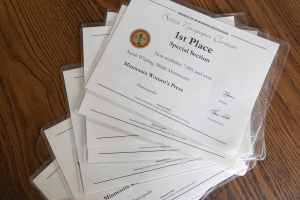 For 2025 coverage, Minnesota Women’s Press earned a community leadership award, three photography awards, and four editorial awards, including for coverage of social issues and for our Spring 2025 “Know Your Rights” special section supported by Unidos MN. Our publisher was named Journalist of the Year by Violence Free Minnesota for gender-based violence coverage.
