


What Happens When We Tell These Stories Wrong, or Not At All?

This story sharing made possible by the donations of Bill and Michelle Pohlad, as well as long-time supporter Kristin Siegesmund.
 As Communications Senior Manager at Violence Free Minnesota, I read dozens of articles a week about domestic violence in our state. I often see victims’ lives and stories presented with context, nuance, and sensitivity, but I also see their deaths presented in ways that insult their memories.
Men murdered by their new girlfriends’ jealous exes are framed as “rivals.” Older women murdered by their husbands are assumed to be chronically or terminally ill and therefore the homicide might be dismissed as a kind of mercy killing. Trans victims are deadnamed and misgendered, their humanity cast aside by blatant discrimination. Through these reactions and narratives, we can see whose lives are considered by some as valuable and whose are not.
Within the past several years, and indeed since January, we have witnessed an explosive rise in misogyny in both virtual and in-person spaces.
This results in wall-to-wall news coverage that is rarely explored with nuance, from the mass rapes of Gisele Pèlicot to many women’s experiences of highly-minimized domestic violence. We are seeing stories about the proliferation of AI technologies that enable disturbing sexually exploitive images of women and girls.
We are living within an ecosystem in which domestic violence is portrayed as a “little fight with the wife” even as the manosphere continues to be a serious threat to the lives of women and girls. Black women and girls in particular are subjected to the intersections of racism and misogyny — their experiences of gender-based violence dismissed, ignored, and mocked online. I have read horrific, stereotype-laden news coverage surrounding Megan Thee Stallion, fka twigs, Cassie, Keke Palmer, and Rihanna.
One story sticks with me, and is emblematic of the work ahead of us. Several years ago, Irwin Jacobs killed his wife Alexandra Jacobs and then himself. A few days later, on the front page of a statewide media outlet, was an article that devoted four paragraphs to his career and accomplishments alongside a smiling business photo. There was no photo of Alexandra, who was granted two short sentences about her life, both of which reduced her identity solely as his wife and the mother of his children. We learned later that Alexandra was a passionate advocate for people with disabilities and a talented painter.
We must transform how we tell the stories of domestic violence.




The annual memorial for Minnesota lives lost in 2025 from domestic violence will be held January 30, 2026, at St. Paul College Club.
Victims and survivors read media stories about domestic violence. So do their loved ones, policymakers, people in law enforcement, health care professionals, social workers, and the general public. People who are causing harm in their relationships read and hear these stories as well. Media narratives have a profound impact on readers’ understanding of this social issue that annually affects thousands of Minnesotans.
Media reporting exists in an ecosystem held together by individuals and institutions, all operating together to influence policy, practice, and public understanding. The outcomes of this influence can be devastating — or, if we work on it together, they can positively shape a better future.
For more than 35 years, Violence Free Minnesota has documented the domestic violence homicides of Minnesotans and memorialized their lives in our annual Intimate Partner Homicide Reports. We are a statewide coalition to end relationship abuse, and the only entity in the state to capture the full scope of these deaths. We know how impactful media reporting on domestic violence can be.
Inadequate Media Coverage
Media is part of a system, as is health care, education, and civil and criminal legal justice. Each system carries a set of principles, practices, and policies, and holds the power to either challenge misinformation and stereotypes, or perpetuate them. Media can confront biases or replicate them.
One area media bias is particularly noticeable is in the less frequent and less respectful coverage of the disappearance and murders of women of color — particularly Black and Indigenous women — as well as women who are disabled, immigrants, elderly, or LGBTQ+ individuals. When the media we engage with is biased, we lose out on critical opportunities for education and prevention.
For the past few years, Violence Free Minnesota has partnered with the Minnesota Coalition Against Sexual Assault and media outlets to transform media narratives around relationship abuse. Our efforts include:
- drawing attention on social media to problematic reporting
- creating a media guide for journalists
- training local and statewide media institutions
- inviting journalists who have caused harm into conversations about accountability and improvement.

 We also believe it is imperative to uplift the many wonderful journalists whose work is central to our mission to end relationship abuse, which is why we recently introduced our inaugural Journalism Awards. This year, Mikki Morrissette, Editor/Publisher of Minnesota Women’s Press, won for Journalist of the Year. Corey Schmidt, Government Watchdog Reporter for the St. Cloud Times, won for Article of the Year.
Ending domestic violence in Minnesota requires powerful, sustained change from every system. We encourage media outlets to become familiar with their local domestic violence agencies and to include hotline numbers in articles; to seek out training on ethical reporting; to read Violence Free Minnesota’s media guide; and to pursue a deeper understanding of the implicit messages that lie beneath each written word. We particularly ask outlets to engage in ongoing work to disrupt reporting that erases, dehumanizes, and dismisses the lives and experiences of 2SLGBTQIA+, immigrant, BIPOC, disabled, and older victims and survivors.
As a speaker at a recent conference I attended noted, “There is story-telling, and then there is story-taking.” As individuals, communities, and systems, and as a state, we can come together to tell the stories of those we’ve lost to domestic violence, and those who have survived. If we accomplish this, we move closer to our goal of ending relationship abuse for good.
 Action = Change
Notice how narratives minimize the impact of abusers

Share tips

Resources
High number of pregnant women killed
- Minnesota Missing and Murdered Indigenous Relatives Office
- Minnesota Missing and Murdered Black Women and Girls Office
- Preventive Press: Violence Free Minnesota’s Media Guide
- The Sexual Assault Advocate’s Guide to the Media, Communications, and Public Relations: Minnesota Coalition Against Sexual Assault’s Media Guide
- Behind the Scenes of a Partnership to Change the Media Landscape in Minnesota: A podcast episode hosted by the National Sexual Violence Resource Center with guests from Violence Free Minnesota and the Minnesota Coalition Against Sexual Assault
- MN 24/7 Day One Hotline
- Call: 1.866.223.1111
- Text: 612.399.9995
- Email: safety@dayoneservices.org

A Few Samples of Everyday Stories


To support our unique media coverage about gender-based violence:


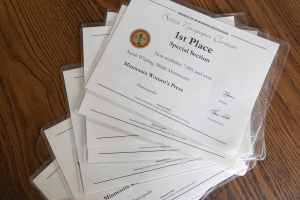 For 2025 coverage, Minnesota Women’s Press earned a community leadership award, three photography awards, and four editorial awards, including for coverage of social issues and for our Spring 2025 “Know Your Rights” special section supported by Unidos MN. Our publisher was named Journalist of the Year by Violence Free Minnesota for gender-based violence coverage.
