

COMMENTARY: What a Fentanyl-Free America Means to Me


In July, I attended the Community Anti-Drug Coalitions of America (CADCA) Mid-Year Training Institute in Orlando, Florida — a midyear summit designed to focus on drugs. Training sessions improve baseline understanding to take home to communities, coalitions, and organizations.
In partnership with the Drug Enforcement Administration (DEA), this summit was the first year to specifically discuss fentanyl. I attended as a youth member on behalf of the Fentanyl Free Communities Foundation, based in Minneapolis. Prior to this, I had been involved as an advocate for drug education, opioid awareness, and legislation for two years.
At the event, I was asked to consider and explore what a fentanyl-free America means to me, as someone who has grown up in the midst of this public health crisis. Although I had learned so much about the topic through my own research and experience pushing for Minnesota legislation, I realized there was more involved in giving an answer to this question.
The truth is, there is no such thing as a fentanyl-free America. There is no world in which this drug access does not exist — only a world in which our youth are educated, our communities are prepared, and our government is there to protect us.
As a younger teen, I worked as a nursing assistant for two years. I learned firsthand why opioids are vital to those who are prescribed it in correct medical practices.



According to the DEA, fentanyl has remained the top drug threat in the U.S., surpassing even deaths from alcohol. It is usually trafficked in powder form, but counterfeit pills are available and complex.
Since 2019, more than 638,000 people have died from fentanyl poisoning. The rise of synthetic opioids has increased the difficulty of controlling this issue. The emergence of synthetic and mixture drugs have vastly outpaced regulatory efforts.
Drugs like Nitazenes, Cychlorphine (synthetic opioids), Xylazine, and Medetomidine (used by veterinarians to sedate animals) are in the market.
What should be prioritized in the fight against fentanyl is youth involvement prevention and education. The involvement of young people is the key to maintaining consistent awareness.
A strong advocate in this fight said, “You cannot save someone who doesn’t want to save themselves.” In other words, we need to give people the tools to protect their own lives.
Fentanyl Should Be a Nonpartisan Issue
During the 2026 Minnesota legislative session, I worked closely with many different bills as an intern. I solidified in my belief that, regardless of backgrounds and political leaning, we can and need to work together to find middle ground in order to co-create real change.
At the national summit, with the governmental DEA as partner, the event had a faith-based approach to addressing addiction and recovery — rather than generalizing to fit all attendees, many of whom were not religious.
One of the biggest reasons individuals abuse drugs are because our current systems are failing them. Marginalized individuals are more likely to be targeted and fall into paths of substance abuse.
Some of my experiences at the summit made me think about how much continued systemic disinvestment is changing our country.
I have hope, however, after attending this conference. I made connections with so many promising people who will not stop fighting for what they know is right.
My answer to the question I was asked about what a fentanyl-free America looks like is, to me, about peace. I believe we can develop collective understanding in the U.S. that is a force of change.
I believe our love is stronger than our fear, our persistence is stronger than our hate, and there is a future to look forward to.
We cannot assign story development to our Future Forward editorial team without financial support:

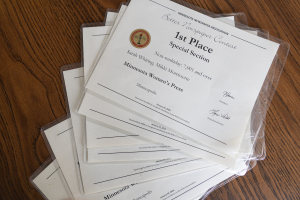 For 2025 coverage, Minnesota Women’s Press earned a community leadership award, three photography awards, and four editorial awards, including for coverage of social issues and for our Spring 2025 “Know Your Rights” special section supported by Unidos MN. Our publisher was named Journalist of the Year by Violence Free Minnesota for gender-based violence coverage.

