

Voices of Energy, Land, and Justice


Photo Sarah Whiting
Margaret Cherne-Hendrick: chief executive officer, Fresh Energy
Minnesotans are well known for their dedication to civic engagement and public service, especially when it comes to taking on the climate crisis. This is one of the many reasons that my wife and I knew Minnesota was the right place for us to start a family — but also the right place for me to continue building my career fighting for science-based energy policy to combat climate change.
In 2018, I joined the team at Fresh Energy — a Minnesota-based clean energy policy nonprofit that has made an outsized impact on our state’s energy landscape over the past three decades. In 2025, Fresh Energy’s board of directors hired me as the organization’s new chief executive officer, a role I’m honored to hold. But, as most of us know, I’m stepping into this job in the midst of a climate crisis, which is exacerbated by a federal government steeped in climate denial.
When it comes to fighting the climate crisis, the changes we make by 2030 will have a monumental impact. A data-driven approach is at the heart of the work. Fresh Energy is continuing to build upon its nearly 35-year legacy by strategically advancing effective, nonpartisan, and equitable energy policy across five key climate-change areas: electricity, buildings, transportation, heavy industry, and agriculture. We know that by crafting energy policy across these five sectors, we can help prevent the worst impacts of climate change.



We are advancing climate and clean energy policies that improve public health, lower the cost of the electricity, and boost our state’s economy with family-sustaining jobs. Even though the work Fresh Energy does is getting more challenging — as nonprofits working in the public interest are under attack — we are not faltering. In fact, we’re doubling down.
Minnesota’s climate change ecosystem is intrinsically tied to the energy that we use to power our lives. The clean energy transition — moving off fossil fuels like coal, oil, and natural gas and onto carbon-free energy like wind and solar — is the critical lever to reduce greenhouse gases to mitigate the social, economic, and environmental impacts of climate change.
Amid the federal challenges we face, I believe that advocacy at the local level has never been more important. If Washington won’t lead, then Minnesota will. We are at a time in history where states must lead.
In 2023, Fresh Energy played a role in passing Minnesota’s landmark 100 percent clean electricity law, which requires that all electricity sold to Minnesota customers be carbon-free by 2040. We must keep prioritizing ambitious, equity-centered clean energy and climate work at the local, state, and regional levels. And sometimes, like this year during the Minnesota legislative session, we know that the best progress we can make is to protect and defend the progress we’ve already made.
Our team of scientists, economists, policy analysts, and educators are working to eliminate emissions economy-wide while also making sure the energy transition does not leave anyone behind. The importance of strong state-based energy policy is more clear than ever. Fresh Energy is building coalitions among Minnesotans and tradespeople, creating policies that lay the groundwork for a clean steel industry, using data to modernize how Minnesotans think of natural gas policies, and beyond.
With the ongoing rollbacks and roadblocks to climate progress, I know it can be hard to stay positive and have hope in the future. But the momentum for fighting climate change can’t be stopped. This gives me hope.

Photo Sarah Whiting
Louise Miltich: executive vice president, Great Plains Institute
On a dark February evening, surrounded by folding chairs in a gym in western Lincoln County, I shook hands with a local farmer who had an armful of maps and papers. His trip through subzero weather to see me was not to talk about the harvest; the research he brought wasn’t about crops. He came because he saw a problem — and a solution.
He made an arc with his hand across an imaginary sky and flexed all five fingers to mimic blinking lights. “The sky shouldn’t flash like this; it doesn’t need to.”
That conversation stayed with me. This local farmer had seen the blinking lights transform the night sky as wind development grew across southwestern Minnesota — a transformation altering the elemental character of his home and community. But even though it would have been easy to arrive angry, he brought more to the table. He understood the tradeoffs wind development presented, and he had researched safety lighting used in the Dakotas that could reduce visual impacts. He brought curiosity, not complaint, to a conversation with a state regulator from the Twin Cities.
In Greater Minnesota, energy infrastructure decisions aren’t abstract — they’re personal, immediate, and woven into the fabric of land, the resources, and even the sky overhead. Getting these decisions right is central to whether we achieve a just, net-zero carbon future.
Minnesota is at a turning point in how we reduce carbon emissions and expand clean energy. Big goals are in place, from our state’s carbon-free electricity standard to ambitious public and private investments in energy and climate action. But meeting these goals requires more than new technology or policy on paper.
Most of the infrastructure that will power our net-zero future — wind and solar farms, transmission lines, carbon pipelines — will be built in Greater Minnesota. If we don’t get the siting and engagement right, we risk deepening divides rather than building the shared future we need.
Too often, rural communities, Tribal nations, and local governments are brought into the conversation late, after plans are drawn. When this happens, people feel decisions are made for them, not with them. The result? Delays, lawsuits, and broken trust that could have been avoided with true early engagement.
These communities bear the physical footprint of clean energy projects. They deserve a fair share of the benefits: resilience during extreme weather, healthier environments, lower energy costs, and local jobs. Rural equity isn’t an afterthought — it’s at the heart of climate justice.
When we talk about energy, we’re talking about daily life: keeping the lights on, running businesses, breathing clean air, drinking clean water. Clean energy infrastructure decisions shape all of this — and the impacts aren’t felt equally.
That’s why leaders who prioritize understanding how people live and what they value, before asking for their partnership in the energy transition, are important. With that foundation, we can co-create better solutions.
One of those leaders is Mary Otto at the Minnesota Department of Transportation. She started as a Tribal liaison at the Department of Commerce and now runs MnDOT’s Tribal-State Relations Training — a program I had all my staff complete when I oversaw the state’s energy environmental review unit. Understanding the history and culture of the land is essential to energy siting.
Mary’s background in education made her a natural translator. She helped me explain technical and bureaucratic processes in clear and respectful ways. She believed, as I do, that relationships must come before projects.
We partnered on early outreach for several siting efforts, including the Big Bend Wind project in southwest Minnesota. State regulators there faced the challenge of balancing wind development with protecting the Jeffers Petroglyphs — a site of deep cultural significance. Thanks to Mary’s help, a solution was forged that protected sacred ground and advanced the state’s climate goals.
Mary’s leadership reminds us that progress isn’t just technical, it is relational. That’s why I was excited to join the Great Plains Institute, whose work has been shaped by this approach for nearly 30 years. We help communities lead energy decisions that reflect not just what we build, but how we build it — and who benefits.
When rural communities, Tribes, and small towns shape energy solutions, they don’t just protect their interests. They strengthen Minnesota’s path to net zero for everyone.
This work isn’t easy. It requires courage: the courage to listen first, to sit with competing priorities, to resist easy answers. It means building relationships that last longer than one project or permit. If we care about justice — if we care about creating a clean energy future that works for all Minnesotans — we have no other choice.
The good news? Across our state, communities are already leading. They’re balancing land use, community needs, and climate goals every day. And they’re showing us that the clean energy transition can be not just faster, but fairer — if we choose to build it that way, together.

Photo Sarah Whiting
Sarah Mooradian: government relations and policy director, CURE
Each year, there are more reports of record-breaking temperatures, droughts, and storms wreaking havoc on our communities, economies, and ecosystems. We know these are the consequences of human-driven climate change and that there is an urgent need to reduce greenhouse gas (GHG) emissions to mitigate these impacts. In Minnesota, electricity generation accounts for about 20 percent of the state’s net GHG emissions. That’s why, in recent years, Minnesota has passed laws aimed at driving down GHGs from energy production. The 100 percent carbon-free standard passed in 2023 is the most recent example.
For more than 30 years, CURE has been one of the few grassroots organizations located outside the metro area, working at the intersection of climate, energy, and environmental harms from a uniquely rural viewpoint. At the core of our work is the belief that a clean energy future is one rooted in rural communities. Without the help of and investment in our rural communities and the people who live, work, and worship in them, we cannot achieve an equitable energy transition. Energy democracy guides everything we do at CURE.
Minnesota’s rural communities have a long history with energy democracy. Through the 1920s, almost all farms and rural communities lacked access to electricity. But over the next few decades, these same rural communities paved the way for a paradigm shift in energy systems by establishing rural electric cooperatives.
Rural electric cooperatives are democratically owned institutions that generate and distribute electricity to member-owners. In fact, Minnesota was home to one of the first rural electric cooperatives in the nation: Stony Run Light and Power Company, down the road from CURE’s office in Montevideo.
Today we find ourselves at another crossroads, with an urgent need to shift to new forms of energy generation, transmission, and distribution in a way that incorporates all voices. Rural communities — and rural electric cooperatives in particular — can and should lead the way in this transition. Rural people must be treated as an integral part of the decision-making process, from pre-project planning and design through permitting, construction, and operation. People must be able to take ownership of the kinds of energy infrastructure sited in their communities and determine what benefits they want to receive for hosting these projects.
Those of us who live in urban and suburban places cannot expect rural people to shoulder the burden of hosting energy infrastructure while shutting them out of the discussion and providing no protections or benefits in return.
For CURE, supporting this rural energy future involves educating the public on the basics of our energy system, renewable energy technologies, siting of clean energy projects, when and how to get engaged in proceedings before the Public Utilities Commission, and why it matters. There’s a lot of bad information, and we want to be a trusted resource for rural communities about energy issues.
Another essential part of our work is to inform those who get their electricity from a rural electric cooperative about their rights and responsibilities as member-owners. Given the unique structure of cooperatives, member-owners (customers) have a unique ability to influence what their cooperatives do. This includes voting in annual board elections, attending board meetings, or running for a seat on the board.
Like their urban and suburban counterparts, the people living in Greater Minnesota know the importance of a reliable electric grid, want cheaper electric bills, and want a brighter, healthier future for themselves and future generations. But understandably, rural people don’t want to be told that they must bear the burden of hosting energy infrastructure by those who have no connection to their communities.
We owe it to our rural neighbors to ensure that their voices and visions are sought, respected, and heeded. That is the only way to achieve a truly equitable energy transition.
Details: fresh-energy.org, betterenergy.org, curemn.org
To support our stories:


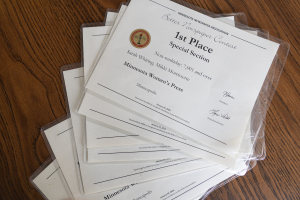 For 2025 coverage, Minnesota Women’s Press earned a community leadership award, three photography awards, and four editorial awards, including for coverage of social issues and for our Spring 2025 “Know Your Rights” special section supported by Unidos MN. Our publisher was named Journalist of the Year by Violence Free Minnesota for gender-based violence coverage.

