


Two Women Talk About Sexual Exploitation Against Palestinians and Korean Women
On October 18, Women Against Military Madness (WAMM) and Minnesota Abortion Action Committee (MNAAC) hosted a discussion in Minneapolis about imperialism and sexual exploitation, using case studies in Palestine and Korea to assert that occupation and gender-based violence are aligned. The event was organized by WAMM’s Palestine Solidarity Committee.
The speakers included Layla Zbinden, a co-author of the Palestinian Feminist Collective’s report released in June 2026, “A Predatory State: Israeli Systemic Sexualized and Gendered Violence Against Palestinians.” The report chronicles the use of sexualized violence by Israel.
Meredith Aby, the director of WAMM, talked about the use of sexualized violence by the U.S. and South Korean government during and after the Korean War. In August, Aby was part of a delegation to South Korea, which drew attention to historical sexual exploitation of Korean women. She was part of the first international delegation to join South Korea’s annual National Liberation Day protests.
A Predatory State

Layla Zbinden (submitted photo)
Zbinden presented findings from the report “A Predatory State,” which examines how sexualized violence is used as a method of occupation rather than a byproduct of war. The discussion centered on the concept of “domicide” — the intentional destruction of home spaces to eliminate generational continuity.
She said automated biometrics and AI-driven checkpoint targeting are used to track Palestinians — an evolution of Basel data collection that began by Israeli forces in Gaza nearly two decades ago.
“Israel has heavily invested money, time, and resources into developing and improving AI for the specific goal of militarization for Israel to locate and identify what they call ‘human targets’ on quicker and much larger scales,” Zbinden said. “The goal has always been how can we identify and kill Palestinians more effectively, quicker, and on much larger scales.”
In 2021, she said, Israel’s ‘First AI War’ utilized semi-automatic military robots, resulting in 253 deaths in 11 days. “This was the first time in the state of Israel that we see the scope and the potential of AI being implemented when it comes to the decimation of Palestinians,” Zbinden said.
Project Lavender, also developed by Israel, utilizes surveillance data to identify targets. She said another tracking tool — ‘Where’s Daddy’ — links individuals to their homes to facilitate household destruction. ‘Gospel’ targets power buildings. She says in less than one week in October 2023, 1,329 out of 2,687 targets were identified as building-based targets.
“Anytime we see [technological] innovation, it is framed as being a more humane, more precise, more focused method of warfare,” Zbinden said. “What we’ve seen through the expanded instances of domicide … is the goal is to make murdering people easy and make it more efficient for the state who holds the tools.”
Korean Occupation

Meredith Aby, WAMM (submitted photo)
Aby shared insights from a delegation to South Korea she was part of to learn about the impact of U.S. military bases. No formal peace treaty ended the Korean War, so the U.S. continues to maintain operational control over the South Korean military, she said. Local anti-base activists view U.S. and South Korean military installations as functionally indistinguishable.
Aby and others met with anti-base movement leaders and went to four military bases, including Camp Humphreys, which is the largest U.S. military base in the world. “We met with activists who physically place their bodies to try to block construction equipment from coming in and expanding Camp Humphreys or expanding the Gusan Air Base. People want to have control over their own land,” Aby said.
She noted that the Status of Forces Agreement (SOFA) grants U.S. personnel legal immunity, complicating justice for crimes committed against locals. “If you are a member of the U.S. military and you rape someone, or you commit murder in South Korea, for the most part, you are simply removed from the country and sent home to the United States. Most of the time, nothing will happen to you,” Aby reported.
Aby addressed the historical and ongoing issue of military-adjacent sex work, through her insights while visiting Camp Casey — a U.S. Army base located in Dongducheon, about 40 miles north of Seoul and 11 to 12 miles south of the Korean Demilitarized Zone.
“Camp Casey is a microcosm — the U.S. not only took military control of the peninsula, but took military control of women’s bodies,” Aby said.
Historically, “camp towns” like those near Camp Casey operated through bondage and organized prostitution to serve soldiers. Women were trafficked, trapped through debt bondage, and subjected to twice-weekly STD testing. Those who tested positive were given extreme doses of penicillin by U.S. Army medics at sites like the STD Management Center in Dongducheon, which can cause penicillin shock. Women were held captive for 10 days in management centers after being injected.
The South Korean government wanted to incentivize U.S. GI’s to spend their money on leave in South Korea rather than going to Japan. Eventually, these ‘comfort stations’ became 25 percent of the GDP of South Korea. In Gyeonggi Province, which is home to the majority of U.S. bases, including Camp Casey, about 10,000 sex workers were registered every year from 1953 to the 1980s. In 2022, South Korea’s Supreme Court ruled the government created and operated the camptowns and encouraged prostitution to boost troop morale and earn foreign currency.
“Women did not consent to be part of these camp towns — they were lied to. The South Korean government would set up job fairs, promising women the opportunity to be able to feed their families and to be able to earn money. Then they were put on buses. They were taken to these places and told that they now owed money, after they stepped off the bus. They were handed over to pimps, who charged women for their food, housing, furnishings . People were set up in the system that they could never get out of,” Aby said.
Current activists continue to protect sites to prevent the erasure of this history from the national narrative.
Occupation Parallels
The speakers argued that sexualized violence is not a series of isolated “bad apple” incidents, but a core, strategic tool used by occupying forces. In Korea, this manifested through the social isolation of women in camp towns, while in Palestine, it is weaponized against both women and queer Palestinians.
“[These events] are the system functioning as it has always intended to function,” Zbinden said.
Aby noted that the U.S. funds or supports occupations to meet geopolitical goals, such as using South Korea as a “dagger in the heart of China” or Israel as an “aircraft carrier” to control the Middle East. “The relationship that [Israel and South Korea] have as puppet regimes, or regimes that are propped up by the United States, is a real similarity,” Aby said.
Both Israel and South Korea have mandatory conscription, which Aby identifies as essential for maintaining an occupation. “An important part of being an occupier is that you have to have people to help you with your occupation,” Aby said.
Aby also highlighted the theme of land theft, noting how the U.S. military expansion near Camp Humphreys and Pusan Air Base mirrors Israeli actions like building walls through Palestinian olive groves and villages without legal recourse for owners. “There was no way that they could legally defend their land because they weren’t even considered the real owners of their land, even though they did own their land. The idea was that the military would trump whatever right they had to it,” Aby said.
While protesting in Korea in August, Aby was alongside South Korean student activists who petitioned their universities to cut ties with Israel. “When you are occupying, it means that you treat both the land as well as the people like you own them, that consent means nothing, and that people don’t have the right to say no — that doesn’t matter if you’re talking about land or if you’re talking about somebody’s body,” Aby said.
Action Steps
Join WAMM for their Saturday book club series and discussion of “A Predatory State” on December 5th, 12th, and 19th at 11 am at the Lucy Parsons Center.
November 7 at Stewart Park in Minneapolis, 1pm


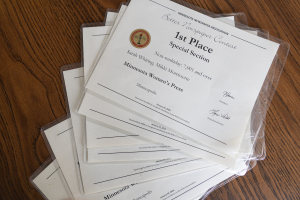 For 2025 coverage, Minnesota Women’s Press earned a community leadership award, three photography awards, and four editorial awards, including for coverage of social issues and for our Spring 2025 “Know Your Rights” special section supported by Unidos MN. Our publisher was named Journalist of the Year by Violence Free Minnesota for gender-based violence coverage.

