


Truth #3: Protecting Small Businesses and Elderly Neighbors
Minnesota Women's Press immigrant storytelling is supported by the Minnesota Council on Foundations.
During the winter 2026 ICE occupation, many businesses — small and large — were given subpoenas by the government. For example:
- The outdoor co-op REI was asked for customer transaction records to see who bought a particular dark green beanie that many people wore at anti-ICE protests.
- After ICE agents were asked to leave a patient’s room, Hennepin Healthcare worker records were seized for employment audits.
- Mischief Toy Store in Saint Paul was put through a costly business audit after providing whistles to community members
Many legal attorneys offered free assistance to help small businesses know what to do when they were hit with subpoenas — which is not a common practice.

Yusra Mohamud (photo by Sarah Whiting)
Yusra Mohamud is the founder of Yuspire, a brand strategy and business development firm. She spoke on the Somali panel at the National Convergence for Democracy panel in Minneapolis in August about the impact of the ICE occupation on small businesses.
“Pro bono work is not easy, especially during a crisis rapid response mode, when you are already doing full-time legal work,” Mohamud said. Today, she said, the biggest need of small businesses — especially those who serve or are led by immigrant community members — is economic support. “They need customers, tools and resources, technical support.”
She recognized the Salt Cure Restaurant Recovery Fund for supporting Minnesota restaurants — making available philanthropic funds to support restaurants that have been hit hard. That effort, she pointed out, was led by Minneapolis Foundation president (and former mayor) R.T. Rybak. “He was an instrumental voice.”
The Economic Response Fund has also helped, “but it’s a band-aid, which helped. But now we’re at that period where those those band-aids are off,” even though local small businesses have not yet recovered from the economic hit.
“We need to continue to advocate to support small businesses, not just in Minneapolis. Greater Minnesota was hit hard too. Willmar, Saint Cloud, Rochester, Mankato, the mining areas and their small immigrant businesses. What is needed right now is education about what small businesses can do to retain their businesses.”



Mohamud recollected the impact of the large government agent presence, including armored vehicles, that appeared in June 2025 at Lake Street in Minneapolis, which is home to many Latino businesses. City council members and legislators were called. “Everyone showed up. It was very scary. And I realized it was going to get worse — and it did.”
She noted that the emotional impact was also felt by immigrant elders who were not there. Even though their grown children were American citizens, “we were the voices, we were supporting our community, and they were afraid of us being at risk.” Adult children responded, “We have to do what we have to do because we are privileged to be able to put ourselves in that position.” At the same time, Mohamud added, “Many of us also had our own kids to worry about.”
Small business owners during government occupation are impacted in many ways, she said — economic impact on their business, as well as caring about their families and employees. “They were walking their staff to make sure they got into their cars and homes safely. And sometimes that didn’t work. Business owners and their staff were picked up. Sometimes the employee might be undocumented, but the business owner wasn’t. They both ended up in in a detention center somewhere.”
She warned that small businesses have survived the pandemic, the uprising after George Floyd’s murder by police, economic crash, and ongoing hardship. But, “businesses are not surviving this, and it’s showing. If you go into cultural malls, businesses are still down to 60 to 80 percent. Business owners have to pick up a second jobs. And then there is the impact of tariffs.”
Policy sessions that listened to testimony of small business owners did not get a strong enough reflection of the impact, she added — not enough of a full picture to pass relief measures. “My call to action is the same. Please support small businesses, not just now and for this year, but for the next 10 years. We need to fight for them,” Mohamud said.

(l-r) Fahad Mahamud and Yusra Mohamud spoke on a panel about the impact of ICE occupation in their communities and how people stepped up for elders and small business owners (photo by Sarah Whiting)
Combating Isolation and Misinformation
Fahad Mahamud was asked how to help people be less isolated in times of fear. Civic participation often shrinks naturally when people are scared, he said. “They don’t want to have a voice. They don’t want to speak up. They’re not coming to meetings.”
He grew up in the Cedar Riverside neighborhood of Minneapolis, where people often connected to chat in apartment lobbies. “That stopped happening very quickly and abruptly when ICE agents were around our neighborhood.” He and ten friends started to walk the neighborhood alongside the many East African elders who lived there, to help them occasionally get out of their apartments.
Family members would be afraid, asking: “Are you crazy? Why are you going out there? Why are you trying to protect people?” As a former U.S. military member who served the country, he said, “I was bold enough because I served this country. Why can’t I stand up for my people?”
He knew the goal of government agents was to choose between feeling safe and having a voice, “which to me is the most un-American thing I could think of.”
Mahamud and friends worked four-hour shifts to help people be less isolated. “You need to have cultural competent outreach. This was my neighborhood. So we knocked on doors. We asked people what they needed.”
“In moments of crisis,” he continued, “people appreciate you just asking them how you are doing. As someone who has suffered from PTSD [post-traumatic stress disorder], it is important to have moments of humor, cracking a joke, simply talking to somebody that you knew for years. Just doing those things can really change a person’s outlook.”
His crew made sure people knew their rights — “what they can do and what they can’t do. When people feel more confident in the way that they can go about their day, it helps them be less isolated. We should not have to choose between feeling safe and having a voice.”
Fellow panelist Malika Dahir of Reviving Sisterhood added, “I’m going to brag on my little brother a little bit, because he has done incredible work in Cedar Riverside: registering voters, combating misinformation, ensuring they get their voice out. To reiterate, a large percentage of this community are citizens. Some were being fed misinformation that you need a passport to vote, or that your ballot will not be counted. He was on the front lines, combating misinformation, not only because of his civic duty, but because of his deep belief that his service had to matter.”


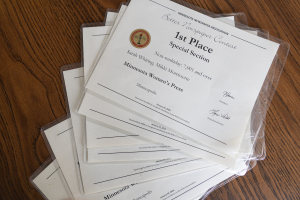 For 2025 coverage, Minnesota Women’s Press earned a community leadership award, three photography awards, and four editorial awards, including for coverage of social issues and for our Spring 2025 “Know Your Rights” special section supported by Unidos MN. Our publisher was named Journalist of the Year by Violence Free Minnesota for gender-based violence coverage.

