


Three 20-Something Women Talk About How They See Hope

Minnesota Women’s Press publisher/editor Mikki Morrissette hosted a conversation with three women in their 20s during the First Unitarian Society of Minneapolis Sunday assembly on January 12. They discussed essays they wrote for the January magazine issue about Hope & Grief. Here is a lightly adapted transcript, as well as the full video, of the conversation.
Cheyenne Wilson, Mikki Morrissette, Melissa Vasquez, Priscilla Trinh
 Cheyenne Wilson
You are author of “We Are the Evidence: A Handbook for Finding Your Way After Sexual Assault.” You wrote the book because you wanted to bring together the voices of survivors, therapists, dietitians, nurses, detectives, and lawyers. You indicated that you did start to feel hopeful about the future in the process of creating a resource that could help others. It’s a very comprehensive 300-page guide. In your Minnesota Women’s Press essay you wrote:
“When I talk with other survivors of sexual assault, I often remind them that healing mirrors the stages of grief. Recovering from trauma is in many ways a grieving process. We grieve the loss of innocence of who we were before the trauma, the future we envisioned, and sometimes even friends and family who do not offer the support we need.”
My question to you: It is common for many people who experience trauma — and I was one of those — to try to very quickly push through the pain or numb it. You were yourself in stages of denial because someone you knew assaulted you, rather than the common myth so many of us have had that it tends to be a stranger. What advice do you have for people who are in the midst of grief, related to trauma or loss, who are desperately searching for a way out of it?”
Response: “I did spend years denying what had happened. That ultimately delayed my healing process, because when we’re grieving or [have experienced] a trauma, it’s very natural to want to run away from that. It’s very natural to want to use ways to avoid dealing with it. But healing happens when we’re able to sit with the trauma and the grief. A great way to start is to educate yourself, looking at resources that are available, looking at the realities of trauma or grief. When you feel like you’re not alone, it’ll help you understand what you’re going through and why you might be acting and behaving the way you are.
Healing also happens in community after trauma. It’s tempting to isolate these feelings — thinking you are on your own, no one is there for you, no one understands what you’ve gone through. That’s natural. It is okay to take some time for yourself, but healing happens in community. If the people around you aren’t supportive at first, try finding other groups in other communities. There are even peer support groups online, in addition to doctors and therapists.
It is also important for those in your community, and those who have a loved one who’s been through trauma or loss, to educate yourselves as well. Not doing so can [unintentionally] cause more harm, as you might ask victim-blaming questions that take the blame of the trauma from the perpetrator — where it belongs — to the victim. So, educating yourself is a big step, and then keep checking in with your loved one. It’s easy to offer help once and then not offer it again. But when you’re in that dark spot of healing trauma, it can be hard to navigate what to do next — it can be hard to say yes when someone offers help the first time — so keep offering. Keep inviting them to engagements even if they’ve said no a couple times when they weren’t ready. It means the world to know that you are thought of.
Healing is a marathon, not a sprint, and that goes for the survivor as well as those supporting them. This a long journey, and there’s going to be ups and downs, but the sooner you are able to start working through the trauma, the sooner your healing can begin — otherwise that trauma festers. That grief will come up later. I denied it for three years after my assault; that’s three years of my life that I can’t get back.



 Melissa Vasquez
You are the communications and community engagement manager of LatinoLead. You wrote in Minnesota Women’s Press:
“The future I dream of is one in which we redefine what it means to belong. It’s one in which immigrant communities are empowered to build and thrive. I believe we are on the cusp of a cultural renaissance that embraces the full complexity of our identities and celebrates our presence as an integral part of this nation’s fabric.”
Question: We talk at First Unitarian Society about the differences between seeing the world with love and fear, and hope amidst the grief, and the inevitable spectrum of feelings between those emotions. We’ve also talked here about the threats of massive deportations this year. Yet your thoughts are hopeful about belonging and thriving and building and creating together, enabling people to recognize and celebrate complex identities in this country. In the work that you do, why do you see this optimism about a coming renaissance?
Response: It’s true that we live in a time where fear can feel overwhelming. The fear of deportations, of losing rights, of seeing our communities further marginalized. But I believe that hope is not the absence of fear; it’s what rises in response to it. My optimism about a cultural renaissance comes from the way I’ve seen communities like mine refuse to let fear define us. As a DACA recipient myself, and the daughter of Mexican immigrants, my existence is shaped by both grief and hope.
I’ve witnessed the pain of uncertainty, and the resilience this experience demands. But through my work at LatinoLead I’ve also witnessed a powerful shift. Latina leaders, advocates, and other community influencers are no longer asking for permission to exist or to belong. We are building spaces where we can thrive on our own terms. That is the foundation of my hope.
I see this Renaissance in the young people who are rewriting the narrative of what it means to be American — not to do away with what currently and beautifully exists, but to further accentuate our roots and our dualities. I see it in the growing recognition that our stories are essential to this country’s future. I see it in the partnerships and solidarities across communities — which are very evident here at First Unitarian Society — which remind me that our struggles are interconnected, but so are our victories.
This optimism doesn’t come from ignoring the grief or the challenges. It comes from embracing the complexities of our experiences. Grief tells us what we’ve lost, but hope tells us what’s still possible. In the Latina community, we carry both along with a deep understanding that joy and celebration are forms of resistance in and of themselves. The renaissance I imagine is one where we are not only surviving, but thriving. Where our cultures are celebrated and our contributions recognized. It’s fueled by the belief that our identities are not deficits but strengths. When I think of the future, I don’t just see the obstacles ahead — I see the generations of leaders, dreamers, and changemakers rising to meet them. That’s why I choose to see the world with love, because love propels us to act to build and to create a world where we all belong.

 Priscilla Trinh
You and I go back several years with Minnesota Women’s Press involvement. You are on our editorial board. You wrote a story in the Hope & Grief issue about the solidarity economy, highlighting that you feel hopeful seeing efforts to support unhoused people at encampments, the creation of community-owned renewable energy, Native women establishing hydroponic food sovereignty, and others. You wrote:
“All these actions indicate a cultural shift from individual efforts to community-oriented solidarity by centering the collective, and developing communal structures rooted in shared resources. We are developing a more inclusive economy with self-governance.”
Question: Similar to Melissa, you see reason for optimism, that we are shifting to a kind of cultural renaissance that is more collective and communal than what we have experienced for decades — probably since we started living in individual homes in an industrialized and capitalistic society. How do you see this community-oriented shift happening and unfolding across urban, suburban, and rural areas?
Response: I work in my 9 to-5 in food systems. I don’t have a communications degree, but I am a communications manager in STEM, which is what I love. Communicators can show how progress is being made. As an immigrant daughter, as someone who has multiple identities, we are seeing the pinch affect everyone. It’s not the first time we’ve experienced recession. It’s not the first time we’ve had sociopolitical unrest. But I think along the spectrum a lot more people are unhappy and they’re more vocal about it.
There is unifying recognition that it’s not just about money — it’s also about social and health fabrics that need tending to. The narrative is shifting. I think people are making the dots and connections a bit more. I talk to people who are right of center, trying to communicate their viewpoints, and they say very similar things — just with different words. What gives me hope is that you see this narrative merging. People are feeling the injustice affect them. I think there have been walls of privilege that have existed for a long time and now it’s starting to come down a bit, no matter what your identity is. I’m seeing people bond over struggles and bond over hope.
I talked about deep time in my article. It’s normal to have reactionary movements. People will say “it’s going to suck,” but then you step back and you say, “well it’s four years in the grand scheme of things.” I have intergenerational conversations in which folks say, “this has been going on for 20 years, you’ll be fine.” I think folks are more open about the victories and the struggles and having this long-term mindset. That’s what gives me hope, because I’m in my mid 20s and I always come back to this quote: “Hope is not mine to lose.” It really is something that all of us are involved in.
Question: We pin our hopes on the young, so I’m going to throw this question to you. One of the Minnesota Women’s Press series is about Collective Health. That’s exactly what all of you are talking — this idea of becoming much more communal, rather than relying on individuals to heal themselves. Being able to tap into the collective power around mental health and housing needs, related to gender-based violence and assault, related to the way we run our economies and our ecosystems. Being able to turn that tide so that we’re less isolated in our spaces, protective in our spaces, and get to a better sense of collectiveness — that we’re all in this together. But we also know that it’s not been an easy transition for people to make; that there’s still sort of a cultish desire to feel like somebody’s going to fix everything for us. What is it that you think has prevented us from being able to be as communal as all of you are talking about? What’s getting in the way? What are the obstacles that we have to deal with?
Priscilla: This is the Friday night conversations I have with my friends. I think it has to do with our cultural psychology. I think the healing process starts individually and then it ripples out to the community. We don’t have in our public education system — at least the one that I experienced — space to talk about mental health, to talk about how patriarchy affects all of us. This healing needs to happen first before we can tackle the greater challenges of our time.
Having the language to connect to each other as humans — having the emotional maturity to hold space for someone that’s different — is not something that was taught in school. To me, that is something I was taught through organizing, being in community with people who did not look like me.
This deep psychological, cultural undoing I think is necessary before we step into working together. Everyone just wants to feel safe. Folks are afraid of change because they’re afraid of uncertainty. When you have that safety net, I think that paves the way for cooperation and collaboration. It’s not perfect, but at least you have the tools, the facilitation, the governance skill sets, to navigate those challenges together.
I see that a lot with my brother, who is only two years younger than me [talking about his feelings]. It involves undoing a lot of learning, but once we undo, then it unravels to something much more beautiful and messy and tangled, but at least you’re not doing it by yourself.
Moderator: My son, who was home for the holidays, had a New Year’s Eve party with a lot of his buddies from high school days. The conversations they were having was so different from when I was that age. They are remarkable young men. It’s been great to see those kinds of friendships — support for each other, men talking about feelings, men talking about respect. We do need a lot more of that.
Melissa: Biculturalism and multiculturalism in general is a superpower. Innately, you’re shifting from community to community, code-switching in that way, becoming accustomed to speaking with and learning from different communities. I think that’s how bridges are established. At least among my peers, it’s not just about establishing those bridges, but also learning how to maintain them and reach across several divides. There is a different kind of consciousness that comes out of that. I celebrate it every time I encounter it. We have to keep riding this momentum.
Cheyenne: I think it continues building off what you both have already said — we have to help people see the value in community. Trauma, grief, healing all seems isolated, but that’s where sharing our stories and raising awareness really comes into play. If you think you don’t need to worry or care about “that type of trauma, because I’m a man” [or not part of an impacted] population, then you learn the realities of sexual assault — that there are people in your life who have been impacted. Or maybe you’ve denied it because you bought into myths about the realities, or the stigmas of different traumas. So, raising awareness is going to help bridge those gaps. That [includes] cities and rural areas, because we need to get the information out there to everyone. A great way to start building more of a community feel is when you get buy-in from everyone that there’s a reason to care about this issue.


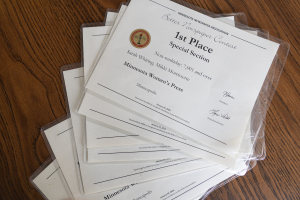 For 2025 coverage, Minnesota Women’s Press earned a community leadership award, three photography awards, and four editorial awards, including for coverage of social issues and for our Spring 2025 “Know Your Rights” special section supported by Unidos MN. Our publisher was named Journalist of the Year by Violence Free Minnesota for gender-based violence coverage.

