

The Twiggers of Central Minnesota
 My interest in art and creativity started very early. My mother was a colorist for a photographer in the days before color photography. Her easel sat on a table by the north window of our living room. I played under the table as she worked on her photos. I absorbed a fascination with visual arts along with the aromas of linseed oil, turpentine, and oil paint.
I took art classes in college and have since worked on large-scale murals, book illustrations, and a whimsical line of note cards that have traveled across the world.
In addition to working as an artist, I am a writer, gardener, herbalist, and woodsy person, as well as a fan of the stories and art of Beatrix Potter and Cicely Mary Barker. I have enjoyed Irish stories of “the little people.” During the pandemic isolation, I spent many hours cleaning up the family woodlot. Working a mundane job allows for time for creative thinking. The Twiggers came to me during that time.
Lilah as a portrait
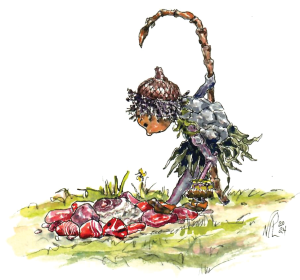
Lilah loves the tiny trumpets that make up lilac flowers. She gets to collect a few each spring, and if she dries them carefully, they hold their shape and color. She was excited in the very rainy warm year of 2024, when the lilacs bloomed again in September. Everyone she talked with agreed that it had never happened before.
Who Are the Twiggers?
Twiggers live in a wooded area of central Minnesota. The Twiggers call it a village, but that is a loosely used term, since there are no quaint houses with thatched roofs. There are no arched doorways, no mullioned windows. The land lies within five finger-hills, reaching from the upland known as the North River Road down toward the river’s flat floodplain.
Twiggers are gentle, vulnerable little people, and their best defense is simply disappearing into their surroundings. They are not interested in drawing attention to themselves by maintaining blatantly apparent roads. The exception is the agate road, created by the Agate Hunters. They’ve heard the story of Dorothy and the Yellow Brick Road. They know it leads to Oz, whatever and wherever that might be. The agate road leads nowhere, but is a delightful sight when the sun shines after a rain.
The Twigger village is a very peaceful place. Twiggers have little conflict because they work together to stay safe in a world where nearly everything is bigger than they are.
The Twiggers all have life stories to share, as well as different roles in the Twigger village. Each has been illustrated with an “authorized” portrait, and some of them have been memorialized in four books (so far) about the residents of Twigger Village.
There are more than 100 Twiggers, which have sprung from the woods around me near Long Prairie.
Community Interaction
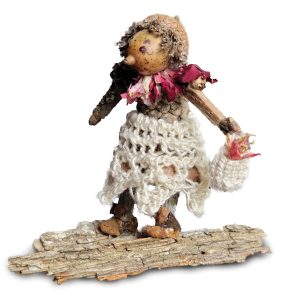
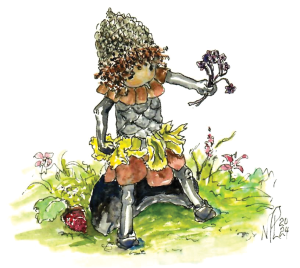
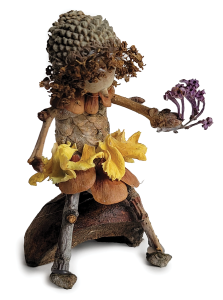
Mandy is happy that she can spend her days picking flowers. She knows a human knitter and asked for a skirt and bag. She’s delighted with her new outfit.
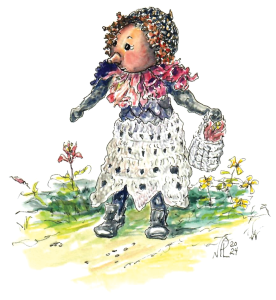
Mandy as a portrait
I was part of a cohort of artists who met regularly over the course of several months as part of a community arts project sponsored by Springboard for the Arts and the Five Wings Regional Arts Council. Each of us was a recipient of a grant that allowed for project development. I was able to give birth to twelve new Twiggers. They then went into the local community to meet people who have made local connections that have led to greater understanding.
The Twiggers who participated learned about concepts like values, goals, strengths, skills, and building relationships. That was pretty heady stuff for simple people, but they were brave, delighting humans and remaining with them to acknowledge their work to bridge diverse ethnic and cultural communities.
Twiggers Gina and Vera met humans Virginia and Jazmin to celebrate friendship. Separated by decades in age and hundreds of miles in cultural background — one born in Minnesota and the other in Mexico — the two humans found a fondness for working together on tasks and projects, which is why Gina and Vera wanted to meet them.
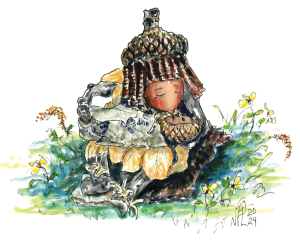
Maria and baby as a portrait
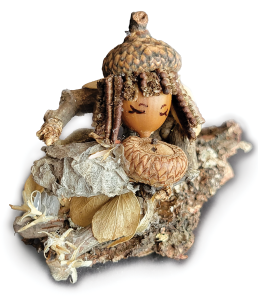
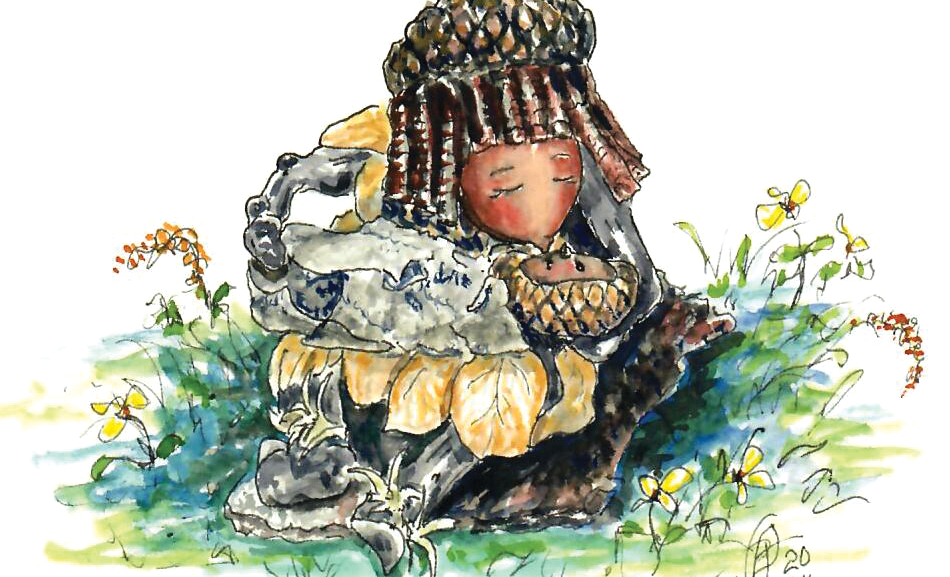
Mother and baby Twiggers usually stay hidden. It is rare that Maria grants a portrait session. She’s a very protective mother and loves her baby as much as a mother can. Honestly, baby Twiggers aren’t very cute. If you’ve ever seen one, you’ll probably agree. They’re sweet because they’re so tiny. But their faces lack definition. Give them time, though, and they cute up.
Barb, from Minnesota, and Rocio, from Argentina, assist people at difficult times in their lives through the Hands of Hope resource center. Twiggers Hibby and Mandy have been self-centered young ladies who think more of fashion than anything, but they wanted to see more of life, so they met Barb and Rocio. They thought any place with “Hope” in its name must be a good place.
Elizabeth grew up in Ecuador. Her life has taken her many places, but she has lived in Long Prairie for more than 20 years. She provides translation and other services to assist immigrants in assimilating into the community. Twigger Liza is small but loves to help her community, and wants to learn another language. She met Elizabeth at the WAVE/Saludos welcome center in Long Prairie — a place for “Welcoming Advocates Valuing Everyone” — and is learning from her. (Saludos is the Spanish translation for “wave.”)
Other Twiggers have visited, thanked, and stayed with people who provide excellent customer service at a post office, hair salon, radio station, chamber of commerce, and pharmacy.
On this month’s cover of Minnesota Women’s Press we have the tangled emotions of hope and grief, which are so often camouflaged by those who experience them. The letters for Hope consist of caragana pods, daisy seed head, birch buds, pine needles, and clover. Seed pods symbolize memories and future expectations, buds stand for potential, pine needles represent poignancy and invocations of scent, and clover is there for luck.
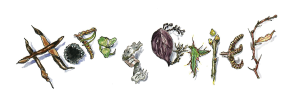 Grief consists of leaves, dried flower heads, lilac buds, birch buds, and bayberry thorns. Grief is sharp and thorny, but the buds for new beginnings are in the midst of it.
Twiggers are fragile, as are hope and grief.
If you appreciate our unique coverage:
 For 2025 coverage, Minnesota Women’s Press earned a community leadership award, three photography awards, and four editorial awards, including for coverage of social issues and for our Spring 2025 “Know Your Rights” special section supported by Unidos MN. Our publisher was named Journalist of the Year by Violence Free Minnesota for gender-based violence coverage.
