

The Singing Resistance Movement in Minnesota, Nationwide, and Historically
Coverage supported by the deep donations of long-time supporters Kristin Siegesmund and Becca Brackett.
My natural impulse is to respond to most everything in my life with song. The ‘right’ song, chant, or jingle bubbles up in me spontaneously, often emerging as a corny revision of well-known lyrics. Singing has always been a part of my being, with roots in family road trips, Sunday School, and summer camp. Singing somehow allows my emotions to come out. Music soothes my soul, energizes my spirit, opens my heart — and, if anything can bring me to tears, it’s the experience of singing with others.

Jullen Stoneberg (right corner) at a local protest. (submitted photo)
Singing was not my automatic impulse when ICE invaded Minnesota. Rage, yes. Tears, yes. But to burst into song? That was not my response.
I first learned of Singing Resistance when someone told me about a group of people walking through terrorized neighborhoods in South Minneapolis singing songs of encouragement: “We get there together or never get there at all,” “We won’t let fear divide us,”“Hold on, my dear ones.”
Soon after, in January, I witnessed these activist songsters leading the convergence of national clergy. I was hooked and joined their Signal group.
Gathering with thousands of people to march, to protest, to witness, and to share songs of solidarity — to learn, to feel, and to build community — all of this has provided me with a resilience I didn’t know I had.
To see how this movement has drawn thousands into its arms has bolstered my faith in our potential to be the change the world needs.
It has nothing to do with being good at singing, about knowing how to harmonize, or even about remembering the simplest lyrics. No auditions are required. Everyone’s voice matters. Everyone is welcomed in.
What matters is showing up and being together. Taking risks to joyfully engage in the resistance. Trusting the leaders. Breathing in and out as one community. Dreaming a world in which values of loving connection and mutual care guide who we are.
Our love for each other will carry us through.
My dear ones, let’s sing it together: Here comes the dawn.
Jullen Stoneberg is an interim minister at First Unitarian Society of Minneapolis. The lyrics in italics come from Lu Aya + Peace Poets, Heidi Wilson, Joshua Blaine, and Sarina Partridge




Singers go to the Capitol to protest the detaining of children by ICE agents. (photo by Sarah Whiting)
The Singing Movement
Singing Resistance started with a handful of people in Minneapolis days after Renée Nicole Good was killed by an ICE agent, and quickly grew from a few hundred to several thousand. Now there are more than 230 chapters around the country. A video of 2,000 bundled-up Minnesotans singing outside a Residence Inn housing ICE agents in February went viral; their message: “It’s okay to change your mind / Show us your courage / Leave this behind.”

Unidos MN executive director Emilia González Avalos (r), sings at the Capitol to protest the detaining of children by ICE agents. (photo by Sarah Whiting)
A nationwide weekend of song in February included coordinated sing-in protests at sites of ICE-related violence, including the Dilley Immigration Processing Center, where children are held.

The Singing resistance leads a group to Minneapolis City Hall, asking for rental and mortgage support to lessen evictions for immigrants who stayed home during Operation Metro Surge. (photo by Sarah Whiting)
According to an essay about Singing Resistance in Southwest Voices, the practice in part derives from Otpor, a nonviolent resistance movement that opposed the dictatorship in Serbia in the late 1990s. Otpor is the Serbian word for “resistance;” the movement was designed to encourage defection. Members of Otpor visited the homes and workplaces of police and military members to deliver the message: “You might not join us today, but you can join us tomorrow.”
They delivered that message for two years. On October 5, 2000, Slobodan Milosevic refused to concede after a lost election and ordered lethal force against hundreds of thousands of protestors. His military — which by then had connections with the protest movement — refused to shoot at their unarmed fellows. The regime collapsed within two days.

Karen Quiroz (in orange), sang in resistance at one of the Minnesota businesses that has served ICE agents. “It is important to be here because Enterprise is renting cars to ICE, and that enables them to terrorize our neighbors and our neighborhood. Whether it’s 3,000 or 150 [agents], they will still be terrorizing our immigrant neighbors and friends and people of color.” (photo by Sarah Whiting)
Singer-songwriter Brandi Carlile in March invited members of Singing Resistance to sing with her onstage at a concert in Minneapolis, which raised $700,000 for families affected by ICE actions. Joan Baez and Maggie Rogers did the same at the March 28 No Kings Day rally at the State Capitol in Saint Paul.

Joan Baez sings with the singing resistance and the solidarity brass band at the No Kings rally in Saint Paul (photo by Sarah Whiting)
The 19th published “Women Are Reviving a Historic Resistance Tactic at Protests: Singing,” which was republished from a story by Candice Helfand-Rogers of The Story Exchange. The article named women through the history of American protests who have served as song leaders: “suffragist Ethel Smyth, workers’ rights activist Aunt Molly Jackson, domestic-worker-turned-folk-singer Odetta, as well as those involved in mixed-gender ensembles like the Hutchinson Family Singers of the abolitionist movement, and the Freedom Singers and Sweet Honey in the Rock (founded by another prominent activist, Bernice Johnson Reagon) of the Civil Rights era.”
Historical protest songs have included African-American spiritual “Go Down Moses,” often sung by Harriet Tubman; “Which Side Are You On?,” written by union organizer Florence Reece; “We Shall Not Be Moved,” a hymn-turned-protest-song performed often by the Freedom Singers.
The story quotes Tammy Kernodle, a PhD of music history and a professor at Miami University in Ohio, who notes that organizers turn to group singing as a form of “embodied resistance,” or, “when a group of people or a person goes into a space and they use their bodies to disrupt the energy of that space.” She says voting-rights activist Fannie Lou Hamer, and farmworker rights activist Dolores Huerta, are known as being orators, but used song as part of those speeches.
One of the members of Beheld, a vocal ensemble based in Washington, D.C., explained in Helfand-Rogers’ story that “there’s a symbolism of [group singing]” that makes it a potent protest tool. “The many are greater than the one. When you lift your voice with someone else’s, there’s this alchemy that happens, and it’s just holy.”

The Singing resistance leads a group to Minneapolis City Hall, asking for rental and mortgage support to lessen evictions for immigrants who stayed home during Operation Metro Surge. (photo by Sarah Whiting)

Stephanie Hart, a Mettekor choir leader, led a singing resistance group at a library in Saint Cloud in preparation for an upcoming rally. (photo by Sarah Whiting)
A Mighty Girl, which provides books and toys to empower girls, posted in February — a directory of Singing Resistance chapters nationwide is available, as is a songbook. (Both might be slow to load.)
- Apple Valley, SR-maestrosyamigos67@proton.me
- Bemidji, me.bji@proton.me
- Bloomington, blmtnsr@proton.me
- Columbia Heights, SingingResistanceCH@proton.me
- Duluth, SingingResistanceDuluthMN@proton.me
- Eagan, SRTCsouthmetro@proton.me
- Eden Prairie/Chanhassen, EPChanSingers@proton.me
- Hopkins, HopkinSResistance@proton.me
- Mankato, singingresistancemankato@proton.me
- Minnetonka, MTKASingers@proton.me
- Northfield, singingresistancenorthfield@proton.me
- Plymouth, PlymouthSingingResistance@proton.me
- Saint Cloud, singingresistancestcloudmn@proton.me
- Saint Paul, singingresistance.stpaul@proton.me
- Stillwater, singingresistancestillwatermn@proton.me
- Twin Cities, singingresistanceTC@proton.me

Claire Roth, a pod leader of Singing Resistance, led a group in protest of Enterprise for their complicity in renting cars to the to Department of Homeland Security and to ICE. (photo by Sarah Whiting)
Singing Resistance pod leader Claire Roth says, “I moved to Minneapolis a few years ago, and was quickly welcomed by a singing community that happened every Wednesday. Through that group, I heard of the Singing Resistance — first with the caroling they did when the war began in Gaza, singing for a ceasefire. Then, when things escalated with ICE in Minneapolis in early January, the leaders of Singing Resistance created a huge community, and called for people to join together in singing. I have connected my friends and anyone who will listen to be able to sing.”

A Singing resistance leader came to the Target protest to support the protesters. (photo by Sarah Whiting)
To support our unique story development:


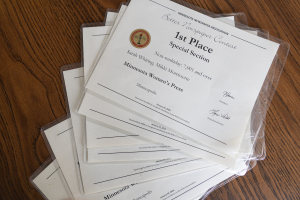 For 2025 coverage, Minnesota Women’s Press earned a community leadership award, three photography awards, and four editorial awards, including for coverage of social issues and for our Spring 2025 “Know Your Rights” special section supported by Unidos MN. Our publisher was named Journalist of the Year by Violence Free Minnesota for gender-based violence coverage.

