


The Ongoing Fight for Having Choice
“The current political climate is so sensitive, and so out of touch with reality. Many women continue to choose to exercise their right to have an abortion, but often having an abortion is no longer as simple as making that decision.”
— Dr. Jane Hodgson
 The abortion rights conversation has been spinning in circles for so long that the doctor’s comment above from 1991 reads like it could have been stated this week. For decades, Minnesota Women’s Press has been documenting women’s struggles and successes in reproductive health care [see womenspress.com/news/reproductive-rights].
It was during my freshman year of college at Penn State that Roe v. Wade was overturned. When I got to the age of being able to create my future, the safety of my body and my personal decisions were threatened by a few politicians and Supreme Court justices.
As an intern with Minnesota Women’s Press this summer, I was able to review archival stories and attend a news conference about abortion rights. I learned from direct sources about the backtreading cycle of arguments against giving women the right to decide when and if they are able to care for a child.



Community Stigma
In a 1995 issue of Minnesota Women’s Press, former publisher Mollie Hoben wrote about The Handmaid’s Tale, which tells the story about a teenage pregnancy, with parents who supported the girl’s choice to have an abortion. Because of backlash from her community, however, the girl was forced to become a mother. She was a child raising a child, Hoben wrote, adding that “political decisions and social debate are not just words, but actions that affect individual lives.”
“The government is slowly taking away women’s rights to safe and legal abortions,” Hodgson said in 1991. “The ones [who] suffer from these restrictions most are the ones [who] are least prepared to defend that right.” She described young women who had to gather money, keep secrets from their parents, and travel long distances to receive abortion care.
At a Whole Woman’s Health of Minnesota press conference in July, Lizz Winstead, an abortion rights activist, said that “when we simply center politics around this issue, we forget that [choice] is a community good. … Voting is the starting line. It is not the finish line.”
Amy Hagstrom Miller, CEO of Whole Woman’s Health of Minnesota, says, “The root of those restrictions is disrespectful to pregnant people. It [assumes] that folks somehow haven’t thought about their decision.”
“Remember Nathaniel Hawthorne’s classic American novel of intolerance, ‘The Scarlet Letter’?” Hoben wrote in 1995. “In that tale, society’s scapegoat was the adulterous woman. Her letter was a scarlet ‘A.’ … The letter today is ‘P,’ for pregnant and poor. Lawmakers in Washington and in state capitals are turning teen mothers and poor women into scapegoats.”
Today, a meme in social media implies that the people who require others to have babies that they are not ready for are the same people who will refer to those mothers as “welfare queens” in nine months.

Who Is Responsible?
In 1993, Grace Harkness wrote that a man “can terminate a marriage without consequences, but a woman cannot terminate a pregnancy no matter what her situation.”
Mimi Molina, a teenaged mother in 1995, said, “Stepping up efforts to obtain child support from [a child’s] father is, like contraception — not always effective,” Molina said.
Today, Miller of Whole Women’s Health points out that “pregnant people who’ve had those abortions — every single one of them — had at least a plus-one whose life was changed and benefited from that abortion.”
As a 21-year-old, I believe that with an increase of women leadership in the country, the freedom to make our own choices can be gained again.
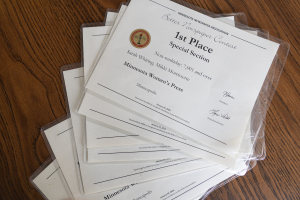 For 2025 coverage, Minnesota Women’s Press earned a community leadership award, three photography awards, and four editorial awards, including for coverage of social issues and for our Spring 2025 “Know Your Rights” special section supported by Unidos MN. Our publisher was named Journalist of the Year by Violence Free Minnesota for gender-based violence coverage.

