


The Menagerie of Therapy Animals

Racheal Lynn with her dog, Terry. Courtesy photo.
Racheal Lynn served 16 years in the military starting with six years in the Army National Guard; she deployed to Iraq in 2007 and 2008. She spent ten years with the Minnesota Air National Guard, largely as a military technician. After returning to civilian life, she suffered from panic attacks — especially when she felt claustrophobic or isolated in a space, such as driving alone in winter.
Eventually, Lynn was diagnosed with post-traumatic stress disorder (PTSD). Her local American Legion helped her access a service dog, a black lab she calls Terry. “He brings this peace and calmness,” she says. “He’s able to bring me my medication. He can wake me up from nightmares. My panic attacks were about not being able to control my body. I knew mentally I was having a panic attack, but I couldn’t calm it down. Terry is trained specifically for this; he’ll lay his head on my lap. He brings grounding energy.
“Simply holding or petting a dog releases oxytocin into your brain and blood system. It’s like medication.”
Terry was trained through the New York–based Guide Dog Foundation. which trains dogs for blind and deaf people, with the affiliated America’s VetDogs program that supports veterans and emergency responders. “They matched me up with the dog based on my disabilities, they trained the dog, then they brought me to meet the dog and we trained together for two weeks before flying home together,” Lynn says.
With Terry, who has been in her life since February 2023, she feels safe. “Without him, I’m always checking the exits, checking behind me. But when I have Terry, I’m just focused on him.”
The American VetDogs slogan is “life without boundaries.” Lynn has flown with Terry, and gone on a cruise together. “When I take a shower, he’s right there next to me. If I’m in a space where I feel overwhelmed with a lot of people, I’m able to say, ‘Terry’s got to go outside,’ exit, and not feel claustrophobic.”
She says the PTSD diagnosis was a bit of a double-edged sword. “I was labeled as someone with PTSD, but I like to consider it ‘post-traumatic growth.’ Instead of simply having this disability, I’m growing and becoming stronger. Terry is amazing. Everywhere we go, everybody wants to talk to him and meet him. He brings people together and licks their faces. He knows it’s okay to engage with others when I take off his vest. When he has his vest on, he’s my pup.”
Farm Animal Therapy
Lindsey Zemanek grew up as a horse girl. She went to college for veterinary studies, but realized she was not as passionate about medicine as she was about therapeutic horse riding. A professor in her marriage and family therapy program suggested she become a therapist who works with animals as part of the process. Zemanek started to work in nature-based therapeutics with Jean Larson at the University of Minnesota, and her unique career began. Four years ago, she and a business partner opened On the Farm Therapy in Northfield.
All counseling sessions are tailored with clients. They can range from traditional talk therapy among 100-year-old trees, to a structured obstacle course with horses, to hiking or building or wood-chopping, to activities with sheep or goats or rabbits.
Zemanek recently talked about her practices in Princeton, Minnesota (east of Saint Cloud), at a day-long event held at Larson’s Prairie Star Care Farm, a fourth-generation “social farming” space where individuals, families, and groups retreat into nature-based activities.
Animal therapy is particularly helpful, Zemanek says, for people who have suffered from trauma and those with neurodivergent tendencies, such as autism, ADHD, dyslexia, and other brain-oriented functioning. She says in general practice, rabbits can be motivators for regulation of clients’ bodies, such as calming down and focusing on the present. “Horses are really good if we want to create an activity to do with a client, or for being with someone with heightened symptoms. Their bigger bodies have a larger capacity for human intensity. Sheep are generally great for grounding and processing in a space.”
Says Zemanek, “Many people come to me because ‘no other therapy has worked.’ I think people often need a dose of nature and the freedom to choose what their session will look like.”
prairiestarcarefarm.org, onthefarmtherapy.com
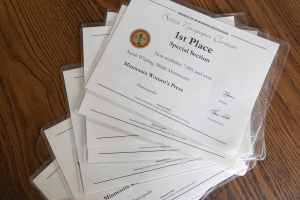 For 2025 coverage, Minnesota Women’s Press earned a community leadership award, three photography awards, and four editorial awards, including for coverage of social issues and for our Spring 2025 “Know Your Rights” special section supported by Unidos MN. Our publisher was named Journalist of the Year by Violence Free Minnesota for gender-based violence coverage.
