


The Long Journey of Zenobia Carson
"Foundation of Housing" coverage, and the May/June 2026 magazine issue, made possible by the donation of Dodd Wilson and the Wilson Social Justice Fund, administered by First Unitarian Society of Minneapolis.

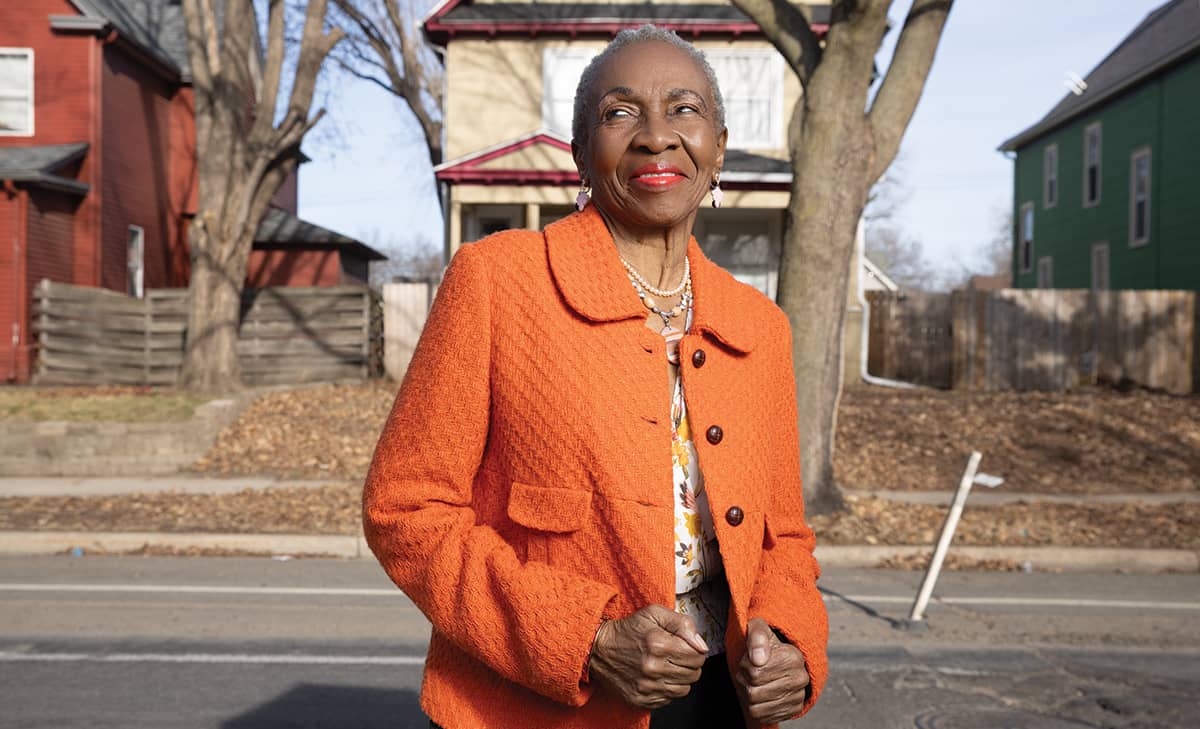
Zenobia Carson in her home, which includes a portrait of her done by a cousin. Photo by Sarah Whiting
I grew up among Bettys and Barbaras and Dorothys. When I was born in 1947, my mother decided to call me Zenobia. You can bet I got teased because of my name, but my mother said I would grow into it. She was a very different kind of woman. I observed her handling both work and home life at a time when many people did not think women could do that.
I was an honor student who skipped two grades in school. I attended art school in Chicago. I was very curious. I was a voracious reader.
I also got married at 17. Eventually my partner was so embarrassed that I was, for example, doing the crosswords in ink that he became abusive. It took time for me to leave. You lose a lot of self-esteem.
Especially when you are young, it can be natural to want to have a man around. If you got pregnant again, the case worker could be ruthless. I’ve been called stupid for letting the man in again. I wondered, “Why not train these men? Many of them are very young. Teach them how to be husbands, how to be a provider. And show me how to do things that will stretch my meal planning.”



Altogether, I had 11 pregnancies: six viable babies, and five miscarried. It took all the air out of me. My first four children were removed from my household, so I turned to alcohol and led a very different life than the one I was raised in. When I got my children back, I could feel myself coming back to life. I started drawing again, and wrote two little books. But my jobs were never enough to keep us in a good place. One of my children died while in someone else’s care.
By 1990, I’d had some good jobs, but they didn’t pay well; my children and I were always on the edge of eviction and poverty. I didn’t have money for the kids’ school trips and supplies. The light bill didn’t get paid, or the gas or water was off. When we lived in a high-rise project in Chicago, one of my kids knew how to hit the floor if they heard guns. It was not living. The children learned to adjust, and I didn’t want them to adjust.
When you are in that space of thinking “this is all I can do, I can’t do any better,” then you are stuck in a limbo life. Many women around me had hearts for doing other things. They just did not know how to make it happen.
Eventually, I said to myself, “I’m not staying here — bullets flying, people stealing your mail, urinating in the common halls.” It was cheap, but at what real price?
Fast-forward through eviction in Illinois, racism in Wisconsin. I read about Elim transitional housing and Sue Watlov Phillips in Minneapolis.
Arriving in Minnesota
I had a 10-month-old grandson. My son and his partner were getting in trouble, so I had this baby on my hip. I also had a sulky 15-year-old son and a 16-year-old daughter who had run away. But eventually, we made it, together, and moved to south Minneapolis. That’s when things started happening for the good.
I got into Section Eight housing. What I learned is that you can’t just give people resources — you have to help shift their mindset. I’ve seen people remain stuck in survival mode even after getting help, still angry, still grasping for more because that’s what they’ve always known.
There were many other sad things that happened, but I kept myself busy. I opened a food pantry called Zenobia’s Community Store, which had donations from police departments and churches. We had food, walking canes, diapers — and it made me happy. One lady said, “Zenobia doesn’t make us feel like a charity case.”
I was in a play called A Raisin in the Sun, named after a famous question: “What happens to a dream deferred? Does it dry up like a raisin in the sun?” I’ve carried that with me for a long time. When your dream begins to dry up and you don’t see any way to bring it back to life, you fall into a gap. Whoever gets onto drugs did not begin that way.
One of the things that helped me through dark times was the knowledge that back in my day, there were no shelters. Beating your wife was common — and the police and your husband or significant other would buddy up, chuckling, saying things like “You didn’t get dinner on the table on time, right?” They might walk him around the block until he cooled, and chances are you would get beaten further because you called the police.
Some things change, at least in small ways.
Growing Past Survival Mode
My own awareness didn’t come overnight. My real education came from lived experience — like traveling with my family using the Green Book, knowing there were places we simply could not go safely. As a mother, I had to figure out how to pass on that knowledge without passing along fear or hatred. That’s not easy. I remember shaking, finding my sons bent over a police car because they “fit the description.” They didn’t — but that didn’t matter in the moment. I had to teach them how to survive without teaching them to hate.
When I talk to policymakers, I ask them to remember their humanity. I believe most leaders start out with good intentions, but they lose them on the floor of politics. They get caught up in agendas, reelection, appearances. Meanwhile, the people they’re supposed to serve become invisible.
And yet, there is so much wisdom to draw from — in people who’ve lived through poverty, through homelessness, through struggle. They know more, because they had to live it.
At the end of the day, what I want people to understand is simple: Stop reducing people to problems. Stop offering easy answers: “Get a job. Stop having babies.”
What people need is help, not judgment: “Help me figure this out, so I don’t keep doing the same things again.” That’s how change actually happens.
I spent a long time thinking I wasn’t lovable. But now, when people knock on my door and say, “We miss you, we love you,” I pause. I take it in. And I think — okay. Maybe all of this, everything I’ve lived through and everything I’ve tried to give back, it meant something after all.
It was a lifetime ago that I was carrying a 10-month-old on my hip, with an angry 15-year-old son. I was about 40 years old. I didn’t want us to be homeless, I needed to be the strength in our family — including remembering how to play with a baby. We survived. Now that baby is 36 years old. He has a wife and two beautiful children, and went to Maranatha Christian Academy on a scholarship.
A history of housing insecurity often leads to health concerns. I have neurological issues in my arms, hemorrhaging diverticulitis, diabetic retinopathy. In April 2025, I had a full-on heart attack. But as long as I’m breathing, I want to help people. In helping others, I get to help myself.
We cannot continue to cover stories like these without your support:



 For 2025 coverage, Minnesota Women’s Press earned a community leadership award, three photography awards, and four editorial awards, including for coverage of social issues and for our Spring 2025 “Know Your Rights” special section supported by Unidos MN. Our publisher was named Journalist of the Year by Violence Free Minnesota for gender-based violence coverage.
