


The Buckskin Dress

Photo of the author’s mother in the Buckskin dress
“I am a woman with wings dancing with other women with wings.”
— Terry Tempest Williams, When Women Were Birds
Her soft white fringed buckskin dress swayed beautifully to the beat of the drum. Mom, a tall, brown-skinned, black-haired woman, danced with the grace, poise, and power of a great bird ready to take off in flight. She danced the lead in a swan dance: a dance in honor of all the winged beings. A dance that was performed only by women and done in a V form, much like the geese when they fly south for the winter, with the women holding out their arms like birds flying — dipping and double-stepping to the beat of the drum. I watched with great love and pride as my mom did her angelic thing.
Mom was an artist extraordinaire, but she would never describe herself that way. She was too humble. Mom was called upon to be head dancer at many powwows in Wisconsin. I tagged along whenever I got the chance. I have watched Mom dance with great interest since I was six years old.
The white buckskin dress, with 18-inch-long fringe on the arms and 8-inch-long fringe on the bottom of the skirt — with sparkling glass beads and beadwork across the shoulders and neck — symbolizes the strength of our relationship to the earth, and the animals who gift us their lives.



The Dress
When they needed tanning, my grandfather brought deer hides to his cousins, who were hard working and very good at handling the hides. In those days, it was women’s work. After they finished tanning, the hides were ready to be made into moccasins, bags, dresses, shirts, leggings, or whatever. Misho then took them to his wife to work her magic.
His wife was Minnie Eagle, a full-blooded Ho-Chunk. Minnie was as beautiful as Thomas was handsome. She was an excellent seamstress and made clothes for her children, as well as other people. They had four children: my mom, Vera, the oldest, and her siblings Ramona, Thomas, and Luverne.
Mom was 13 years old when Minnie finished the dress. Soft and pliable, the dress was in two pieces. The skirt was made with a slip-type top with cloth sewn into the buckskin that could be changed out when needed. The top of the dress was a separate piece that covered the shoulders, arms, and torso. Grandma Minnie tied and sewed each piece of fringe by hand.
The longer fringe on the sleeves was in the tradition of buckskin dresses. The dressmakers hung family trinkets such as silver buttons, a ring, or coins on some of the fringe. When Mom was getting ready for a powwow, she showed me a thimble that was sewn into one of the fringes on the sleeve.
Mom said, “This is the thimble your grandmother used to push needles and fringe through the buckskin when she sewed this dress.”
So personal and creative — something moved me. I felt an overwhelming sadness, and tears welled up in my eyes. It was clear this was a labor of love from Minnie; I wish I could have known her.
Minnie had meant to sew buckskin dresses for all three of her daughters. Unfortunately, she did not live long enough to make that dream come true. She died of tuberculosis (TB) at the young age of 36. In those days — the early 1900s to the 1930s — TB was an active killer, and thousands of Native families succumbed to this disease nationwide. Most of her family was taken early by TB. She died alone in a sanitarium on Christmas day.

Minnie would never know how many eyes would see this dress, and how much this dress would be a catalyst for cultural enrichment and education. The dress traveled all over the country. It was worn by my mom, but also her two sisters, her stepmother, and three of Minnie’s granddaughters — me included — to powwows, celebrations, parades, contests, and fashion shows.
My Aunt Lu wore the dress when she was voted the homecoming queen at the Haskell Indian School in Kansas. My sister Darlene wore it when she was a finalist in a Miss Indian Milwaukee contest. My sister Janice work it in a Fourth of July parade on the streets of Milwaukee; she looked like a princess waving as she rode by on that float.
I wore the dress for the first time when I was 13 years old. A fashion show was organized as a fundraiser for a Native cultural group, the United Indians of Milwaukee, in order to fund their annual powwow and to pay the rent for an old fire house that had been converted into a cultural center. I felt absolutely beautiful.
The dress was made by a young mother, who would not live past 40, as a gift to her eldest daughter to carry on the dances of our ancestors. With that dress, we showed our pride in our culture. We danced, laughed, paraded, greeted war heroes, educated people, and raised funds for important causes in our community.
The dress represents not only the beauty in our culture, but also the importance of our survival and the teachings of ancestors as we continue to fight our oppression to this day.
May the love and caress of Minnie’s creation carry us through the next generations.
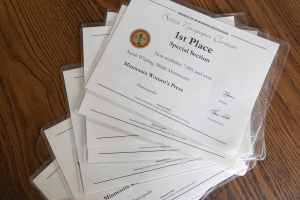 For 2025 coverage, Minnesota Women’s Press earned a community leadership award, three photography awards, and four editorial awards, including for coverage of social issues and for our Spring 2025 “Know Your Rights” special section supported by Unidos MN. Our publisher was named Journalist of the Year by Violence Free Minnesota for gender-based violence coverage.
