


Susan Raffo: Listening to America’s People and the Land

Photo Anna Lemler
When I was 16, I read Walking Across America, by Peter Jenkins. A couple days after reading it, I woke up knowing I would do this. In my 60th year, I wanted to know if it is possible for us to live together on this land.
The Seven Fires Prophecy
On this walk, I was guided by my understanding of the Prophecy of the Seven Fires — an Anishinaabeg prophecy that primarily offers wisdom and guidance for Anishinaabeg people, but also carries warnings about the impact of “the light-skinned ones.” We are living in the time of the Seventh Fire: a time in which we are standing at a fork in the road, with one fork leading to our shared destruction and the other to the Eighth Fire, a time when we live together on this land in peace.
As I have come to understand it, there is a warning for those who follow the ways of the light-skinned ones, who are not acting as though we are part of creation. We do this when we assume that gathering enough money, enough strategy, and enough people will enable us to somehow fix the complexity of problems that include people we don’t know, as well as other beings of the Earth. It’s important for us to remember that we are makers — we bring together resources that already exist, beings with their own lives, and make small shifts and changes in the greater complexity that is this land. These teachings shaped the walk, and they continue to shape how I understand change and possibility.

The walk started on April 13, 2024, from Castine, Maine. The walk finished on January 11, 2025, at Doheny Beach State Park, California.
Miles traveled: 3,450 walked, 750 ridden (approximates). Pairs of shoes worn through: five, with the sixth pair on Susan Raffo’s feet at the end.
About Truth-Telling
I think about the piece of the Prophecy that focuses on how you can’t immediately tell if the light-skinned ones are friend or foe — and you will know when the rivers [are poisoned] and the fish begin to die. Initially, I thought this was about outright lying and manipulation, or lying to an external audience, but I’ve now started to think of it as an internal state. I notice the excuses I made about this walk, and the excuses I continue to make so that I feel more badass than I actually am.
The truth is, on the walk I wanted some comfort at the end of the day. I wanted a shower. I wanted a feeling of home. I wanted to know where I was going to sleep, even if it was in a tent. I wanted access to people or to some form of connection, rather than just being alone in a tent in the middle of an unknown space.
I wanted to be the person who just camps in an empty field — sometimes I was her, but I wanted to be her far less than I thought I would. So, I am noticing; I believe the Prophecy is as much about the internal lying — the internal separation of the performed self from the true self — as it is about external audiences.




Photo Anna Lemler
On Listening Well, Care … and Violence
One of the commitments I made was to listen but not allow violence to go unchallenged. It was usually the verbal violence that people would lay at my feet. It was anti-immigrant stuff or transphobia, mostly. When I pushed back, I also tried to keep a connection. How do we deeply disagree but not write each other off?
I met more ex-police officers and active police officers on this walk than I’ve met in my entire life. Who is going to meet a stranger walking across the fields? It would be them. But when it got to the point where I felt there was a power struggle about to happen, where I could feel them trying to control me, almost always the question that would soften them would be some version of, “Is this the best that we can hope for our children?”
So, unsurprisingly, being in relationship to Descendants is what would help even the most tight-minded soften.
Kansas and Missouri both touched me deeply. I think they’re the poorest states I walked through. There I was reminded of where I grew up and who I grew up with. There I witnessed generations of destruction of rural infrastructure. The slow, constant erosion in which family businesses became big-box stores. Then big-box stores closed. Moving through places where the nearest grocery store is 50 or 60 miles away, I saw and experienced so much care. I stayed in many RV parks where people ended up living together who didn’t know each other previously, where they are taking care of each other. But in the city, that’s not how it worked.
I didn’t have people try to proselytize me, like I thought might happen. I talked with people about God more than politics, because that’s what they wanted to talk about. I was also very clear that I’m not Christian in the way they know, but that I do believe there is spirit; I believe in source. They wanted to go there with me. That is what we mostly talked about.
I’ve witnessed, been written about, and been a part of so many movements that have language about collective care and safety, with analysis and awareness about consent. I think about the movements I’m in where there is so much focus on people getting exactly what they need — but it doesn’t last.
Nothing lasts unless it’s really local, rooted in a family connection, or there’s a reason people are together. But outside of that, it doesn’t last.
The irony is that the coastal communities, where the liberal bastions are, were the only places I experienced cruelty. In California, I think people perceived me as unhoused. They threw things at me from their cars, yelled, and pretended they were going to run me over. On the East Coast, people mostly called 911. It was cold and closed, and I was considered a problem somebody else needed to deal with.
The West Coast had f*** you energy. And it wasn’t just a one-off thing. People were actively cruel toward me. On the East Coast, people called the cops to make me disappear.

Photo Anna Lemler
Takeaway
I wanted to know, “Is it possible for us to live on and with this land together?” What tended to happen would be a pause, a connection, a softening, and a listening.
Only two people I met tried to answer that question directly. The most profound experience occurred when an Amish elder said, “Well, that would be the right question, wouldn’t it?”

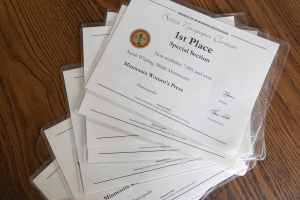 For 2025 coverage, Minnesota Women’s Press earned a community leadership award, three photography awards, and four editorial awards, including for coverage of social issues and for our Spring 2025 “Know Your Rights” special section supported by Unidos MN. Our publisher was named Journalist of the Year by Violence Free Minnesota for gender-based violence coverage.
