

Stories of Boundary-Breaking Women
We asked some of our team to offer synopses of recently published books about interesting women that they read this summer. Here are a few:
A Flower Traveled in My Blood, by Haley Cohen Gilliland
 On a rainy Friday afternoon, José Manuel Pérez Rojo and his partner Patricia Roisinblit — who was heavily pregnant — were seized by masked, armed policemen and shoved into an unmarked vehicle. The year was 1978, and José and Patricia had just become two of tens of thousands of “desaparecidos” who would be kidnapped, tortured, and murdered without a trace by the Argentinian military dictatorship between 1974 and 1983.
So opens Haley Cohen Gilliand’s gripping history. It follows Rosa Roisinblit, Patricia’s mother, as she becomes an integral part of the Abuelas de Plaza de Mayo. This extraordinary group of mothers and grandmothers of kidnapping victims were tireless advocates, leading to the identification of more than 130 grandchildren who had been kidnapped alongside their parents or were born into captivity. Facing stark danger (three of the Abuelas’ founding members were murdered by the dictatorship) and constant public backlash for their “unpatriotic” truth-telling, the Abuelas persisted then and now. Surviving members continue to protest Argentina’s current slide into historical revisionism.
Gilliland captures a period in which authoritarian violence was rising around the world, creating a global web of terror as well as a worldwide network of anti-fascists. The Abuelas collaborated with journalists, human rights advocates, and renowned scientist Mary Claire King to create groundbreaking genetic testing to identify grandchildren.
The Abuelas’ story reminds us that however devastating the situation, the pendulum does swing toward justice — if people work together to make it so.
— Siena Iwasaki Milbauer
Secret Servants of the Crown: The Forgotten Women of British Intelligence, by Claire Hubbard-Hall
 In British intelligence, many women served as secretaries, typists, and personal assistants — inconspicuous job titles that masked their true occupations in secret intelligence service. As a female army that served as a cornerstone for British intelligence, the women who made up this section of MI6 governed secrets and classified information, spearheaded by Kathleen Pettigrew, the real-life inspiration behind James Bond’s Miss Moneypenny. Within the pages of this fascinating look at forgotten women agents, Hubbard-Hall utilizes extensive research, declassified documents, and family archives.
— Olivia Worcester
Last to Eat, Last to Learn: My Life in Afghanistan Fighting to Educate Women, by Pashtana Durrani and Tamara Bralo
 “Oxford wasn’t just a school; it was a mythical place that turned women of South Asia into heroines. I was going to be one of them. Until I wasn’t.”
Fueled by her father’s insistence on giving her an education, Pashtana Durrani recognized early on in life that her mission would be to educate other girls and young women in Afghanistan. The power of learning granted Durrani the opportunity to leave the refugee camp she was raised in and obtain an acceptance to a preparatory program at Oxford — but this was decidedly not her path. Instead, she founded the nonprofit LEARN, which is dedicated to providing quality education and health care to communities in conflict zones. This memoir details Durrani’s courage and commitment to educating young Afghan women as a self-described “accidental activist” who started out merely standing up for herself. “I was born loud,” Durrani writes, “and whatever the consequences of speaking up might have been, suffering in silence seemed so much worse.”
A portion of proceeds from Durrani’s memoir are donated to LEARN (LearnAfghan.org).
— Olivia Worcester
E.D.E.N. Southworth’s Hidden Hand: The Untold Story of America’s Famous Forgotten Nineteenth-Century Author, by Rose Neal
 With more novels to her name than Nathanial Hawthorne, Herman Melville, and Mark Twain combined, Emma Dorothy Eliza Nevitte (E.D.E.N.) Southworth was one of the 19th century’s most prolific, successful authors. Despite having written over 50 books and reaching a wide audience during her lifetime, Southworth flew under the radar until Neal uplifted her in this biography.
Southworth’s stories touched on taboo topics for the time — including alcoholism, poverty, and domestic violence — all under the guise of “domestic fiction.” Her signature style included “feisty heroines who rode horses, shot pistols, captured notorious villains, became sea captains, and had other such grand adventures.”
Her best-selling novel The Hidden Hand was published in 1859; its heroine, Capitola Black, was so widely popular that many readers named their daughters after her. Neal draws on archival research to document Southworth’s boundary-pushing literary career and personal life.
— Olivia Worcester
Dear Miss Perkins: A Story of Frances Perkins’s Efforts to Aid Refugees from Nazi Germany, by Rebecca Brenner Graham
 “Perkins habitually felt others’ pain as her own, and refugees were no exception.” Flanked by an all-male staff, Frances Perkins’ handbag and heels starkly stood out under the presidential cabinet’s meeting table. As the first female cabinet secretary in U.S. history, some of Perkins’ accomplishments have been well-documented, including her work as an architect of the New Deal, and her time as the longest-serving labor secretary. Less known are her life-saving efforts aiding Jewish refugees fleeing Nazi Germany. With the Third Reich coming to power in the 1930s, many German Jewish citizens wanted to leave. One way to do that was reaching out to the Immigration and Naturalization Service, which was under the Department of Labor. Letters began pouring in to “Dear Miss Perkins …” Drawing on thousands of letters housed in the National Archives, Brenner Graham’s biography is an insightful, compelling read.
— Olivia Worcester
My Seven Mothers: Making a Family in the Danish Women’s Movement, by Pernille Ipsen
 At its surface, Pernille Ibsen’s memoir retells an experiment in female-centric community and parenthood. A child of seven mothers who chose to raise her in a women’s commune in Copenhagen, Ibsen — now a professor of women’s and gender studies at the University of Wisconsin — shines a light on social activism and female relationships.
Ibsen found herself in the center of the action as her mothers experienced and even effected a cataclysmic era of political and social change in the early seventies in Denmark. Sharing stories from the founding of the first Women’s House in Copenhagen, the surmounting stamina of the Danish Women’s Movement, and her mothers’ unexpected choice to raise a child together, Ibsen recounts the daring and ambitious attempts to organize and cooperatively power a society completely by and for women. Even as this movement unravels — due to organizational conflict between heterosexual and lesbian women — Ibsen’s analysis of the balance of power and identity between her mothers is a sensitive and thoughtful reflection. She explores enduring challenges as well as possibilities, examining what it means to be a woman and to create women’s spaces.
Rich with interviews that span years of chronicling her mothers’ memories, as well as contextual additions from relevant historical academia and media, Ibsen explores the rise and fall of a movement; its complicated legacy; and persisting questions about liberation that still grip social activism today.
Ibsen expertly analyzes her own telling of the story, grappling with how to record the history of the movement, as ostensibly she is a lasting tangible triumph of its efforts. She asks: “How do you measure the amount of happiness in a story about a social movement?”
— Diane Meyer
Are you signed up for our monthly Creativity & Connection newsletter, about books, arts, and events?

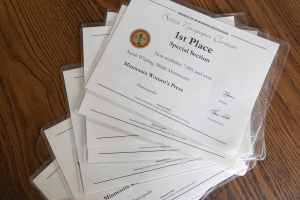 For 2025 coverage, Minnesota Women’s Press earned a community leadership award, three photography awards, and four editorial awards, including for coverage of social issues and for our Spring 2025 “Know Your Rights” special section supported by Unidos MN. Our publisher was named Journalist of the Year by Violence Free Minnesota for gender-based violence coverage.
