

South Minneapolis Neighborhood Chronicles the Trauma and Hope for Its Unique Space
Confluence: An East Lake Studio for Community Design is calling on neighbors to help distribute “Landscape Issue 4,” which has a print run of 10,000 copies — nearly 10% of the Third Precinct Patrol Zone. The Studio invites residents to join a weekend-long distribution effort to share these neighborhood stories about the community in the aftermath of George Floyd’s murder in 2020.
A South Minneapolis neighborhood has created a newspaper to share the stories of place; specifically, the area around the former Third Precinct site, connected with the history of George Floyd’s 2020 murder by police in that neighborhood.
In Our Hands: Landscape #4 is produced by Confluence: An East Lake Studio for Community Design, and documents collective memories, struggles, and visions for the future of the former police precinct site. The site is considered a potent symbol of police violence, community trauma, and the fight for democratic control of local spaces.
The newspaper offers an editorial framing to introduce the neighborhood, and describes how its residents are working toward healing and transformation. Since 2021, Confluence and partners have hosted assemblies for residents to imagine a future rooted in care, safety, and collective governance. At these meetings, two clear demands emerged: the site should serve broad community purposes and its redevelopment should be led by residents themselves.
Despite this, the newspaper shares, the City of Minneapolis advanced plans for a “Minneapolis Democracy Center” — a warehouse for election equipment and storage, with minimal public use. Residents see this as a betrayal of democratic participation and authentic engagement. The paper chronicles perspectives of community organizers, artists, business owners, faith leaders, and former officials.
Rachel Boeke, former director of the Longfellow Community Council, describes the community’s exhaustion with being ignored by city officials. She recalls residents’ overwhelming opposition to reinstating police presence, calling instead for services addressing survival needs — food, water, shelter, and dignity.
Lauren Callis, director of Curiosity Studio, argues for transforming the site into a non-clinical healing and creative space. She likens authentic democracy to art-making — relational, slow, and messy — warning that the City’s approach reflects “transactional democracy,” not the trust-based transformation communities need.
Former Circle editor Joseph Allen situates today’s conflicts in a long history of Native resistance to police violence, recalling how the American Indian Movement arose to protect residents from brutality. He calls for the site to become a communal gathering place for storytelling and truth-telling rather than another monument to suffering.
Local business owner Jamie Schwesnedl of Moon Palace Books recalls direct confrontations with violent Third Precinct officers and the betrayal of small businesses after the uprising. He envisions the site as a place for truth, reconciliation, and cultural exchange — a living center for connection.
Others, like former council member Cam Gordon and community leader Antonio Williams, echo a call for participatory democracy and education rooted in historical accountability.
Faith leaders frame the struggle as one of moral access — ensuring those most harmed can lead the healing.
Ultimately, In Our Hands is both archive and invitation — a manifesto urging residents to reclaim the former Third Precinct as a space of radical imagination, care, and democratic rebirth. It insists that the future of South Minneapolis — and the nation — must be built collectively, from the ground up, by those who have suffered most and yet still dare to hope for a better tomorrow.
Find the digital newspaper here.
To support our unique coverage of community needs:

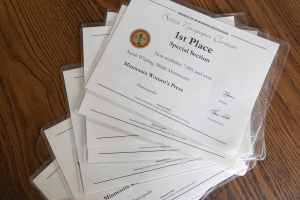 For 2025 coverage, Minnesota Women’s Press earned a community leadership award, three photography awards, and four editorial awards, including for coverage of social issues and for our Spring 2025 “Know Your Rights” special section supported by Unidos MN. Our publisher was named Journalist of the Year by Violence Free Minnesota for gender-based violence coverage.
