


Returning to My Hometown After Three Decades in the Military

Kristine Shelstad

I joined the Minnesota Army National Guard at 18 in my hometown of Madison, Minnesota. I did not grow up thinking I wanted to be a military person, but I needed money for college. I was active duty with the Army National Guard, including in Germany. I deployed to Bosnia and Iraq. My final position was with the Texas National Guard, where I retired in 2012. In all, I served 31 years, with 21 of those in active duty.
In early years, when I was at the Pentagon, it was before computers and cell phones. I worked as a clerk typist. Eventually I was involved in planning stages for the civil war in Bosnia and responding in Rwanda. Through much of my career, I served as a liaison between civilian organizations, nonprofits, and other agencies. For example, when Hurricane Katrina hit, I helped coordinate an understanding of what the National Guard could do and how state responsibilities differed.
I essentially served as an adviser for solving issues using partnerships, especially to get equity into the room. We needed everyone’s input in planning approaches, such as — pre-Covid — what the roles of each organization would be when responding to a pandemic. We talked about what we needed to do for problems that were societal and cultural, not just military.



Some people I meet today are surprised to find out that I am a veteran. I am pretty liberal, and some people think that’s uncommon in the military. But people who have lived around the country, traveled in foreign countries, and served with all sorts of people can be open minded. My experiences led me to accept people as they are; to judge them on their actions and not their origins. I learned there is no “black and white” — rather, issues exist in the gray. It is important to try to see things from other perspectives.
I had some very good bosses who trusted me, empowered me, and respected me. They supported me through tough times and helped me find my voice. There also were a few that were simple “good old boys” and didn’t do the right thing when presented with the facts. But those were rare.
I did see young female soldiers who didn’t feel empowered. I could see some of them being groomed by predators and would intervene. I gave them my phone number if they ever got into a space where they felt like they had no one to call to get them out of an awkward situation.
I retired from my military career in Austin, Texas, alongside my husband, who had been an Apache pilot in the Army. After he died unexpectedly, my siblings helped me make the decision to move back to my hometown.
I spent a year getting settled and then decided to do something big. I bought a 15,000-square-foot building and opened the Madison Mercantile coffee house and the Madison Art and Innovation Center as a nonprofit art gallery. It quickly turned into a giant multifaceted community center. We host over a dozen groups, from a quilting club to Narcotics Anonymous.
I had all this military experience in planning and leading, and wanted to do something to make a difference in my hometown.
Madison has a thousand fewer people than when I was in high school, but it is still a vibrant city with a volunteer-oriented base and an influx of people returning to rural roots. What Madison was missing was a gathering space where everyone can feel welcome — that was not a church or a school or a bar — especially after the social isolation of the pandemic. Because of my pension and health care benefits, I have the ability to do this. My military career gave me that freedom to do something good for my community, because I have that safety net.
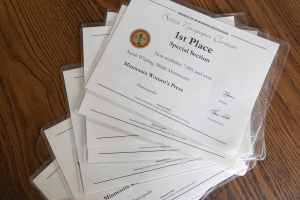 For 2025 coverage, Minnesota Women’s Press earned a community leadership award, three photography awards, and four editorial awards, including for coverage of social issues and for our Spring 2025 “Know Your Rights” special section supported by Unidos MN. Our publisher was named Journalist of the Year by Violence Free Minnesota for gender-based violence coverage.
