


Recording the Stories of Veterans
AMPERS is a radio association that supports 17 public community radio stations around Minnesota. Over the past 10 years, they recorded audio interviews with veterans for a series of first-person narratives. Here are some of the women featured, including additional details offered by Verna Littlewolf.
 Verna Littlewolf
U.S. Navy during the Gulf War
Being Native American, serving in the military was something that I wanted to do since I was a child. I am affiliated with the Minnesota Leech Lake Band of Ojibwe.
As a full-blooded Native American, I did feel lonely. I felt isolated. [When I could,] I would go back to nature. I would find myself going for walks in the forest or in the desert. I would take a look at myself inwardly and say, “Thank God that I’m alive,” and bless the day. I found that to be comforting.
After finishing basic training, I was transferred to Port Hueneme in California. I began weapon qualifications and Seabee training [basic diving principles and applications, followed by challenging underwater construction and demolition handling techniques]. I earned sharpshooter status with the M16A rifle and expert status with the military issue Colt.45 Caliber.
After graduating top of the class, I was given three choices: to transfer to one of two positions in Alaska, or to relocate to the beautiful weather of Coronado, California.
I reported to Naval Station Coronado. Upon reporting to new duty station, I was notified that my battalion was already in Iraq — and so it began.
I met my former husband of 31 years in Coronado. Our travels within our U.S. Navy careers were always together.



 Lina Knox
Minnesota National Guard, spent her first deployment in Iraq (pictured in uniform with her wife)
“Don’t Ask, Don’t Tell” was about making sure there were no homosexual activities. You had to be straight. [But] oh, my goodness, there were so many gay people. I thought that was hilarious. Everybody knew — you had that look, you did the wink, you did the handshake — and everybody knew you were family. I helped a few people throughout my time with the VA to be able to help get their discharges [because of the policy] get overturned.
 Cindy Strange
Discharged from the Air Force for being gay, then re-enlisted with the Army after the rules changed
After I got out, I decided to go to college, continue my education, use up my GI Bill — and then “Don’t Ask, Don’t Tell” was repealed. That’s when I decided to [re-enlist], because wow, [things had] changed, including how we look at some mental issues, and how we look at PTSD, and how we look at people’s sexual orientations that have nothing to do with your service. When I decided to go back, in 2012, I went back to the Army.
 Christine Leith
U.S. Navy, from a family of Leech Lake veterans
I enlisted in January 1998. We were at the tail end of Desert Storm. I went to boot camp, not thinking we would go to war. In December 1998, we went to war. We were in the Persian Gulf. The ship started shaking. I thought we were having an earthquake. We were in the middle of the ocean. There were a lot of unknowns, but it was also automatic — everything that we trained for, day in, day out. There was no second- guessing. We got our planes up in the air in five minutes, and then [those of us on the ground] sat around and waited, and waited, and waited. Then birds were coming back. Looking at the pilot’s faces as they came out of their airplanes, it was intense, because they were grateful. Everyone was grateful they came back, even though their birds were full of bullet wounds.
 Manichan Xiong
Hmong veteran in Laos
I didn’t train with any division. My husband trained soldiers, so he taught me how to shoot a gun, shoot artillery, and run across the mountain. I learned, in case he wasn’t around, so that I would know what to do. The Americans said to my husband, your wife never trained and doesn’t belong to any division, but she acts like a soldier, so you’re her boss. He gave me the title of commander; my husband was a colonel.
 Valeria Buchan
Head nurse for U.S. Army during Vietnam War
Lots of times, people forget that women were involved in war. My father was a farmer, a World War I veteran. My mother was a school teacher. She taught in small country schools. A big part of our life was our church. I went to Hamline University School of Nursing in December 1965. We started getting letters from nursing agencies telling us that opportunities were in the military. Then we started getting letters from recruiters from the Air Force, Army, Navy. I had eight cousins and an uncle in World War II, a couple of cousins in Korea. I saw it as something that I should do. We were all girls in our family.
I went to Fort Sam in Houston for basic training. That was seven weeks. Then I went to Japan for two years; to Vietnam for one; and to Fort Devens, Massachusetts, for two more years. That was my five years of active duty. I’ve never taken care of a group of people who were more grateful, more respectful. They were healthy young males, so they had a good chance to get well if they could get to us. And they were grateful for anything that we could do for them. Nobody’s got any place to go, which really contributes to being a very close-knit group. We got dependent on each other. In fact, when I got home, I realized I was looking for that again, and I’ve never found it.
We had Vietnamese people working with us, and we don’t know what happened to them after we left, and that bothers me. They were good people, very loyal to us, hard workers.
I’ve never been happier than when I’ve got my suitcase, at the airport. I love to travel, and I think that’s because I saw so many interesting places. It made me thankful for my own country because I saw how people in other places had to live and what they had to put up with and the [limited] chances they had for education. We have so much to be grateful for here.
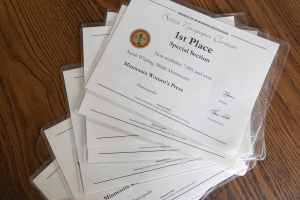 For 2025 coverage, Minnesota Women’s Press earned a community leadership award, three photography awards, and four editorial awards, including for coverage of social issues and for our Spring 2025 “Know Your Rights” special section supported by Unidos MN. Our publisher was named Journalist of the Year by Violence Free Minnesota for gender-based violence coverage.
