


Publisher’s Note: Sharing Stories About Some of History’s Powerful Women
Sharon Marquart, Anika Robbins, and Alliance Francaise host Valerie Tremelat
The Minneapolis-based Alliance Française hosted a conversation on April 1 titled “Women’s Voices on Progress, Setbacks & Oppression.” I joined four other speakers to explore the history of overlooked, inspirational, and everyday powerful women, as well as to question whether women will be the ones to lead the rebuilding of communities after the devastation of current events.
Sarah Jones-Boardman teaches French at the Alliance, and talked about a book, Les grandes Oubliées: Pourquoi l’Histoire a effacé les femmes — in English, The Great Forgotten: Why History Has Erased Women. Currently the book is only available in French, written by journalist Titiou Lecoq. It goes back in time to the Paleolithic era, when the genders were much more equal than they are today. The book explores why the world turned increasingly patriarchal over time. Women, for example, fought in the French Revolution; it was the Napoleonic Code in 1804 that declared French women to be inferior to their husbands.
Sharon Marquart directs the Gender, Women and Sexuality Studies program at Gustavus Adolphus in St. Peter. Among others, she shared the story of Madeleine Riffaud, who joined the French resistance as an 18-year-old, was tortured by Nazis, worked as a nurse during the Vietnam War, and died last November in Paris at age 100.
Marquart said Riffaud and others are “examples of people who knew you always had to fight, that you couldn’t accept the situation that you were in, and the importance of always having that fist in the air ready to go.”
Anika Robbins founded the Anika Foundation to reduce health disparities and increase civic participation through Black Votes Matter. She indicated she grew up in Lagos, Nigeria, where she learned about warrior Queen Amina. Many African cultures are matriarchal, she said. “The men are solid in their manhood and very supportive of the women.” Her inspiration came from several powerful women, including her aunt Mary Merrill Anderson, the first Black — and first female — Minneapolis Park Board superintendent, and her mother, who moved to Lagos in the 1980s to launch a beauty company.
Briana Joyner is focused on cultural transformation at the Women’s Foundation of Minnesota. She shared the story of several women, including Mary Lee Dayton, who recognized the lack of resources for women and helped establish the Minnesota Women’s Fund in 1983, donating $1 million to kickstart the Women’s Foundation. Joyner pointed out that today, according to research by the University of Indiana, less than 2 percent of philanthropic dollars go to organizations that center women and girls.
I talked about our upcoming 40th anniversary celebration and quoted from our 35th anniversary book, to give context for the ways Minnesota women have and have not been able to transform social issues — from gender-based violence to diverse representation in politics. I quoted Arvonne Fraser from a July 1986 Minnesota Women’s Press article about the need to rebuild society: “A fellow in Washington told me, ‘You women are going to have to do it, because we’re all captured by our institutions, and we don’t dare.’”

Briana Joyner, Sarah Jones-Boardman, and Minnesota Women’s Press publisher Mikki Morrissette
Related Stories
One of the women Briana Joyner amplified was the story of Hallie Q. Brown, the powerful Black woman who is the namesake of a community center in the Rondo neighborhood of Saint Paul. Find a story about the center here.
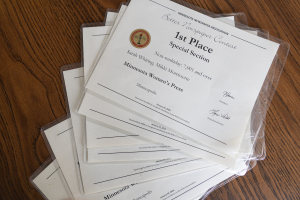 For 2025 coverage, Minnesota Women’s Press earned a community leadership award, three photography awards, and four editorial awards, including for coverage of social issues and for our Spring 2025 “Know Your Rights” special section supported by Unidos MN. Our publisher was named Journalist of the Year by Violence Free Minnesota for gender-based violence coverage.

