

Publisher’s Note: Reflections on Five Years Since the Pandemic (from KAXE Radio)

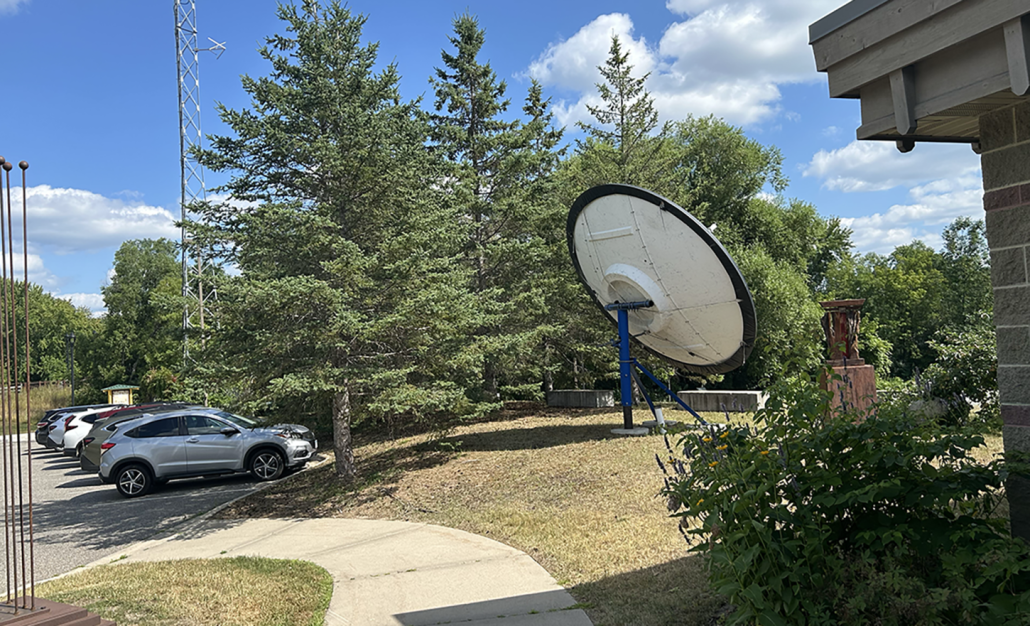
KAXE radio station in Grand Rapids (photo by Mikki Morrissette during a visit to the area in 2024)
I recently was interviewed by Michael Goldberg for a KAXE (Grand Rapids) radio show about the 5-year anniversary of the pandemic. He interviewed several people, including medical professionals and journalists, about reflections from that time, and what has transpired since.
Dr. Greg Davis of Essentia Health said morale among his hospital team was high at that time — they were working to save lives on a daily basis — but it was frustrating after the vaccines became available that they continued seeing so many critically ill patients. “In the intensive care unit, it really became a pandemic of the unvaccinated. We had almost no one in the intensive care unit who had been fully vaccinated.”
He treated one man who was in the process of dying from a deflated lung — ‘“this seemed to happen a lot with one of the strains.” One strategy to deal with it was dangerous because it would sometimes lead to leaks on the ventilator, which can fill your chest with air and squeeze other body parts. “I got done putting a chest tube in this patient, and he sort of stabilized, and I said to others in the room, ‘You know what is easier than this is getting two shots.’ There might have been an expletive in there.”
Davis says since the pandemic his message has been, “A lot of forces encourage us to be divided, but as a society and in healthcare, we do better united. We need to look after each other.”



 I talked about the tough financial situation the pandemic put the magazine — which we still have not recovered from — but that it shifted our attention toward enhanced online coverage that was not simply coming from the print magazine, which needed two month lead times. With mutual aid efforts, especially after the George Floyd murder and aftermath in our neighborhood, it was important to have daily and weekly stories that were not related to the magazine themes.
The first online series we started, I explained, was Ecolution — a term I coined to describe the movement in restoring local economics and ecosystems at the grassroots level. It was about “people who were figuring out how to restore health to communities. We developed a new newsletter around it.”
Ultimately, this and other ongoing online series became part of our Changemakers Alliance umbrella, with its own mission statement: connecting engaged feminists who care about solutions and action. That led to the Badass membership support in Fall 2023. “Because we’re now in another phase of life here — where people are overwhelmed with all the bad news — we this year spun off our third newsletter, focused on books, arts and events, that just gives people something that’s not the political news of the day.”
I also talked about my big personal story from March 2020, when my dad died at the Vets Home from dementia and congestive heart failure. “He died a week before the lockdown took effect. My dad had a great sense of humor, and had impeccable timing, so I joke that he had the foresight to die before the lockdown happened. He would have hated it. We would have hated it, not being able to visit him.”
I noted that in our case, we were never able to host a memorial service for him. “I agree with those who have said we’ve never really properly grieved what we lost at that time. It was very isolating.”
I talked about how thankful I was that, despite all the sorrow, I ended up having both of my kids at home — my daughter came home to finish college online, and my son was finishing his junior year of high school online.
The message I had hoped to see from that time, I said, was that we would “become better at recognizing how interconnected we are, that we would have to acknowledge the fact that we all need each other.
“People that were emergency workers often times never get any credit, and they were having to show up and do their job so that the rest of us could still function. I had a lot of hopefulness at that time that it was going to help us become better people. It’s been, of course, very dismaying to find that that’s not really the case for so many people. There is still an othering process of not recognizing the value in everybody that’s around us.”

Journalist Chelsey Perkins talked about her coverage of the first death in Crow Wing County, where she lives. “It wasn’t until several months into the pandemic. It happened to be someone that I knew and had interviewed in previous stories, so that was particularly shocking. That fall and winter of 2020 was when the hospitals really started feeling the pressure in northern Minnesota. Lots of people were dying, including young people.”
At Thanksgiving, people talked about whether they should have get-togethers and see families, and they did, and some people died because of that, and that’s just the facts. There were family get-togethers and people died.”
At Christmas, Perkins said, she covered one of the hardest stories for her during the pandemic. “I interviewed a woman whose husband was in intensive care, on a ventilator. He had been on a hunting trip with friends, and several of them tested positive after that trip. He was the only one that had really severe impacts. He became sick very quickly, and was on and off the ventilator. At the time that I interviewed her, things were looking up. It seemed like he was recovering, breathing on his own. The doctors appeared optimistic.”
She wrote the story, and it ran with a headline that he wouldn’t be home for Christmas, but he was alive.
“On Christmas Eve, I received a message from his brother that he had died, and I remember sitting in my house with tears welling up, because this headline I wrote was so starkly different than what had just happened. I logged into our system from home to add an Editor’s Note to the top of the story that said, ‘Since the publishing of this article, he’s passed away.’ That was really hard.”
She said it was also difficult to get pushback from people that the pandemic reporting was a scam. “Our comment sections were filled with people who were skeptical. After the vaccine rollout, it really intensified. It was such a dichotomy. You had people clamoring to get this vaccine, cars lined up to go through drive throughs to get vaccinated. And on the other side, you had people soaking with misinformation. To be constantly criticized and accused of collaborating with some sort of worldwide cabal, as if all news media were having secret meetings to trick people. It was very frustrating.”
Perkins says she kept track of statistics every day for almost two years. “We felt like we were writing the first draft of history. Now, five years later, some of that feels really distant. We’ve had a really rough flu season this year. The precautions that people were following during the pandemic — no one does that anymore. People come to work sick.”
She says, “It makes it feel like ‘did we learn nothing?’ I really hope that we did. I do hope that if we encounter another pandemic in our lifetimes, that people will have learned from that time in our lives, but I’m skeptical. I’m frustrated with some of the continuing anti-vaccination rhetoric. It’s hard to understand.”
Goldberg ended the hour-long show with a wonderfully written conclusion. He compared 2020 with the start of 2025. “We’ll start with two iconic photographs of the skies over Los Angeles. In the first one, the sky is a stunning blue, the air cleaner than anyone alive has ever seen it there, because the city has stopped. In the second one, all black smoke — ash and scorching flames stopping the city.”
Among his comparison list he said, “Everyone wondering what’s happening and what to do next, and nobody really knows what happens next. Check. People thrown out of work and the economy teeters on collapse. Check. People gathering in small groups, talking about events far outside their control, and looking for ways to adapt. Check. Groups of neighbors, friends, and family strictly segregated according to which one of two completely different versions of reality you subscribe to.”
 For 2025 coverage, Minnesota Women’s Press earned a community leadership award, three photography awards, and four editorial awards, including for coverage of social issues and for our Spring 2025 “Know Your Rights” special section supported by Unidos MN. Our publisher was named Journalist of the Year by Violence Free Minnesota for gender-based violence coverage.
