
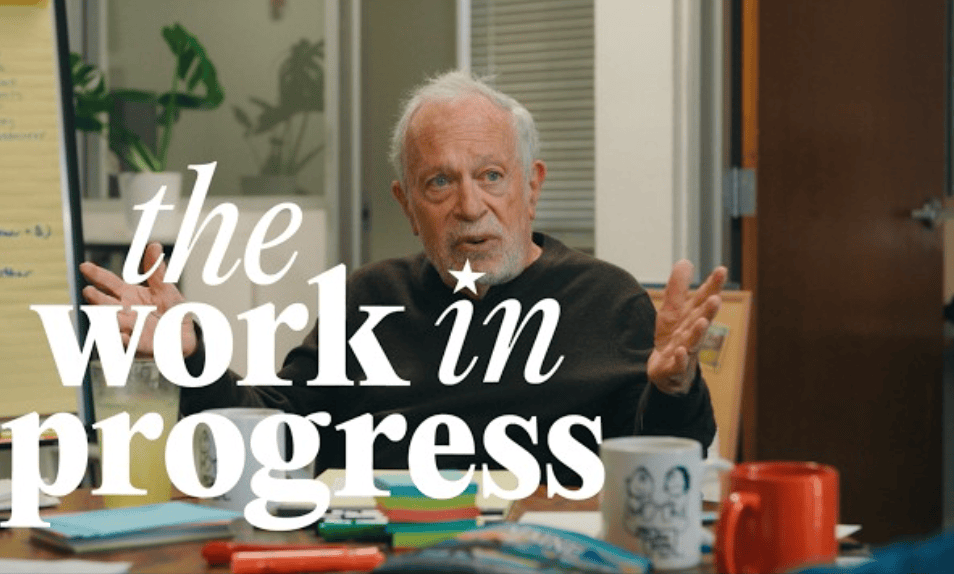
Publisher’s Commentary: “A Work in Progress” Documentary by Robert Reich
Coverage supported by the deep donations of long-time supporters Kristin Siegesmund and Becca Brackett.
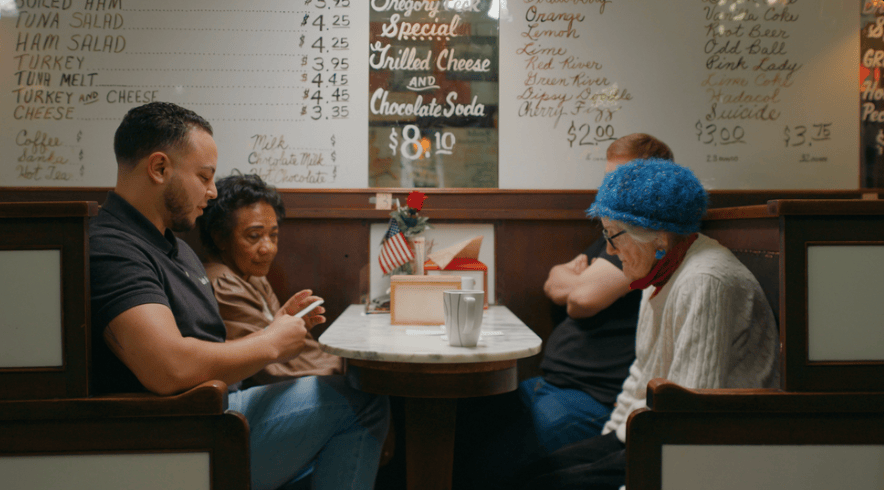
Photo still from “The Work in Progress”
A few weeks ago, I saw a special screening of a new Inequality Media documentary affiliated with Robert Reich, “The Work in Progress.” Reich has long been a national commentator on behalf of inequities impacting the country; he was Secretary of Labor during the Clinton administration.
The film opened with his viewpoint that the best way to address underlying structural problems is through community conversations. “What do we owe each other?” He also asked, in this 250th year of the country: “I would be very, very curious to know how the 30-year-olds regard in terms of the 250th anniversary. What exactly are we celebrating?”
The film crew traveled to six U.S. cities in early 2026 with a deck of questions. After inviting small groups of people to introduce themselves to each other — most did not previously have a relationship, other than a few family members and a group of four men incarcerated together — the people randomly picked four cards and asked each other the questions. Some of them:
- In your early life, how did you learn about what America is?
- Describe America in one word.
- What’s something that makes you angry about our country or world?
- What do we owe each other as Americans?
- What makes you proud to be an American?
- Who belongs in America?
- What do you think about the American dream?
- What do you think is unfair about America?
In addition to the questions, a hope chest was offered for each participant to share mementos they want a future generation to have in 50 years — reflecting something important to them. It was created by a woodworker who described himself as “a collapsarian. I think things are more likely to get worse than better. What I would want people to have is tools, seeds, instruction manuals about how to live daily life without all this technology.”
A hope chest was described as different than a time capsule because it “is a place for people to put their hopes for the future, that’s secure enough to take it around and share with other people, to honor their thoughts and feelings.”



The Discussion
On Politics and Policy
An elderly man in Iowa indicated that most of the people in his area are Republicans. “My dad was a county supervisor back in the ’50s, Republican, and our neighbor was a staunch Democrat, but my dad and him could go down and visit all day and walk away friends. Now they can’t get away without calling each other names.”
A participant noted that when George Washington and the early founders set up our principles of a republic, the idea was to serve a term or two and then go home and live under the rules they helped to make. Now, however, the elected class simply stays in power and doesn’t go back home.
When asked about unfairness, a woman in Pima, Arizona, said: “We’re all five-fingered people. We all bleed the same. I grew up on the Navajo Reservation and attended a boarding school. It was forced. They used to have a poster that says, ‘Kill the Indian, save the man.’ We had to beat the Indian out of us. We had tons of treaties that we signed and they’ve all been broken.”
Another, from Chicago, replied: “The older I get, the more I’m convinced that what America is about is the dollar. The religion of this country is money. ‘Who has it? How can we steal it from them? What back deal can we make? Forget your community. Forget we’re all in this together. Everything is an individual responsibility. If you mess up, if you do drugs, if you go to jail, it’s your problem.’ It’s all about ‘what can you do for me, and where’s that money?’ It’s the obsession I have seen with this country at large. “
The elderly woman he was talking with, when asked what she is proud of, replied: “I’m proud of my survival skills. For about 20 years I have had a home. Previously, I was homeless and had to survive that. Now I’m trying to eliminate homelessness, especially for women and children.”
She added that as a child, the mandatory air raid drills — precautions taking in schools to train students during the Cold War with Russia — were somewhat scary. “Unfortunately, this generation, where they have active shooter drills, that is a reality that comes very close.”
A traveling comedian from Chicago said regardless of the big cities or small towns he travels to, people ask how dangerous it is living in Chicago. “’Are people just out in the streets shooting each other all the time?’ And I have to say, turn off the TV, ignore social media. It’s too easy for people to believe what one small loud voice is saying about this great city.”
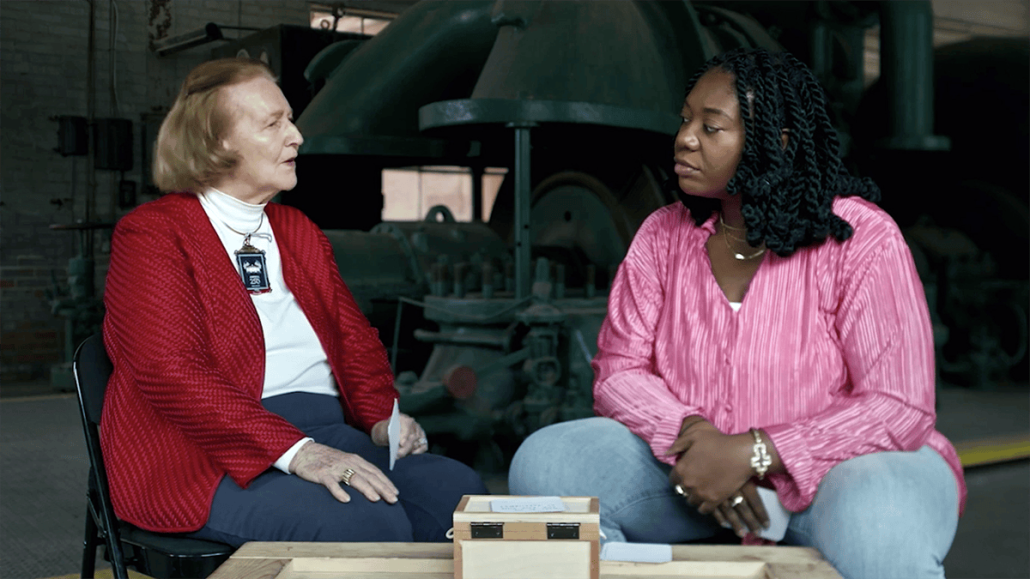
The documentary also included memorable conversations between an elderly white woman and a young Black woman in Alabama — about the difficulty in understanding that some people aren’t starting from the same place — and a Hawaiian teacher who philosophized about what this time in U.S. history might force us to reckon with.
A conversation in Alabama (photo from “The Work in Progress”)
On Immigrant Roots
One participant was Mexican American. “I’m very proud of where my family comes from — of the people, the community that I come from. Without immigrants, we aren’t the country that we say we are. As much as we want to currently exclude them, they are the foundation of every part of this country.
Another immigrant indicated he was a Republican, “but if it continues like this — I have seen the signs and symptoms of a dictator coming to power because I fled one. … I fled 17 days on foot, mostly by night, to flee the country that I belong to. For me, this is heaven. You know, with all the bad things it has, when you compare it to the third world, this is nothing. I came with $7 in my pocket to this country. I own several houses. I own properties. The American dream. “
One shared that he was born in poverty. “I always believed this was the land of plenty, of opportunity. That’s why I came here, and I did find most of it, but one thing that keeps eluding me is this idea of home. I’m suffering from cultural dislocation. When I go back to Colombia, I don’t feel like I belong there anymore. Here, will I ever be a full-time gringo? Probably not.”
A land owner in Arizona said he is proud that the U.S. protects public lands. “I have about 40,000 acres of public land. The ranch is on the international border. In 2024, 20,000 people came around the end of the wall on my ranch. At least 20 percent, according to the Border Patrol, were packing hard drugs, and now that’s zero. Things have changed.”
The same elderly man said: “Immigrants are wonderful. Our nation has benefited so much by immigrants, and we need immigrants. I think personally we ought to have a law that admits more immigrants. We currently admit about a million a year. Why not two million? But we have to have a border, and we need to secure it.”
Another indicated his family arrived to the U.S. in the early 1900s, escaping anti-Semitism, chased out of modern-day Ukraine. “I feel like there are so many similar situations right now with people fleeing horrific situations. And they wouldn’t be let in. If those were the laws at the time when my family came here, we probably wouldn’t be around. I agree that we need to increase opportunities for people to come here.”
A Chicago minister noted that his immigrant community has always lived with a sense of fear, but in 2026 it escalated to more than fear.
A rabbi engaged in conversation with him, said: “Even in my family, which has been here for so long, we still have that fear. We have conversations regularly about where we would go if or when it becomes unsafe for us to live in this country. Times have been particularly frightening when there have been these mass acts against the Jewish community. The Tree of Life shooting in 2018 in Pittsburgh, for example, was the largest anti-Semitic act of violence on U.S. soil. Eleven people were murdered.”
She added: “My synagogue has always had locked doors. We’ve always had police presence or security presence because it’s not safe. Every time I walk into my building and I’m greeted by a police officer, I’m reminded that they’re there because there’s the potential that somebody hates me so much that they want to kill me.”
The priest, who is an immigrant Black-skinned man, replied: “There have been moments as I grew up on the south side of Chicago where racial profiling was a thing; they expected every teenager was involved in a gang. There were times I got pulled over by Chicago police officers and I would get checked completely. They would empty out the car. Those moments were heartbreaking. But they also gave me the strength to continue the journey that God had placed me in.”
He added: “The beauty of this [conversation], as you said, is like a joke. ‘A rabbi and a priest walk in.’ Being able to engage in these kinds of conversations, recognizing the humanity in each of us — that’s part of that responsibility. How do we provide ourselves that space?”
Personal Takeaways
In the long conversation I had with friends after seeing the documentary, I realized one thing I was grateful for: the film did not try to organize itself around the question of “hope.” Instead, woven through the fragments of conversation the editors had gathered and carefully stitched together was something more substantial — an understanding that genuine conversations about our values, our roots, our inequities and the ways we live alongside one another have become neglected essentials of civic life.
That, in many ways, is the gap I want the future MN Press Changemakers Alliance to fill, as the consumer-owned media cooperative we are transitioning to in 2027. I want our stories to come with invitations to conversation — discussion prompts that give people a way to linger with an idea, question an assumption, share an experience, or consider what might be possible in their own communities.
The conversations we can have with each other are not about telling people what to think, but by creating more places to think together. More opportunities to explore the essential ingredients of collective health and personal fulfillment, and to ask what we owe one another as neighbors and citizens. This feels more consequential to me than the horse races, outrage, and gossip that so often define the media landscape.
What I want us to co-create, as a pioneering media co-op, is a place where conversation itself becomes a form of community care.
See “The Work in Progress” trailer
To support our vision for a multimedia storytelling co-op:

 For 2025 coverage, Minnesota Women’s Press earned a community leadership award, three photography awards, and four editorial awards, including for coverage of social issues and for our Spring 2025 “Know Your Rights” special section supported by Unidos MN. Our publisher was named Journalist of the Year by Violence Free Minnesota for gender-based violence coverage.
