


Presenting as My Age


The author Andrea Gilats (Photo by Sara Tucker)
The memoir Radical Endurance opens with the author reading her doctor’s notes from a check-up.
“Andrea Gilats is a seventy-four-year-old female who presents at that age.” What? … I felt bemused and slightly hurt. I had never thought of myself as the picture of pink-cheeked vitality, but I had always thought of myself as “presenting” younger than my chronological age.
I was indignant! I was belligerent! I swore to myself that on July 15, 2020, my first day as an old woman, I would treat myself to a challenging yoga practice, including sun salutations, warrior poses, and balances in order to prove beyond all doubt that these exercises, which had become second nature over my thirteen years of yoga practice, were still safely within my capabilities. I had heard the word frailty used to describe an alarming medical condition in which weight loss, fatigue, weakness, and depletion of spirit overtake unassuming old people, and I wanted to squelch that prognosis pronto. I hoped that if I could maintain enough physical fitness to preserve my independence, I would feel less afraid to face what I imagined, rightly or wrongly, would be the most consequential era of my life.
I celebrated my seventy-fifth birthday online over Zoom with my siblings. Congratulations! I have officially entered the age of invisibility; I am now a member of the mushrooming, if mythic, cohort of people who, dull people absurdly believe, have out-lived their usefulness. Like Kazuo Ishiguro’s dear Klara, who was cruelly relegated to senescence in a futuristic junk heap, I remind myself that in spite of my continuing humanity, putting me out to pasture or sorting me out of society is a normative, acceptable way that my contemporary workaday culture treats old people. My whirring old mind whizzes through my life course, and I find myself returning to a 1970 film that blasted all naivety from me, forcing me to accept the lifelong possibility that I could, along with millions of others like me, be selected out of existence.



There was a time not so long ago when I claimed a rightful space in the world, when my softening voice was still audible. When was that? Where did I go? Are my past selves lost to the passage of time? Have they aged into the scars, rough patches, and liver spots that speckle my skin? I am not sure. I am not clear yet. Still, against alarming evidence, I have begun to hope that old age might hold a last chance to find clarity, to arrive at end-stage peace.
Our society’s dominant culture, from its physicians and research scientists to its sociologists and marketers, has long parsed our adult lives into stages that delineate how we should spend our time, what kinds of health issues we are likely to confront, from whence we should derive meaning and value, and how we should perceive ourselves. These experts usually divide our lives into five stages: childhood, adolescence, young adulthood, middle age, and old age, categories created before people began living what psychologist Laura Carstensen calls “extra long lives.” Today, gerontologists further divide later life into three oxymoronic categories: young-old (ages sixty-five through seventy-four), middle-old (seventy-five through eighty-four), and old-old (eighty-five and older). Regrettably, too many of us have gotten used to contextualizing ourselves according to these kinds of categories, an act that I believe reduces our individual humanity and diverse life paths to mealy descriptors that have little specific meaning.
According to a recent Merck Manual study, I am one of about 44 percent of American women who were living alone by the time they reached seventy-five years old. I am also one of 30 percent of American women aged sixty-five and older who are widows. This same study found that 60 percent of Americans aged seventy-five and older reported feeling lonely, and the same number reported feeling socially isolated. Tragically, this reflected the state of older Americans before Covid killed three-quarters of a million old people and forced those of us who survived into long-term social sequestration, turning the everyday isolation we had been used to into prison-like solitary confinement.
I resent myself for becoming smaller in spirit, suddenly intolerant, overly paranoid, shamefully petty, and hatefully selfish. But these resentments pale in comparison to the anger I feel at the incompetent, cruel United States federal government that failed to control this killer when it had the chance. I grieve with each person who has lost loved ones to Covid. All my anger at the federal government, all my resentment of the pandemic, all my sorrow at so much death: all are manifestations of grief.
Excerpted from Radical Endurance: Growing Old in an Age of Longevity by Andrea Gilats. Published by the University of Minnesota Press. Copyright 2024 by Andrea Gilats. Used by permission.
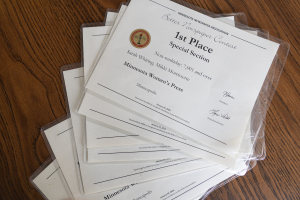 For 2025 coverage, Minnesota Women’s Press earned a community leadership award, three photography awards, and four editorial awards, including for coverage of social issues and for our Spring 2025 “Know Your Rights” special section supported by Unidos MN. Our publisher was named Journalist of the Year by Violence Free Minnesota for gender-based violence coverage.

