


Political Disinformation Hurts, Especially at Home
"Diversity in Politics" coverage is made possible by Women Winning and Vote Run Lead.
Misinformation and disinformation — incidentally or intentionally false information — have major impacts on already disenfranchised populations, often making them a target of hateful rhetoric. However, it is these same communities who can also be targeted. This is especially painful when it is in your own home and community. Trying to respond can be challenging.
 My nightmares involve Youtube conspiracy theorists and propagandists — and the fights my mom and I have, because my politics don’t align with hers. Those nightmares are intertwined.
Our recent blow-out was a few days before I finished this essay for Minnesota Women’s Press. She was watching somebody on Youtube talk about “re-education camps” Democrats want to send Republicans too. My mom asked what I thought about it and if that idea scared me: “Can you believe the Democrats are this evil?”
Normally I stay quiet, but this time I could not. “This is fake news,” I answered. We proceeded to fight, going down the same road that has become commonplace for us.
During my doctoral studies, and in recent years as a community journalist, I have became focused on disinformation and misinformation. I started to teach community journalism because I want to make sure communities of color, QT communities, immigrant communities, and low-income communities, know how to respond to the failures of U.S. media to tell meaningful and contextualized stories about experiences of oppressive systems.
My mom started watching Russia Today (“RT”) after Donald Trump was elected. Now, every night she sits down with my father and they watch a slew of what I call propagandists. All conservative (and/or libertarian) white men: Col. Douglas MacGregor, Larry Johnson, Judge Napolitano, and more. Every one of them scare me.
My mom is an incredibly smart woman. For much of my life, she also was an incredibly kind woman. Over the last several years of watching these Youtube platforms, I’ve seen her become more cruel. She believes the world is out to get Christians — out to get people like her and my father. The media she watches is steeped in anti-trans and anti-queer hatred. To them, liberals and leftists are the devil incarnate, working on behalf of a Deep State. I do not know how she went down this rabbit hole.
My family is Middle Eastern, so it is also terrifying to see these same propagandists use the tragedy of genocide to push their own anti-American, anti-Democratic views. I want to yell: “Don’t you know they’re using you, using Palestine (and Lebanon, Syria, Iran) to push their own agenda forward?” I wish I could better verbalize what that agenda is.
When my mom talks about the possibility of a Civil War, I worry because I know we won’t be on the same side. My commitment to justice and to the communities I have organized in and taught goes too deep — my mom taught me that loyalty. I hope the mom who raised me would understand if I chose not to be on her side.
When I worry about Election Night violence and “stop the steal” insurrectionists, I worry about my parents cheering them on from home while I report on violence from the streets.
When I think about another potential Trump presidency, I know that I would be reporting on community organizing, mutual aid, and a lot of hurting people, while my parents might even think those hurting people deserve it.
I think of a shooting in Tennessee in 2023; it is the only school shooting we’ve talked about in my home in years — because the perpetrator was a trans man.
I think about Uvalde, which some of my family members believe is made up, on behalf of a liberal government to overturn the Second Amendment and use that as a platform to begin overturning all the rest of the Bill of Rights as well.
As a Democrat and leftist, I think a lot about what my parents and the rest of my family think about when they think about me, because my politics sure make me the enemy.
I’m offended by these propagandists as a nearly 40 year old woman in this country. I’m also offended by these platforms as a journalist. And I believe that journalists should be scared because we are being undermined in our ability to do our work.
What I also think about is this: Misinformation is incidental or accidental false information. Disinformation is intentional. Its purpose is to hurt all of us.
“Disinformation is a weapon of divide and conquer. It is a weapon that is strategically and surgically used to keep people divided,” says Annastacia Belladonna-Carrera, executive director of Common Cause MN. “Disinformation is about who has political power, who has socio-economic power. So you have to ask yourself the question, who benefits from disinformation?”
Misinformation and disinformation come in many forms, and vary depending on the community and their access to the internet. In urban and suburban communities, social media networks can be sources of misinformation and disinformation. In rural communities, where there tends to be less broadband access, this can spread through relational networks, maybe because of a respected individual spreading false news.
“The common impact for both urban and rural communities experiencing disinformation and misinformation is that it can undermine social cohesion and trust in institutions,” says Belladonna-Carrera, who argues that combatting this should be central to the conversations we have about media and its responsibility to a well-functioning democracy.
“Media designed to advance the public good, hold power accountable, or build mutual understanding is now actually competing with intentional disinformation and misinformation narratives — the conspiracy theories,” says Belladonna-Carrera.
This can lead to a greater mistrust not just of legacy media, but also of our elections and governmental institutions. If people do not trust our election process, they will not feel called to engage with it and they might not trust the results.
“Think about the arsenal — redistricting, gerrymandering — that is in place to do what? To keep Brown and Black people, as well as other disenfranchised, from political power. And if you cannot stop people from getting power through districts that are designed to nullify and waste their ballot, then you have to keep them from the ballot box,” says Belladonna-Carrera, who also is quick to point out that misinformation and disinformation is not just about race.
Low-income white communities are just as impacted by misinformation and disinformation as non-white communities, though they often listen to harmful narratives about Black and brown communities. What this might sound like: your small businesses aren’t going out of business because of big corporations and legislation unfriendly to small businesses. It is the undocumented immigrant, the trans person next door, the big city, that person over there.

One form of disinformation specifically comes from the use of “deep fake technology.”
“Deep fake refers to videos, audio recordings, or photos that are created using tools powered by artificial intelligence to realistically impersonate someone without their consent or knowledge,” said Rep. Zack Stephenson (DFL, Coon Rapids) to a meeting of the House Elections Finance and Policy Committee in 2023. He authored a bill during the 2023 legislative session aimed at banning the use of deep fake technology to influence Minnesota elections.
The bill, alongside the Senate counterpart authored by Senator Erin Maye Quade (DFL, Apple Valley), became law, building on prior legislation aimed at banning other forms of election interference.
While misinformation can lead to a lack of trust in our political and social systems, disinformation is intentionally trying to cause that lack of trust. “I think misinformation and disinformation have been able to get such a grip on our spaces in Minnesota because there hasn’t been a lot of discourse about what the role of media is in a healthy, accountable democracy,” says Belladonna-Carrera.
Belladonna-Carrerra adds that rural Minnesota, and suburban and urban Minnesota, need two separate responses aimed at inoculation. One approach, she says, is to “urge people to fact-check, fact-check, fact-check. You can use online fact-checkers that check reliability and bias, as well as political slant.”
Importantly, however, disinformation and misinformation are not just about facts. It also is about the intentional use of language to incite certain feelings and certain reactions, she adds.
Within my family, I have seen the twisting of information put an incredible strain on us. We have lost a lot of trust in each other. The home life is constantly tense. I don’t know how to speak up against my parents, because that’s not acceptable in my culture. But I also cannot sit and watch my loving parents disappear in front of me.
I don’t have a response to the question of who benefits from my parents’ disappearance. But as I think about who benefits, I am reminded of all the time and money they give to platforms, movements, and propagandists that they never gave to before.
to support our unique first-person narratives:
How to Assess Media
The Coalition for Liberated Ethnic Studies offers question-oriented practices for achieving critical media literacy (CML), which goes beyond traditional literacy by focusing on the consumer’s understanding of what is in front of them. CML lays out a series of principles and beliefs to assess questions about what we consume.
Critical media literacy proponents believe:
- All media is political.
- All media is subjective. No media is neutral.
- All media has a purpose and serves who owns and creates the media.
Questions to help assess a media story (paraphrased from a longer list):
- Who is the author? Are any details on the author provided?
- What words are being used? Are they amplifying or inciting?
- How does the article make you feel? What is the media/text’s point of views on the issue at hand?
- How are people portrayed in the media or text, if at all?
- What is the potential impact of this media on communities and issues of injustice?
- What stories and perspectives seem to be missing from this media or text?
How to Combat Misinformation and Disinformation
The Union of Concerned Scientists (UCS) notes that misinformation and disinformation cannot necessarily be countered with facts and truth. Instead they offer several other options:
- Don’t share disinformation and misinformation in the first place, such as on social media, where it has even more chances to go viral. “When a lie is repeated and seen multiple times, people unintentionally begin to accept it as truth, due to their increased familiarity with the false claim, a phenomenon known as the illusory truth effect.” The best way to get in front of it is to keep it from being spread in the first place.
- If you accidentally share disinformation or misinformation, then learn the news or information was fake, issue a correction.
- Instead of trying to counter with real information, warn people to be wary of potential disinformation. That will get their guard up and they’ll be more likely to be critical of the media they engage with.
- Amplify accurate and credible sources. Specifically, UCS recommends making a truth sandwich — begin and end with the facts, and layer a reference to the lie in the middle — while making it clear that it is a lie.
- Report perpetrators of disinformation on social media platforms.
- Have one-to-one conversations. “Relationships must be built and strengthened with family members, friends, and community members to have solidarity against the bad actors who use disinformation to divide, distract, and demoralize communities. Be patient with people in your life who have bought into and are amplifying disinformation. Often, they’re reacting from fear or other negative emotions.”


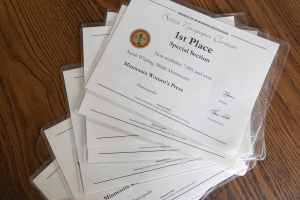 For 2025 coverage, Minnesota Women’s Press earned a community leadership award, three photography awards, and four editorial awards, including for coverage of social issues and for our Spring 2025 “Know Your Rights” special section supported by Unidos MN. Our publisher was named Journalist of the Year by Violence Free Minnesota for gender-based violence coverage.
