

Part 2: Building Prosecution and Prevention Into Addressing Domestic Violence

Coverage supported by the deep donations of long-time supporters Kristin Siegesmund and Becca Brackett.
In 2023, Minnesota legislation passed that was signed into law by Governor Tim Walz to help address increasing gun violence, which had become the leading cause of death for children in the U.S. The bill included an Extreme Risk Protection Order (ERPO) law, which gives family members, law enforcement, and sometimes medical professionals, coworkers, and school officials a way to petition the courts to temporarily seize or prevent the purchase of firearms by someone who is in a mental health crisis and in danger of harming self or others.
At the time, the Minnesota Commissioner of Public Safety, Bob Jacobsen, testified that these orders give people who notice warning signs an ability to raise concerns to the legal system related to potential suicide and homicide. He pointed out that firearms are used in almost half of the documented domestic violence homicides in Minnesota. Rep. Cedrick Frazier — who is now running for the role of Hennepin County attorney as Mary Moriarty prepares to step away — led the legislation effort.
After the ERPO law passed, Everytown for Gun Safety’s local Moms Demand Action chapter reached out to Moriarty to ask if she needed help educating and implementing the ERPO law. Moriarty said it was in that meeting that she realized “none of us know what we’re doing with this law, including law enforcement, so we needed somebody to coordinate the response here in Hennepin County.”




Rana Alexander
Rana Alexander was hired by the Hennepin County Attorney Office (HCAO), she started trainings around the county about what the Extreme Risk Protection Order legislation enables law enforcement and community members to do to remove guns from an abusive person. “She is the person responsible for getting law enforcement on board, which needed to happen.”
“Rana was the perfect person because she was already doing training with law enforcement and they trust her,” says Moriarty. “She’s been amazing, helping everyone figure out what we are supposed to do, how ERPO works, and territorial things — like, should it be the sheriff that does it, or should it be the city in which it happened?”
The attorney’s office also was able to hire an advocate, Bridget Liverca, to work directly with the county’s Domestic Abuse Service Center (DASC). She talks to walk-ins and others about what their options are, creating a safety plan, deciding whether they want to pursue legal action — including an ERPO — against an abuser, and getting them navigated to resources.
What Continues to Need Reform
Domestic violence cases continue to need adjustment — for both prevention and protection.
In the ideal case after homicide, the police department does a thorough investigation that yields evidence that can be proven in a court of law to hold someone accountable. The HCAO can respond to investigator questions during their process, or the HCAO can ask for follow up material after it is submitted.
In the case of 47-year-old Indigenous woman Allison Lussier [see details from an audit of the investigation here], says Moriarty: “Saying it lightly, the investigation was not ideal. The assumption police had was that she died of a drug overdose. She died of a subdural hematoma.”

Mary Moriarty (photo by Sarah Whiting)
Although Lussier was the victim of previous assaults, the police did not seem to suspect that she was a victim of her abuser. “The medical examiner could not definitely say whether it was a homicide or an accidental death,” says Moriarty, partly since so much time had passed after Lussier’s death before an autopsy was requested. “The medical exam is very important evidence to us, because we have to prove beyond a reasonable doubt not only about the person that caused whatever it was, but that the death was homicide and not an accident. So, that was a challenge.”
The evidence submitted to the HCAO about Lussier’s death was “in pretty unchargeable form.” The attorney’s office did some of their own investigation, meeting with the family and advocates. “Sometimes community members don’t want to talk to police, and sometimes the police don’t seek them out for an interview. With the medical examiner unable to say what caused the subdural hematoma, we need strong circumstantial evidence. No videos of the area were collected, and some video was taped over.”
Moriarty had been a public defender for decades. “If the prosecutor goes to court with limited evidence to prove without a reasonable doubt, the defender can argue that she might have accidentally fallen. That’s all it would take for an acquittal, and if that happened, we could never try it again.”
Moriarty says she understands why the family is frustrated. “People screwed up here, and Allison is not getting justice. But we are still working on it.”
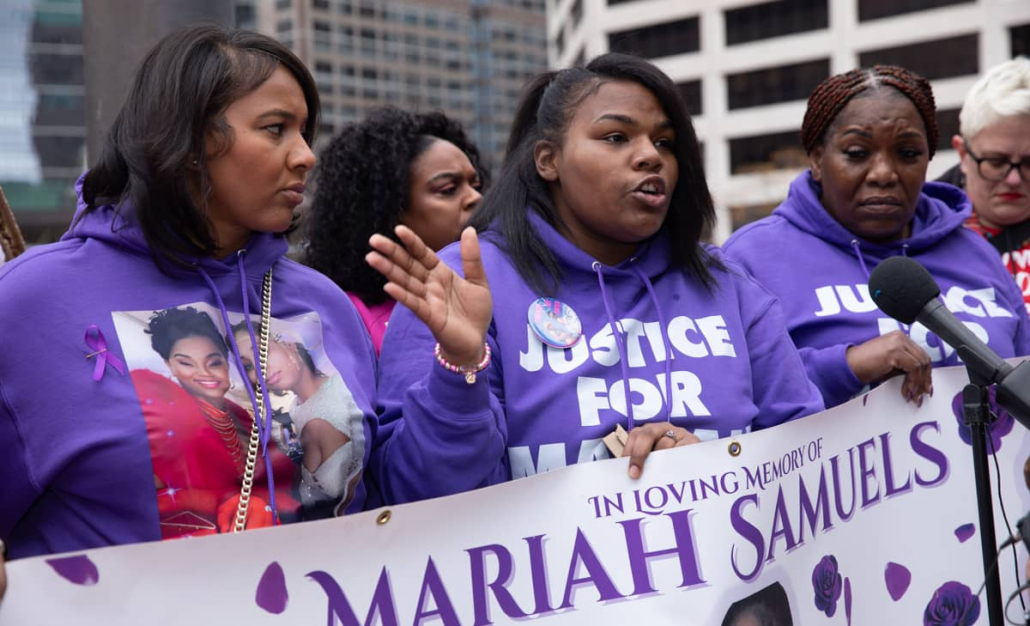
Sisters Salina Owens (l) and Simone Hunter (c) talk about their sister, Mariah Samuels, and how the Minneapolis police department did not intervene to stop her abuser. Mariah Samuels was shot 10 times by her abuser. Photo Sarah Whiting
Shortly after Lussier’s death, a similar mishandling happened in the case of Mariah Samuels: a history of domestic violence that led to murder and a renewed reckoning with a faulty process. Moriarty pulled her team together to discuss: “What can we do here? Is there some way we can streamline the process?”
She asked her staff to make recommendations “about how we could improve, and what MPD could do. One of the pivotal issues is the ‘gone on arrivals (GOAs).’ In 2025, MPD responded to more than 2,000 felony-level domestic violence calls for service. On 1,286 of those calls, the suspect was gone on arrival (GOA). MPD was not investigating those. They also had language about lack of cooperation from some victims, which could lead to dismissal of investigations.
HCAO now has City of Minneapolis funds to reach out to every victim on domestic violence GOA cases so that victims have a consistent point person to talk to and build trust with. “This partnership will help ensure a quicker trauma-informed and victim-centered response to victims following a highly lethal domestic violence incident, a greater streamline of victim services and support, and a more effective systemic response by providing victim input to law enforcement and prosecution,” says Moriarty.
As soon as police chief Brian O’Hara left his role in May — who had a strained relationship with Moriarty — Katie Blackwell, the acting police chief, asked Moriarty to talk together about changes to domestic violence investigations. One of the things on Moriarty’s list was that MPD has not had an officer embedded with DASC for six years. “She agreed to put that person back.”
The MPD also used to have about 14 domestic violence case investigators and were down to about four. “Katie had already moved that up to about 10.”
Moriarty also asked for a domestic violence arrest team that could arrest suspects who are GOA. “If you have 2,200 GOAs and nothing much is happening on those, that tells perpetrators that if they leave the scene before police arrive, nothing will happen. That can’t be the message sent to people who are engaging in harm.”
They agreed on all the items on the list. Moriarty hopes that is still the case with the newly installed interim police chief, and the eventual permanent replacement.
The Role of the DASC
In the Samuels case, MPD had indicated in a report that she was experiencing no threats — but she had received texts from the abuser, despite having an Order of Protection against him. “That’s a violation,” Moriarty says.
Samuels also never indicated that she felt safe, even though the officer said she did. “If that cop had given her a card of someone at DASC who could have worked on a safety plan, we could have relocated her to a hotel, for example. There are a lot of things that need to change, including streamlining the process. We’re working on that with the MPD,” she says.
Having an MPD officer embedded again with DASC is important, because advocates, city attorneys, and county attorneys talk actively together about cases. “If the risk assessment is high — are there guns in the home? has there been strangulation? — we can say we need to go out and pick up the suspect because we’re afraid something terrible is going to happen. We can review for charges right away, safety plan with the victim, and intervene.”
There have been several reports to the Minneapolis mayor’s office and police department recommending how they can improve response to domestic violence cases, such as better assessment of risk factors.
Why Hasn’t the Process Improved Over Decades?
Says Moriarty, “To be honest, people put the resources where their values are, right? Credit to Katie Blackwell, who was adding resources when she had the opportunity. But what does it say when you have only four or five investigators doing all of the domestic violence cases in the city of Minneapolis?”
She noted that Hennepin County commissioner Irene Fernando wrote a letter to the mayor asking questions. “Any time a tragedy happens, we all have to be looking at what happened, what did we do, what did we not do. There were glaring things in Mariah Samuel’s case that did not happen. We should be able to say ‘this should have happened, we should have done better on this, and we’re going to improve it.’ That’s leadership.”
For Moriarty, the former public defender: “Prevention is the best public safety you could possibly have.”
We need deeper support to continue Violence Prevention coverage:

About the Domestic Abuse Services Center
The DASC office and staff reflect a unique collaboration among law enforcement agencies and domestic abuse service providers. The Hennepin County Attorney’s Office, Minneapolis City Attorney’s Office, Fourth District Court, Hennepin County Sheriff’s Department, and a range of social service organizations work together with regular office hours.
Advocates engaged with DASC — which is now in its 32nd year — include Asian Women United, Esperanza United, Division of Indian Work, SEWA-AIFW, Phumulani, and Domestic Abuse Project. The staff provides culturally specific and trauma-informed services. DASC has advocates that speak English, Spanish, Hmong, Somali, Hindi, Newari, Nepali, Telugu, Tamil, and Sanskrit.
Central Minnesota Legal Services provides pro bono legal consultation and representation to individuals at DASC. Referrals for legal consultation are made by advocates.
“We Don’t Have to Choose” podcast about the work of ERPO (“red flag laws”)
Related Reading


 For 2025 coverage, Minnesota Women’s Press earned a community leadership award, three photography awards, and four editorial awards, including for coverage of social issues and for our Spring 2025 “Know Your Rights” special section supported by Unidos MN. Our publisher was named Journalist of the Year by Violence Free Minnesota for gender-based violence coverage.

