

Part 1: How Control Perpetuates Gender-Based Violence

This story sharing made possible by the donations of Bill and Michelle Pohlad, as well as long-time supporter Kristin Siegesmund.
 Minnesota Women’s Press and Saint Cloud State University Women’s Center hosted a gathering of advocates who talked about aspects of gender-based violence in Minnesota’s diverse communities that are not given enough attention. The conversation detailed instruments of abuse — and silence — that often trap survivors in a continued cycle of pain.
Preserving Family Honor
Control is often used to preserve family honor. Shoua Kong, a sexual assault advocate with Saint Paul-based Transforming Generations, explained that victims are often silenced by their own loved ones due to intense shame and the desire to preserve family reputation. This pressure is acutely felt when the harm-doer is a relative. The victim is forced to choose between seeking safety and upholding “peace in the family,” with the latter often leading to protection of the abuser, which maintains the structure of dominance.
Said Kong, “Sexual assault is more common than people realize in the Hmong community and Southeast Asian. It’s kept under the rug; this silence doesn’t mean that it’s not happening. We also have seen the survivor tell their story and get victim-blamed in social media. There is no accountability, and the cycle will repeat.”
For healing to happen, she continued, there needs to be “a blend of cultural practices, such as storytelling, spirituality, and traditional healing.”

Shoua Kong, Transforming Generations
Transforming Generations offers support groups for sexual assault and domestic violence survivors. They also host support groups for harm-doers, with an emphasis on accountability, growth, and change, “rather than only a focus on punishment.” The group offers support to those in the LGBTQ+ community and youth.
Kong said male patriarchy can be high in Southeast Asian cultures — “I’m the man, and you’ve got to do whatever I say. That is controlling power.”
Religion can also inhibit healing, she said, by asking victims to repent for what happened.
Solutions need to happen by education within the family and community, and by helping youth understand what sexual assault is and offer prevention strategies.



Trauma Begets Trauma

Comfort Dondo (photo by Sarah Whiting)
Comfort Dondo, founder of Phumulani: Minnesota African Women Against Violence, talked about how isolation and separation from one’s culture can increase vulnerability to violence — and how the greatest threat often comes from within the community itself.
We met days after Falus Ali, who was 17 weeks pregnant, was murdered by her ex-partner in front of their three-year-old child. Dondo took a moment to honor her and “bring her into this space.”
As a survivor of domestic violence and attempted homicide, Dondo said, she created a nonprofit after “seeing the need among African-born immigrants and refugee survivors and the lack of culturally specific shelters for African-born women. Minnesota has two of the largest [population groups of] civil war survivors out of Monrovia and Somalia. A woman who wants to flee might be taking care of seven kids, including some from a late sister from home. So it’s complex. Those women don’t really fit in a mainstream shelter.”
She says Phumulani’s work is centered around acknowledging that African immigrants moved here steeped in the trauma of war or fleeing dictatorships. “Our work is focused on the healing aspect: naming the trauma and providing housing stability.”
She offers healing circles to also address the commonalities of isolation and separation from culture. “Depression rates can increase with immigration. So our healing circles mimic the way our mothers used to gather — around storytelling,” Dondo said.
There is an intergenerational nature to trauma, Dondo added. After she wrote about her own traumas of assault in a book, she was outcast from her family because she named perpetrators. Eventually her mother was able to acknowledge that she, too, had suffered in a similar way.
Before colonization in Zimbabwe, Dondo said, the community had a matriarchal culture. The toxic nature of patriarchy arrived and led to a perpetuation of stigmatizing women, which now also includes genital mutilation as a rite of passage.
After Dondo moved away from her abuser, she was a single mom. “The word for a single mom in my language translates into second hand, used — so you become discardable. The women who are married don’t want us to stay with you. The men who know that you’re single are very disrespectful. Some women would rather maintain a sense of security rather than be outcast by community.”
Societal outcasting and disrespect is a tool of control, she said, which enforces silence.
On the other hand, community can be an integral part of the healing process — if it chooses to be.
Dondo indicated that she received a Bush fellowship in 2022, which offered her the time to go back to traditional ways of healing — such as gardening, lunch conversations, plant medicines learned from Indigenous practices.
“I think individualism has separated us from recognizing each other’s humanity,” Dondo said. “In the healing circles, we are creating a space where we can see each other and acknowledge each other’s humanity. We have done more than 50 healing circles over the last eight years. I saw women who caused harm in the war in Liberia — different tribes coming together and, after six weeks together, acknowledging the harm and talking about it.”
She said talking about mental health is stigmatized in her culture. “We don’t have language in my language for mental and wellness. When we say someone is not doing well mentally, we just say they’re sad, they’re tired. We don’t have names for things like PTSD — so you cannot heal it.”
With that lack of definition, “People are very resistant to doing traditional therapy,” Dondo said. “Instead, we create multi-generational connection. When you’re coming from civil war, there’s no trust. When trust is rebuilt in healing spaces, then some people become more open to combining ways of healing: in nature, gardening, therapy.”
She added: “Healing is a whole journey. Who defines what successful healing is, or how long any given person’s healing should be?”
Blinded to the Problems
Dr. Brittany Lewis of Research in Action
Brittany Lewis, founder of Research in Action (RIA), works at the intersection of health, housing, and human services. She wrote a legislative report in 2022 that helped Minnesota develop the office for Missing and Murdered Black Women and Girls — first in the nation. She knew that a gap to be filled was understanding the needs of Black women and girls for shelters and services — learning about their experiences “being housing insecure, and with health agencies and facilities that have a role in [addressing] their susceptibility to violence.”
With a Bush community grant, RIA has launched a five-year study of the needs of Black women and girls around the state, “asking questions about their safety, vulnerability, and trust in these institutions.” It will lead to a “social vulnerability index” that public health providers and others can use to measure susceptibility.
One of her goals, Lewis says, is to work directly with counties after identifying needs. In Hennepin County, agencies will have a new evaluation tool to learn how the homelessness prevention programs, safe communities programs, domestic violence services, and street work services are working for survivors.
It has been harder to find rural counties to work with. Lewis indicated that a public health director in one county asked her to convince him that the topic mattered. “People aren’t fully aware of the disparate ways that women of color, Black, and Indigenous people are disproportionately impacted by a number of health issues.”
Lewis added, “I believe in the power of research. I think it’s been used against Black, brown and Indigenous folks in not very helpful ways, historically. But it is a language that moves conversations and that we need to be a part of. We need at least 600 Black women and girls to complete this survey.”
It can be challenging, she added, to do public policy work that focuses on particular communities and cultural ethnic groups. “We have had to present a lot of data to distinguish why it mattered, and also to show the stark numbers of the impact in Minnesota — that Indigenous and Black women are disproportionately more likely to be murdered.”
It does not help, Lewis indicated, when media narratives get the stories wrong. One woman consistently needed to testify to policy-makers about her sister’s murder, resharing the story, dealing with insensitive questions about the young girl’s life.
“The Star Tribune alleged she was a prostitute, which she was not,” Lewis said. “For women of color, it’s about [convincing others that] your life mattered, to support the act of searching for you. Presumably, if she was a prostitute, the public would care less, which is extremely problematic.”
Lewis indicated that Black feminism largely emerged in 1980s Boston when male leaders ignored missing Black prostitutes in the city. “The politics of masculinity during that time meant that these Black women’s lives didn’t matter. And that’s the heart of Black feminism — the organizing that created what Black feminism is today.”
She said it is disheartening when families need to continue to tell the story of a missing and murdered young woman, and to prove to legislators and other officials that this deserves attention. “When we actually create practices and support around these women, we support All women. That is a hard narrative for some folks to understand.”
Lewis said that she hopes the research RIA is doing will evolve into “no longer being able to hide behind not knowing.”
As she explained, “One of the first things our data team did was map every domestic violence shelter in the state. Then we mapped where the concentrations of Black women and girls lived and moved — how far it would take for them to get there. The further you get away from the Twin Cities, the more disparate these spaces are geographically. You would have been shocked how hard it was for us to actually map these places. We were working with the Office of Justice Program at the State of Minnesota to see if they had lists — they did not. We have now created what I believe is the most comprehensive list [of shelters].”
The gaps in what we do and do not know are vast, Lewis says. “You can’t even have the conversation until the data exists. We started at: Where do we need to fill the gaps in physical proximity to getting to a safe place? The gaps in attention from law enforcement — I don’t know that we have enough time to talk about that. How the FBI is able to collect murder records is dismal, because not all county officers and police departments are required to report the same data. Was it murder by gun or strangulation? Was it a domestic violence situation? That’s not always reported. The existing data on who was murdered is so limiting. It is sad.”
In bigger cities like Minneapolis, “They’re collecting more information and have a systemic process for doing it, with infrastructure and funding.”
Lewis said even within law enforcement, there are gaps in understanding the lack of mental health support for officers. Personal life challenges — from addiction to divorce — and how that comes to work, is not understood, alongside the intersection with cultural bias.
“We wanted to do a project that will help us get a sense of what mental health support services they really need,” she said. “We argued that it would be a benefit for everyone in the community. They entertained it initially, but the police union shut it down.”
The collective message from these advocates was clear: Only by empowering survivors through culturally appropriate healing, forcing data transparency, and challenging deep-seated stigmas can Minnesota truly begin to break the intergenerational and intercultural cycles of gender-based violence.
Resources
Related Stories
To support our coverage of violence prevention:


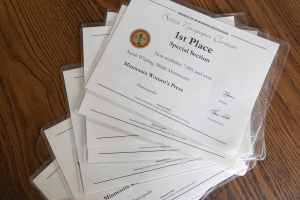 For 2025 coverage, Minnesota Women’s Press earned a community leadership award, three photography awards, and four editorial awards, including for coverage of social issues and for our Spring 2025 “Know Your Rights” special section supported by Unidos MN. Our publisher was named Journalist of the Year by Violence Free Minnesota for gender-based violence coverage.
