


Nadia Mohamed: An Historic Rise as Mayor
Nadia Mohamed. Photo Sarah Whiting
When Nadia Mohamed thinks about her journey to becoming mayor of Saint Louis Park, she marks a beginning in 2016, when Donald Trump was elected president for the first time. As was the case for many young activists, after seeing the election results she propelled herself into political action and community organizing.
She also traces her journey ten years earlier, when she started making monthly visits to Saint Louis Park City Hall to drop off her family’s rent check for subsidized housing. “Somewhere inside me [today] is a 10-year-old girl who wanted her face on the wall of mayors,” she says. She noticed that all of the city’s mayors were white, and only two of them were women.
Then a new immigrant to the U.S., Mohamed longed for a sense of belonging in her city. She says part of her role as mayor is to inspire young residents who look like her. Shortly after she was elected mayor, Mohamed visited a local elementary school, where she “watched in real time as the students tried to compute how someone who looks like me could be the mayor.” One girl wearing a hijab told her that the two of them are probably cousins, Mohamed recalls with a laugh.



After four years serving on the Saint Louis Park City Council, from 2020 to 2024, she is acutely aware of the systemic barriers that reinforce underrepresentation in elected office — starting with the steep cost of running a campaign. Her city council campaign was financially draining. “Most people in my network did not have the disposable income to make even a small contribution,” she says.
When she ran for mayor, Mohamed was able to tap into new connections and resources. Today she promotes mixed-income communities where “those in million-dollar homes live next to those in Section 8 housing.”
Another financial barrier to holding elected office is the salary. Like many elected officials, Mohamed works a second job, spending her 9-to-5 at a state agency doing child advocacy work. She and parents and siblings rent their home in Saint Louis Park — an experience that sets her apart from former mayors and city council members.
Mohamed’s commitment to affordable housing was central in her city council campaign and remains at the top of her priority list as mayor. “There’s a stigmatization of renters, with some [indicating that renters’ status means] they are not invested in the community,” she explains. She is working to provide pathways for renters in her city.
Since her election to city council at age 23, becoming its youngest-ever member, Mohamed has developed much more confidence about her age.
“I used to worry about my age and play it down,” she says. Now her 28 years are a point of pride. She says that most Saint Louis Park residents are excited to see someone young in the mayor’s office. She’s also found power in sharing openly about not knowing something, pushing back on the expectation that “women in public office must reach for total perfection.”
One point of Mohamed’s identity that has not wavered is her faith. The national attention in the wake of her election — as the first Somali mayor in the United States and the first Muslim mayor of Saint Louis Park — has died down, but the questions about her relationship to Jewish constituents persist.
For Mohamed, these questions overlook the complexity and diversity of her city. “When people look at Saint Louis Park, they look at white, affluent community members, and they often think of the history of the Jewish people here,” she says, indicating that growing Thai and Somali communities are changing the city’s demographics.
Mohamed says she builds trust with all residents in a simple, straightforward way: “I just show up with my values, with my hijab, with what I stand for. And I do what I can to provide the things that residents need.”
Now in her second year on the job, she remains focused on the basics. “My constituents need their roads safe, their water drinkable, their snow plowed,” she says.
The accomplishment she is most proud of so far is powerful but simple: she passed her first budget for 2025. Mohamed says, “I’ve been reiterating and reaffirming that I am for Saint Louis Park, by Saint Louis Park, of Saint Louis Park.”
If you appreciate our unique coverage focused on the power of Minnesota women:





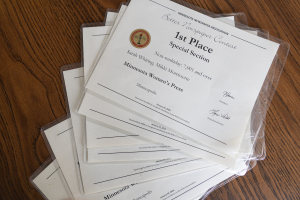 For 2025 coverage, Minnesota Women’s Press earned a community leadership award, three photography awards, and four editorial awards, including for coverage of social issues and for our Spring 2025 “Know Your Rights” special section supported by Unidos MN. Our publisher was named Journalist of the Year by Violence Free Minnesota for gender-based violence coverage.

