


My Quest Seeking Progress Since 1960
Coverage supported by the deep donations of long-time supporters Kristin Siegesmund and Becca Brackett.
Lynette Malles. Photo Sarah Whiting
My journey toward justice was sparked in 1960, when I was 17. I was raised in racially divided Saint Paul and attended a nearly all-white school. My dad had a brief assignment at a Black university in Nashville. There I met Black students who had participated in lunch counter sit-ins. Scars on the backs of protesters’ necks shocked me deeply. Racist white boys, in addition to pouring ketchup and mustard onto the heads of sit-inners, would also hold lighted cigarettes against protester’s necks. These victims told me they sat silently despite the pain.
Sit-ins sometimes continued for weeks until owners who were losing money began serving all customers. I desperately wanted to help their cause. My family urged me to continue school rather than join Civil Rights freedom riders to the south. I followed an unwavering educational path for years.
During the summer of 1966, I was leading art classes at historically Black Tougaloo College in Mississippi. Someone drove me to meet Fannnie Lou Hamer, who lived in a shack nearby. She was in ill health, at age 49, because of beatings in prison four years earlier after she tried to register to vote. In 1966, being a white person in a car with Black students was dangerous. One Saturday evening, heading to a Black bar, I was advised to lie down on the back seat floor under a blanket. If I’d been seen in mixed company by white motorists, we might have been shoved off the road, or worse. At the bar, I was included and welcomed. We danced all night. Freedom!

(l–r) Floyd McKissick Sr., Martin Luther King Jr., and Stokely Carmichael participating in the March Against Fear, which was originally initiated by James Meredith. Photo Bob Fitch Photography Archive, Department of Special Collections, Stanford University Library
Civil Rights
James Meredith had desegregated the University of Mississippi, where he graduated in 1963. Three years later, it was still risky for Blacks to vote in the south, so he started a march. He wanted to encourage Black residents between Memphis, Tennessee, and Jackson, Mississippi, to register to vote. On the second day of the march, a sniper shot him. He recovered at a hospital.
Horrified by the news, Martin Luther King Jr. called for thousands to continue the 21-day march. It resulted in over 4,000 Black people registering to vote. Shortly after, I joined 15,000 people on a walk to the Mississippi state capitol. I was alongside Stokely CarmichaeI as he shared his new vision of Black Power.
Approaching the capitol singing “We Shall Overcome,” we saw the building was surrounded by state troopers with rifles. The governor threatened to shoot anyone who set foot on the steps. King, the recovered Meredith, and other scheduled speakers set up a canopy nearby and spoke from there to a televised audience.
While teaching in New York City in 1968, I learned about the assassination of King. I saw crowds of Black women in tears of anger walking arm in arm toward Times Square. The next day I resigned from my job to join King’s Poor People’s Campaign in D.C. The mission was to expose and address the country’s income inequality.
The ‘’Resurrection City’’ encampment was erected along the National Mall. It was its own miraculous town run by sharing, caring Civil Righters. We had a barber shop, city hall, food tent, and day care. Residents arrived from all over.
During the day, meetings were scheduled with legislators and protests were held at the capitol. On June 14, I awoke to the roar of bulldozers destroying tents. Resurrection City’s permit had expired. We escaped with only our backpacks. D.C. activists put us up for several weeks while we continued protests and did door-to-door organizing. But it felt like our momentum had waned. Many were traveling to the Democratic National Convention in Chicago.
My Trip to Morocco
Next, I sailed on a freighter to Tangier, Morocco. Far from the racism of the U.S., I reflected for several months on where my path toward justice might lead.
Tangier was incredibly diverse. One could hear Arabic, Spanish, Portuguese, and French. One day I was invited to join others on a trip via donkey up the Middle Atlas Mountains to a Berber village. Villagers were in the midst of a seasonal agricultural celebration. Women and children were joyously singing and dancing around a fire while men played music indoors.
Weeks later, my mood changed with the discovery that I was pregnant. My boyfriend at the time directed me to a corner in the old city where a man opened up his jalaba [cape], displaying over 20 syringes. I stepped behind a wall, where he injected me with an abortion solution. It worked.
Feminist and Socialist Organizing
By 1970, I was back in New York City. I joined a few Radical Redstockings feminist meetings. Returning to Minnesota to help my mother with my ailing father’s care, I met feminists on a picket line. I joined the Twin Cities Female Liberation for Consciousness-Raising, and assisted the Women’s Counseling Service in helping pregnant women get to California for legal abortions.
During consciousness-raising sessions, we learned how we had accepted feeling belittled and had experienced mild to violent abuse by males for years. Black Civil Rights veterans and other people of color shared with feminists a passion for justice and the need to restore dignity and self-worth. I appreciated the small-size meetings and actions with a flexible, informal organizational structure.
Back in Minnesota by 1971, I came out as a lesbian and started taking karate for safety. One dark evening, a man rushed toward me. Readying my kick, I yelled out a martial arts “kiai.’’ Startled, he rushed away.
By 1972, I missed not being around women of color. Female liberation groups were almost exclusively white in the Twin Cities. I started socializing with Native and African American women. Chicana feminists held a conference in Houston attended by 600 people. They addressed sexual discrimination, childcare needs, abortion access, and forced sterilization.
In 1973, I learned about the Rising Moon lesbian commune and headed into the countryside of Aitkin County. There I found a delightfully self-sufficient farm without running water or electricity — part of a 160-acre land trust. The “Back to the Land” movement for straight hippies, religious sects, and other groups were thriving elsewhere as well.
By 1975, socialist organizations in the Twin Cities had begun to attract my attention. I had started to lose hope that lesbian and radical feminist groups could end war, change unjust laws, or precipitate political and economic change through protests, bookstores, and living in isolated communities. I yearned to belong to a serious, nonviolent, radically structured group that could lead us toward a long-lasting, equitable society.
I joined a labor union after getting a working-class job, and found my people in the later stages of life. I married, raised a family, and have lived as a Marxist for 17 years.

Lynette Milles. Photo Sarah Whiting
Lynette Malles (she/her) has come full circle, now living in her childhood home in Saint Paul. She works as a reserve teacher.
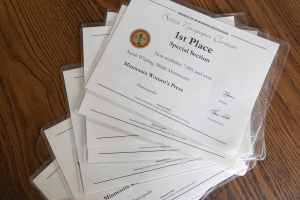 For 2025 coverage, Minnesota Women’s Press earned a community leadership award, three photography awards, and four editorial awards, including for coverage of social issues and for our Spring 2025 “Know Your Rights” special section supported by Unidos MN. Our publisher was named Journalist of the Year by Violence Free Minnesota for gender-based violence coverage.
