


My Multiple Identities: The role of grief, honesty, and embracing all of me

Xay Yang (photo by Sarah Whiting)
I’ve been reflecting on my mom lately. I spent so many years trying to make her proud, knowing what she gave up in order for us to be here in the U.S. Her life was about raising us. That is who I saw her as: a mother. She loved me unconditionally, even the parts of me that were queer, sassy, and different.
And then she died, right at the height of the pandemic. It wasn’t until after she died that I started hearing stories about her: how she saved all her siblings in Laos during the war, and who she was as an older sister. Our family roles were so clearly defined that I couldn’t see her being anything but a mother to me until much later, and by then it was too late. I didn’t get to ask her all of these questions about her as an individual before we kids came along.
Over the last couple of years, I have been thinking about who my mom was as a person; all of the complex layers and intersecting identities. I’ve appreciated how my mom gracefully embraced all of her identities. There’s a difference between knowing her and hearing stories about her. I’ve always known she was a sister, but I never knew the dynamics between her and her siblings.
I never knew she was one of the oldest daughters in her family, responsible for her younger siblings from an early age. She always advocated for us to be kind to people who were different from us, whether they looked different, had a disability, or were from a different class, because most of my mom’s siblings are deaf/hard of hearing. I knew this about her, but it felt different to hear the story about their life together — how my mom had to navigate them through the jungles in the middle of the night during the secret war as they were being pursued; how my uncles made so much noise without knowing and my mom was stressed as the only hearing person.
My mother was a gardener who ran her own flea market stand for many years. She was an herbalist and healer, a storyteller, and a comedian. I can still hear her laugh, wiping tears away because she had laughed so hard. Food was how she showed us love. I swear my mom was a superhero and a ninja — stealthy in how she instilled values in us.
It’s a weird feeling, being a Hmong daughter and motherless. I’ve spent the last few years grieving the loss of my mom, but also parts of my identities that were tied with her — like being a filial daughter, or being an interpreter and translator. Grief is complicated, but the good thing about it is how it holds up a mirror to see the ways I still carry my mom wherever I go.
Being a Queer Woman From a Refugee Family
It is difficult to succeed in school as someone from an immigrant family; I was the only one of my biological siblings to go to college. I created my own major in design, youth studies, and social justice, partly inspired by what my siblings experienced. I went back for my master’s degree in social work to become a therapist. I wanted to work with LGBTQ+ folks and the Hmong community; that was very important to me as someone who had benefited from therapy myself.
When I came out as queer at age 17, I was in search of a community. I got involved with Shades of Yellow, a Hmong LGBTQ+ organization, as well as the LGBTQ+ center at my university. Over 15 years later, I am still passionate about doing queer justice work.
I’m the executive director for a nonprofit called Transforming Generations, which focuses on ending gender-based violence in the Hmong community through organizing, educating, and transforming cultural and power dynamics. I have an amazing team that cares. I come to this work as a survivor myself. One of the biggest things I want to uplift in this work is that we don’t talk enough about LGBTQ+ intimate partner violence. In fact, many don’t believe it can happen between same-sex couples.
LGBTQ+ victim survivors often don’t come forward because of fear thatpeople won’tbelieve them, thatauthorities won’t take it seriously, or that they’ll face additional harm as an LGBTQ+ person. As queer people, sometimes we don’t want to bring attention to the fact that we also experience intimate partner violence, but when we don’t disclose parts of our realities, that can do us a disservice. I want to help change that so others don’t have to go through what I did.
We are all impacted by gender-based violence, even if it is indirectly. Providing trauma therapy and listening to the darkest parts of the human experience is heavy.
My Next Steps
This work and the process of grieving my mom have led me to comedy and writing.
An opportunity came up for me to be a part of the Funny Asian Women Kollective (FAWK) fellowship, and I gave it a try. It has been one of the most healing things I’ve ever done. It requires you to write down what’s in your heart. You have the power to make someone else laugh and be in the moment. How amazing is that?
We have a tendency to box people into simple categories, but we should not be defined by limited labels. I am many things: nonprofit director, artist, organizer, therapist, auntie, sister, Hmong, queer, and survivor.
On days that are hard, I stop by the Hmong flea market to hear the bustling noise of everyone who is buying and selling Hmong veggies. It reminds me of my mom, who embraced all of her identities and lived fully in her truth.


My Quest Seeking Progress Since 1960
Lynette Malles shares her journey from civil rights America in the 1960s to Morocco to New York City feminist meetings to the Rising Moon lesbian commune and socialist organizations in the 1970s — back in Minnesota — to a labor union and now, living as a Marxist for 17 years.
On Amazon Women and Sinister Wisdom
“It was a place where women knew they could come and be very welcome, and if they were lesbian, they could maybe find other lesbians or work written by lesbians,” Weiser says. “So many times I’ve had people come up to me and say, ‘It just saved my life [when I was] coming to town.’”

Commentary: Dykes Who Watch Out For…
“Jonathan Ross did not kill Renee Nicole Good because he was afraid of her. He killed her because she was not afraid of him. We are dangerous because we care about our neighbors.”

Dousing My Heart With Hope for 2026
For me, someone whose work is about spreading a message of compassion and kindness for all, the idea that I might be arrested for speaking out against injustices hurled at my community is incredibly unsettling, to say the least. But despite all the trauma and fear, there is reason for genuine hope.

Recognizing Four Other Changemaking Voices This Year
Changemakers recognition is usually given to people who tend to be unknown outside of their immediate communities, and who have not yet appeared in our pages. This year we wanted to give recognition to two people for lifetime achievements as they step into retirement (Sue Abderholden and Pamela Zeller), Nekima Levy Armstrong and the impactful Target boycott protesting their pullback from diversity pledges, and the PFund Foundation for trans health.
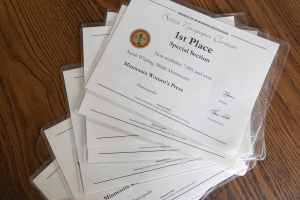 For 2025 coverage, Minnesota Women’s Press earned a community leadership award, three photography awards, and four editorial awards, including for coverage of social issues and for our Spring 2025 “Know Your Rights” special section supported by Unidos MN. Our publisher was named Journalist of the Year by Violence Free Minnesota for gender-based violence coverage.