


Marvina Haynes: Determined Voice for the Wrongfully Accused

Marvina Haynes in the State Capitol building. Photo Sarah Whiting
Minneapolis native Marvina Haynes didn’t choose to become an advocate for the wrongfully incarcerated; rather, she was “forced into it” by the wrongful murder conviction of her brother Marvin.
On May 16, 2004, a man attempted to rob a north Minneapolis family-run business, Jerry’s Flower Shop. The shop was staffed at the time by 57-year-old Cynthia McDermid and her 55-year-old brother, Harry “Randy” Sherer. The suspect entered, inquired about a bouquet of flowers for his mother, then drew a gun on McDermid and demanded money. Sherer walked in on the scene. McDermid escaped, but Sherer was shot and killed.
When McDermid spoke to a 911 operator at a nearby home, she described the assailant as a Black man in his early twenties, 5’10” to 5’11”, 180 pounds, with short, cropped hair. Two days later, police received an anonymous tip that the gunman went by “Little Marvin.” They immediately pinned the crime on 16-year-old Marvin Haynes, despite his markedly different appearance from McDermid’s physical description of the suspect. Marvin was younger, shorter, and weighed less than the man McDermid originally described. He also wore his hair longer and natural.



This was in an era when Minneapolis was trying to be “tough on crime.” Authorities seemed ready to point the finger at the wrong person rather than come up empty-handed. The police arrested Marvin for a curfew violation, then interrogated him for hours about his alleged role in the murder — saying, incorrectly, that they had evidence against him. Marvin denied any involvement and repeatedly asked to speak to his mother during the interrogation.
Police obtained a search warrant and raided the Haynes family home with search dogs. “The media, the police, investigators, dogs, showed up to our house,” Marvina recalls. “We found out through the media that my brother was being charged as an adult for first-degree murder and second-degree assault.”
The police had no fingerprints, DNA, murder weapon, or surveillance video indicating Marvin was involved in the crime. But because of teenage boys’ statements — which were later found to have been coerced and subsequently recanted — Marvin was convicted on both counts and sentenced to life in prison.
Haynes’s parents fought to free their son. Legal fees depleted the family’s finances. Then, the couple split up. After their separation, “every day of my life became a fight,” Marvina says. She started speaking out, but encountered apathy toward her brother’s plight. “A lot of people believe in the system because we have been taught this system works.”
Through her advocacy, Marvina discovered that wrongful incarceration was common.
“This didn’t only happen to my family; it happened to many families in that time,” she says. “There was a pattern. The same prosecutor, attorney, investigators. These folks were ruining people’s lives, and still haven’t had any accountability.”
In 2021, she founded MN Wrongfully Convicted Judicial Reform (MNWCJR), an organization that provides families impacted by wrongful conviction with legal assistance, advocacy, and emotional support. Families across the country seek out the organization’s help. The organization is working toward legislation “so the system can stop trying to just solve cases and actually do the work and get it right,” she says.
In 2022, attorneys from the Great North Innocence Project took on Marvin’s case. On December 11, 2023, Marvin was released from the Minnesota Correctional Facility in Stillwater, and his conviction was vacated. He had been in prison for 19 years and 7 months.
Marvina says that today her brother is “encouraged, and he’s hopeful, and he has a lot of faith.” But he is also struggling, due to those almost two decades in prison — some of that time in solitary confinement.
“Our family lost everything,” Marvina recalls. “So when he got out of jail, there was really nothing that we could give him besides love. He needed more than that.”
Marvina says she values justice, accountability, and empowerment through education. In 2023, she ran for Minneapolis City Council in the fourth ward and finished second. She created the annual event Minneapolis Speaks, which connects local businesses and families. Community members enjoy free haircuts, face painting, and other entertainment. The third annual event in August distributed 250 book bags and fed 500 people.
 Marvina Haynes does her work on a volunteer basis. MNWCJR welcomes volunteers and donations. Supporters can call elected representatives and share the stories of the wrongfully incarcerated. “This is what it takes. Without telling [the] story over and over again, they’ll just [overlook] it and act as if it never happened,” she says. “I want to make sure no one in Minnesota prison is wrongfully incarcerated.” Learn more: mnwcjr.org
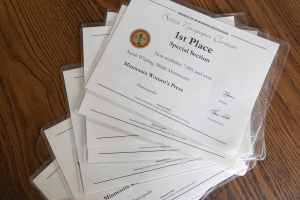 For 2025 coverage, Minnesota Women’s Press earned a community leadership award, three photography awards, and four editorial awards, including for coverage of social issues and for our Spring 2025 “Know Your Rights” special section supported by Unidos MN. Our publisher was named Journalist of the Year by Violence Free Minnesota for gender-based violence coverage.
