


Making Income Disparities Visible in Marshall
Do you want to be an underwriter for our Southwest Minnesota “Hometown Values & Vision” series?
Please contact ads@womenspress.com
We met with 15 community members in Marshall on August 9 to discuss challenges, needs, and solutions in this Southwestern Minnesota city three hours outside of the Twin Cities. The three-hour conversation was coordinated by local advocate Joyce Tofte, who spoke at the April 2024 event celebrating our “39 Years of Voice & Vote.” She assembled a representative collection of perspectives.
One woman described the struggles she and her fiancé have trying to find affordable housing and child care for their young family. “We’d like to rent something bigger, but the cost of living is ridiculous.”
A man who works in the local health care system indicated a concern that “everyone might be heard, but not listened to. I think there are a lot of things in our community that could be better if we all listen to each other.”
A woman who just finished a degree in health education at the local Southwest Minnesota State University indicated she is interested in how students’ mental health issues are being met. A dean from the college participated to reflect the voices of all the genders at the college who are seeking success.
A local history teacher, who ran for Minnesota state senate office in 2022, attended to discuss the challenges of electing representative political leadership.



A New Horizons Crisis Center community education coordinator said, “I believe in small rural communities. They are a place that people want to be in, but don’t always know how to gain [access] in the space.” She says she wanted to be part of the solution to create spaces that “allow folks to learn, grow, and become a part — community isn’t just about what leadership is doing. It’s about what people feel like they’re welcome to be.”
Tofte wears multiple hats in the community, related to anti-racism, safety at the college, and program coordinator for New Horizons Crisis Center. “I see the intersection of all of these hats that I wear in the direct impact on our communities,” she says. “There’s a reason that one person has to wear multiple hats, and it’s a lack of resources. Because of that, often it’s the same people speaking life into a room. It’s important to bring other people into the space for them to have their voice influence and shape the culture of the community.”
Another woman indicated she tends to be the voice for LGBTQ+ issues in the community, as well as “how we can do more to create an environment where sexual violence is 0% part of our community. I am a foster parent, so I want to see how we can make sure that foster kids can get the care that they need. And I’m also a parent of kids with disabilities, and I have a disability myself, so looking at how we can create an equitable space for people who exist in that intersection as well.”
Another woman works with at-risk youth, especially those impacted by sex trafficking, and people impacted by domestic violence. She says, “I’m a lived-experience expert of being a child that was part of the criminal justice system and one who lived in poverty. I’m here because our communities are stronger when we all know we exist.”
Three members of the Southwest Minnesota Housing Partnership were in attendance to learn from and discuss the housing issues in the region.

The Struggles of Income Discrepancies
The conversation started with shared insights about economic insecurities [as it did when we visited with a group of community members in Grand Rapids and Worthington].
- “We all have friends who are struggling to pay their bills. We’re complaining about the grocery store prices and asking why gas is so expensive. But I don’t think, as a community, that we are [recognizing] the percentage of people struggling with housing or food insecurity.”
- “Sometimes they are aware, even if they don’t know how mass spread it is. But it’s also hard to recognize that you cannot help the people who are struggling. Lots of times, I think people don’t want to think about it if they are not able to do anything about it.”
- “As a relatively affluent community, I think the lack of understanding and awareness is huge for those who don’t fall into the affluent category. A large percentage are often overlooked in policies, procedures, and programming. Many of the immigrants in the area, or lower-economic individuals don’t have access to things, but it’s not talked about very loudly.”
- “I think there is also a level of thought that it is okay for our refugee population and college students to be struggling. We expect it.”
- “I’ve been living in Marshall for a little over three years now. A lot of the friends that I’ve made says they’re living in their parents’ old house. It’s nice to have parents give you a house. I wish I had parents who could give me a house.”
- “A majority of the population in Marshall has a high school diploma and some college. The entry-level jobs in Marshall don’t match that. There are not enough jobs. Then the housing costs don’t match the income of people in entry-level jobs. We don’t have the amount of businesses [offering] the revenue that the Twin Cities has.”

-
“I come from a real small town. Everyone calls Marshall a small town, but there are tinier towns that surround us, with communities feel completely out of all of these conversations. Their voices are almost dismissed. Because the housing is often cheaper there, people are moving out of places like Marshall because they can’t afford $1,500 a month. So even in the smaller communities, rent prices are going up because they have more options now for renters.”
- “I live in a town of 138 people. We have two paid roads in the entire town. We have to come to Marshall for everything, shopping-wise, which makes us very transportation dependent.”
- “If you have transportation issues even in some of our bigger cities, many affordable housing spaces are away from grocery stores and other conveniences.”
- “Many people don’t even have internet access, or they’re still using dial-up or satellite, or existing with a home phone. That is a very real reality for people, including for people my age who moved into an old family farm that hasn’t been kept up in years.
One person who travels for work to South Dakota and Iowa sounded a concern: “I think Marshall is very underdeveloped compared to cities of comparable sizes. I am in Brookings, South Dakota, very often, and I’ve often wondered why Marshall is not closer to the development of Brookings. We have the population and all the surrounding towns, but it seems like, economically, the people who have already been established don’t want the community to grow economically, because there’s some sense of control that will be lost.
But we’ve seen throughout history that if things don’t grow, they eventually die. I wonder, what is it going to be like in 10 years here?”
The intent of Changemakers Alliance is to develop relationships around the state with partners and readers who share a passion for issues of housing, mental health, gender-based violence, diversity in politics, and evolutions in local economies and ecosystems. We are working together on conversations, discussion/reflection questions, and eventually mutual action steps, as well as community awareness.
Support our unique brand of media as a Badass member and enable us to pay for deeper perspectives from people we are meeting around the state.


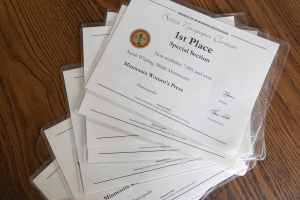 For 2025 coverage, Minnesota Women’s Press earned a community leadership award, three photography awards, and four editorial awards, including for coverage of social issues and for our Spring 2025 “Know Your Rights” special section supported by Unidos MN. Our publisher was named Journalist of the Year by Violence Free Minnesota for gender-based violence coverage.
