

Making Art in the ‘Nick of Time’
Minnesota Women's Press arts coverage is supported by the Minneapolis Institute of Art, offering inspiration, family fun, date nights, and galleries to unwind and relax. Everyone is welcome.
 In a new anthology, 27 Minnesota women explore what it means to be an artist over the age of 60. “Nick of Time: Women Write about Art and Aging,” published by the University of Minnesota Press, brings together stories by visual artists, actors, musicians, dancers, and writers.
The idea for the anthology began over coffee between Minneapolis-based writers and teaching artists Julie Landsman and Morgan Grayce Willow. “Julie was talking about the changes she needed to make in her artwork and she wondered out loud how other women artists are dealing with aging,” Willow says. “I just said, ‘Julie, that sounds like a great topic for an anthology.’”
Landsman, 82, and Willow, 77, invited St. Paul writer Debra J. Stone, 74, to join the project. Stone wanted the collection to include perspectives that have historically received less recognition. “I was interested in joining the writing of this anthology because I wanted to get a diversity of women’s voices, especially BIPOC women,” Stone said. “I want to include those ancestral voices.”



In “I Ain’t Your Side Chick and Other Things You Need to Know About This Old Woman,” North Minneapolis writer and performing artist Amoke Kubat honors the resourcefulness of Black women who transform what is worn into something new.
“Your body was like a favorite dress. In time, it became too big, too small, faded, threadbare, or just unfashionable. But not disposable. Old Black women were always creatives. Old dresses transformed into new clothes for some fast-growing child, became kitchen curtains that flapped in soft summer breezes or a heavy winter quilt that kept six kids in a bed warm.” – Amoke Kubat
Kubat died at age 74 on October 13, a few days before the anthology’s book launch October 21. Aging never diminished her creativity. Instead she asked what else it might become. Near the end of her essay, she reflected on the legacy she hoped to leave her family, friends and communities writing, “I wish to be revered as an Ancestor.” [See essays Kubat wrote for Minnesota Women’s Press below.]
The artistic legacy of textile artist Suzanne Thao is stitched into cloth. In “From Generation to Generation: Handing Down Art for the Ages,” Thao reflects on her relationship with paj ntaub, a Hmong embroidery tradition she learned from her mother and grandmother as a young girl in Laos.
After marrying in a refugee camp in Thailand in 1976, Thao moved to France before settling in the United States in 1990. Through displacement and migration, the art form connected her to her culture.
“I came with a knowledge of trauma in my body and in my memory. But I also learned how to overcome times of sorrow and find healing through the art of paj ntaub. Hmong paj ntaub is a creative process that connects me back to my place and identity in the world. Over time I put all the celebration of who Hmong people are and what they have endured in my work.” – Suzanne Thao
Thao continues to embroider, even as the physical demands of the work have grown challenging. “Aging has made this harder now. I have to slow down, make bigger stitches. I find smaller patterns harder to see and work with,” she writes. “I know this is a natural process of turning older.”
For some contributors, growing older has also brought creative freedom. In her monologue “Kacee,” theater artist Kim Hines pushes back against the idea that youth is an artist’s best or most exciting period.
Kim Hines
“I don’t ever think about being in my 20s. I know a lot of older people who think of that period of time as their golden age. Hmmmm, not so much for me. I remember a lot of tiredness from overworking and overpartying, and the hangovers from overdoing everything that I shouldn’t have been doing! … The twenties are grossly overrated!!
My late 30s and almost all of my 40s was a good time for me. And that’s where I sit most days. When my autoimmune disorder kicks up, then I feel like I’m in my 90s”
– Kim Hines

[Kim Hines was an early columnist for Minnesota Women’s Press; see her reflection below]
For novelist and playwright Marcie Rendon, aging has brought greater confidence in her work. In “Living Well,” she recalls attending her first theater workshop with Spiderwoman Theater in the 1990s and meeting the theater’s co-founder Gloria Miguel.
Marcie Rendon, photo by Sarah Whiting
“I am in awe of her creative talent, her sharp, engaging mind and what must be her determination in the face of physical aging. Gloria is not in denial about aging. She is certain about living. Whether from willpower or decision she has decided to continue living fully each day. I want to be just like Gloria Miguel when I grow up. Mi’iw.”
– Marcie Rendon

After seeing Native stories onstage for the first time, Rendon, 74, realized she could write her own. Her murder mystery series, which debuted in 2017, follows a young Ojibwe woman investigating murders on reservations across North Dakota and Minnesota.
In “Nick of Time,” 27 artists resist the idea that aging marks the end of an artist’s most meaningful work. “I’m stunned by the persistence of these artists,” Landsman says. “It made me really realize I’ve got that too. I have that persistence.”
No one in the anthology offers a single answer to the challenges of growing older. Some artists slow down while others find new confidence. Some look toward the future of their work while others return to the people and traditions that made it possible.
Events
Wednesday, October 21, 6-8pm
Loft Literary Center, Open Book Performance Hall
1011 Washington Avenue South, Minneapolis, MN 55415
Free; advance registration required.
Registration
Details
Related Stories
May my life have meaning and purpose until the end of life as I know it.
May I greet my demise like an Olympic team member relinquishing the baton with my eyes still on the finish line.
May I be welcomed in the Realm of my Ancestral Pantheon.
May I be a revered Ancestor. May I return born in the loving arms of my descendants. Ase. (May it be so).
- Amoke Kubat: “Hidden in Plain Sight”
- Kim Hines: “Passing Through Time”
- Marcie Rendon: “The Cycle of Our Justice”
Support our unique story sharing

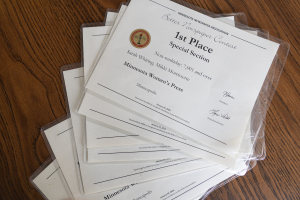 For 2025 coverage, Minnesota Women’s Press earned a community leadership award, three photography awards, and four editorial awards, including for coverage of social issues and for our Spring 2025 “Know Your Rights” special section supported by Unidos MN. Our publisher was named Journalist of the Year by Violence Free Minnesota for gender-based violence coverage.

