


Lessons from the Scene of a Coup

Photo SweSwe Thein
I learned how to be an activist in Minnesota during my early twenties, advocating for immigrant rights, trans youth, and housing. I learned how to speak out and write about it from the East Side Freedom Library and the Loft Literary Center. The streets and community spaces of the Twin Cities shaped the way I show up in the fight to protect my own home country’s fragile democracy.
On February 1, 2021, I woke at 6am in Myanmar (also known as Burma) to news of the military coup. My mother shook me awake and, in a hushed tone, said, “They did the coup.” Nearly four years later, on November 5, 2024, it was around the same time of day that I learned about Trump’s victory in the U.S.
Both moments brought a gut-punch of disbelief and a profound sense of loss, although the stakes were drastically different. In Burma, the fragile democracy we fought to build was crushed in a single orchestrated act of violence. Tanks rolled into the streets. Leaders were dragged from their homes in the early-morning hours. Months followed with more disappearances, death, and destruction.
Yet as I scrolled through my phone, the screen flooded with images of soldiers, cries for solidarity, and the faces of friends who would soon risk everything for freedom. It was a reminder that hope — if it is to survive — requires defiance.
This convergence of personal and political awakenings has shaped my understanding of what it means to live in the aftermath of seismic political shifts.
Whether in the chaos of a military coup, or the jarring realization of a divisive election result, the emotions of grief, anger, and helplessness feel strikingly familiar. Yet, what I learned in Burma has stayed with me: despair, while natural, is a luxury we cannot afford. Hope is not passive; it demands action.



In the days following the coup, we took to the streets, knowing the risks. It was a deep belief in the collective power of ordinary people that drove us. I remember the sound of chants echoing through neighborhoods, and the quiet courage of those who held the line as military trucks rumbled closer. The protests were messy, fragile, and heartbreakingly human. But they mattered. Each small act of defiance — raising a flag, banging pots and pans, marching despite the curfew — was a declaration of hope.
These experiences have given me a lens through which I view the current U.S. political climate. Polarization, distrust in institutions, and attacks on democratic norms have left many Americans wondering if the foundation of their democracy is as secure as it seems. For those of us who have lived through the collapse of a democracy, the warning signs are glaring.
What I’ve carried across borders is the understanding that resilience is forged in community. When the systems meant to protect us falter, it is the connections between people — the willingness to show up for one another — that become our greatest defense.
In Burma, it was the networks of students, artists, and laborers that sustained the movement.
In the West, success is often framed as sweeping victories and immediate results. But the reality of activism, especially in times of crisis, is more incremental.
In Burma, we celebrated the smallest wins: a protest that lasted longer than expected, a journalist’s story that reached international headlines, a neighbor who joined us for the first time. These moments didn’t topple the regime, but they kept the spirit of resistance alive.
Similarly, in the U.S., progress might not come in grand gestures, but in the daily work of holding the line — whether through voting, organizing, or simply refusing to give in to apathy.
Hope is not a naive belief that everything will be okay. It is a deliberate choice to envision and work toward something better, even when the odds seem insurmountable. It is what has sustained me in Burma, and it is what I hold on to now.
If you appreciate our unique first-person narratives:
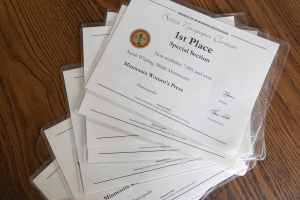 For 2025 coverage, Minnesota Women’s Press earned a community leadership award, three photography awards, and four editorial awards, including for coverage of social issues and for our Spring 2025 “Know Your Rights” special section supported by Unidos MN. Our publisher was named Journalist of the Year by Violence Free Minnesota for gender-based violence coverage.
